
18,073 views ·
1 replies
18k views
1 replies
Pergola in steel. Dimensions and spacing?
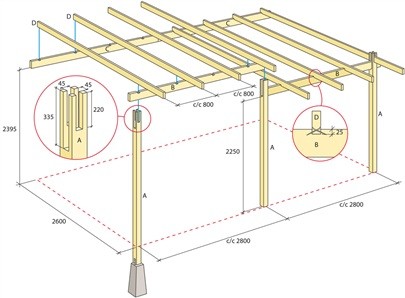
I was thinking of using Angle iron as the basic construction, but I have little knowledge of what dimensions are needed. There are sizes ranging from 15x15x3 mm to 65x65x7 mm. To make it easier for me, I would prefer to use the smallest dimensions possible to facilitate the handling and cutting of the steel.
If you refer to a construction guide like this one (see image)
Where the depth is 260 in the picture, if I want 400 instead. Do I need an extra post? If the width, where it is cc 280 now, I want 600-800, how wide can I have between the posts?
The beam marked B in the picture above. Should I have the same dimension of the steel there as I have on the standing posts?
For the roof, I was thinking of taking quite small dimensions to reduce the weight and possibly adding rebar mesh to allow climbing plants to climb better. I hadn't planned on using stainless steel because I like when it gets a bit "worn" and rusty. Is that a bad idea or should the metal be treated in some way?
Anything else I haven't thought of or that you think I should consider?
Haha, ten years since the thread started and no one has commented, it must be commented on…
It might not be a bad idea with a pergola in steel, but I think the OP has too little knowledge about metals and their properties to take on this project. Among other things, one wants to use stainless steel to get the rusty "look", stainless steel is like a modern refrigerator or an old sink, it's shiny and, as the name suggests, doesn't rust. Another misconception is using angle iron on such a cantilevered construction and also in weak dimensions, it will sag under its own weight. Instead, one should use rectangular square profiles at least 50 high and perhaps 25-35 mm wide. The beam between the posts should also be a rectangular profile, perhaps 100 high and 50-60 wide. As with wood, it's the height that gives strength, not the width. You could also use I-profile or H-profile laid on its side, but generally these are heavier and therefore need to be dimensioned thicker so as not to sag…
If you want them rusty, you must remember that over time they will weaken from the rust and thus require even thicker dimensions. If you have a wooden deck under the pergola, you should also be aware that there may be rust stains on the wood.
Hopefully, the stainless steel material has already been ruled out, otherwise, the price will automatically do it…
To the OP, I want to recommend contacting a blacksmith or mechanical workshop to get a proposal with the price of materials and labor costs. Unfortunately, it will probably be at least twice as expensive as wood built by a carpenter…
It might not be a bad idea with a pergola in steel, but I think the OP has too little knowledge about metals and their properties to take on this project. Among other things, one wants to use stainless steel to get the rusty "look", stainless steel is like a modern refrigerator or an old sink, it's shiny and, as the name suggests, doesn't rust. Another misconception is using angle iron on such a cantilevered construction and also in weak dimensions, it will sag under its own weight. Instead, one should use rectangular square profiles at least 50 high and perhaps 25-35 mm wide. The beam between the posts should also be a rectangular profile, perhaps 100 high and 50-60 wide. As with wood, it's the height that gives strength, not the width. You could also use I-profile or H-profile laid on its side, but generally these are heavier and therefore need to be dimensioned thicker so as not to sag…
If you want them rusty, you must remember that over time they will weaken from the rust and thus require even thicker dimensions. If you have a wooden deck under the pergola, you should also be aware that there may be rust stains on the wood.
Hopefully, the stainless steel material has already been ruled out, otherwise, the price will automatically do it…
To the OP, I want to recommend contacting a blacksmith or mechanical workshop to get a proposal with the price of materials and labor costs. Unfortunately, it will probably be at least twice as expensive as wood built by a carpenter…
Click here to reply