
2,547 views ·
11 replies
3k views
11 replies
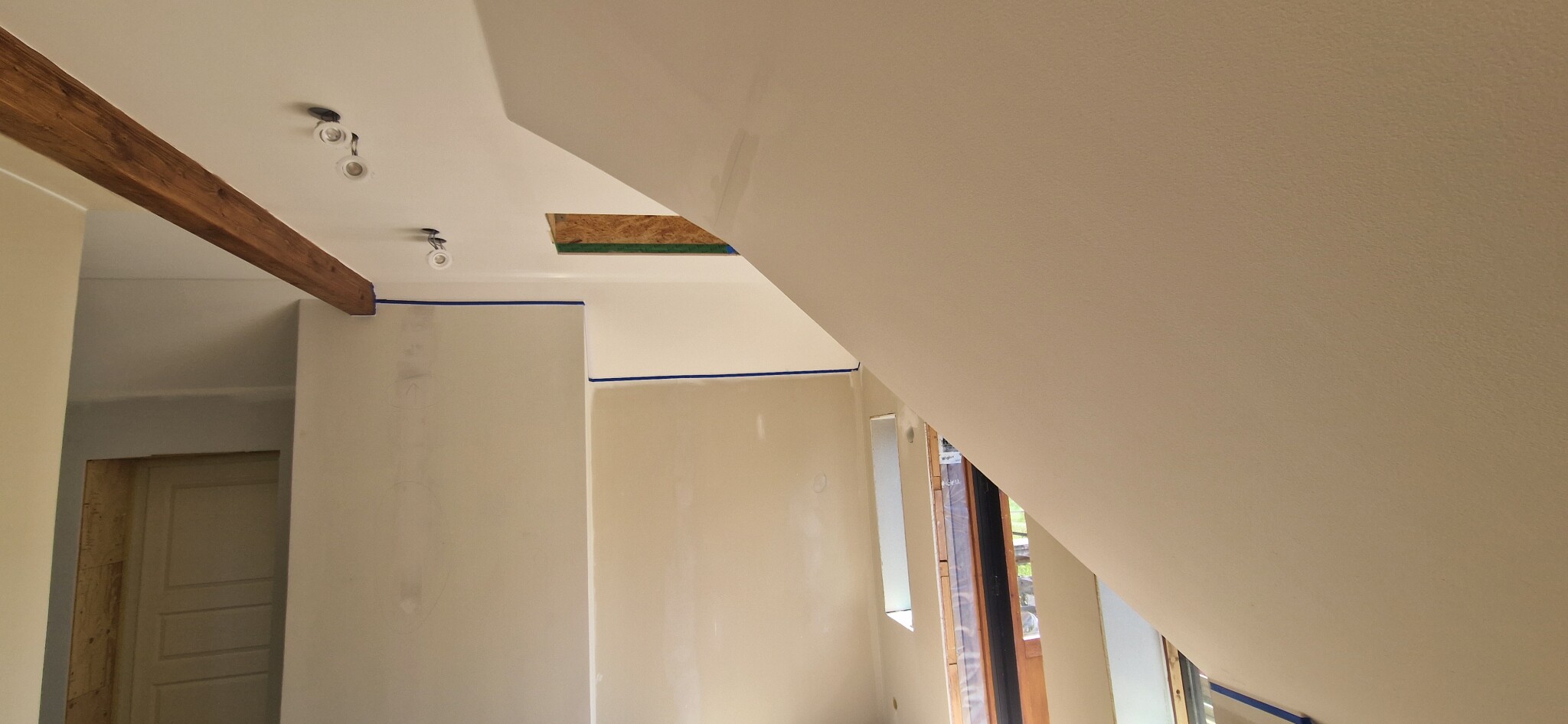
Paper strip double gypsum on short seam.

I'm hesitant to apply tape over the butt joints because I'm afraid it will create too much of a bulge that's noticeable in the side light. (Never done this before) The butt joints are already screwed and are laid over an existing drywall that doesn't have a joint underneath. How big is the risk that it will crack?
I've put double drywall everywhere since there were too many layers of wallpaper and junk on the old one. It was also nailed (ceiling boards were hanging), so screwing would have been necessary anyway. The butt joints are mainly in the ceiling but also on a wall where the studs are at the wrong distance so the taper couldn't be maintained. However, all these joints without a taper are on studs with underlying drywall without a joint (staggered).
In the tapered joints, paper tape is of course used, but I'd prefer to avoid it on the short edges and walls where the boards have been cut and the taper isn't there.
IF something cracks, how long might it take? Because the filled tracks are holding up well. After about a week.
The house is from '65 and has already settled as it should.
Hilfe Bitte!
I've put double drywall everywhere since there were too many layers of wallpaper and junk on the old one. It was also nailed (ceiling boards were hanging), so screwing would have been necessary anyway. The butt joints are mainly in the ceiling but also on a wall where the studs are at the wrong distance so the taper couldn't be maintained. However, all these joints without a taper are on studs with underlying drywall without a joint (staggered).
In the tapered joints, paper tape is of course used, but I'd prefer to avoid it on the short edges and walls where the boards have been cut and the taper isn't there.
IF something cracks, how long might it take? Because the filled tracks are holding up well. After about a week.
The house is from '65 and has already settled as it should.
Hilfe Bitte!
If there is a bump, then you haven't sanded and filled enough.
Now, it's not me who does this at home since I live with someone who worked as a painter in their younger days, but it's filled, glued, and sanded 2 if not 3 times before painting. But the end joints and those without rebates get strips.
And that's unconditionally what's behind.
Now, it's not me who does this at home since I live with someone who worked as a painter in their younger days, but it's filled, glued, and sanded 2 if not 3 times before painting. But the end joints and those without rebates get strips.
And that's unconditionally what's behind.
Sanding and filling a few times is not a problem. It's the worry to get it right; the strip must be covered but not more. But in my world, it should build at least 2-3 mm. But you mean that IF you do it right, you shouldn't be able to see it anyway?P PappasHammare said:If there's a bump, you haven't sanded and filled enough.
Now, it's not me who does this at home as I live with someone who used to work as a painter in their younger days, but it gets filled, glued, and sanded 2 if not 3 times before painting. But the short seams and those without tongue-and-groove get strips.
There is always an extension/bump when you plaster a short joint. You just have to make sure to plaster very far out from the joint where you know the light will be grazing.
Also, use a more matte paint on the ceiling when you have a gypsum ceiling so that irregularities are less noticeable.
Also, use a more matte paint on the ceiling when you have a gypsum ceiling so that irregularities are less noticeable.
In my ceilings, I applied paper tape on the short seams. However, I didn't set them in joint compound but used wet room adhesive instead. I spackled and sanded once, then glued the tape before spackling and sanding 2 or 3 more times. Finally, I hired a painter to apply microlit/renovation wallpaper to the ceiling. The result was great, but it all depends on the prep work. In a room with a slightly higher ceiling, I hired another painter who wasn't as meticulous with spackling and sanding. This resulted in my wallpaper painter having to touch up. If you think it looks bad after one coat of paint, you can always spackle a bit more before continuing with the painting 
Yes, the ceiling paint will be matte, so we're on track. It's just a matter of spreading the spackle out far enough. I'll probably try it in a bedroom where it's less noticeable. Does it matter if the tape shows (assuming it is properly attached, of course)D DaDolly said:
Yes. I glue the tape because I couldn't get it right with the putty. And even worse on the short joints...B Bluppidupp said:In my ceilings, I used paper tape on the short joints. However, I didn't set them in putty but used wet room adhesive instead. I spackled+sanded once, glued the tape, then spackled+sanded 2 or 3 times. Finally, I hired a painter to put up microlite/renovation wallpaper on the ceiling. The result was great, but everything depends on the prep work. In a room with slightly higher ceilings, I hired another painter who wasn't as meticulous with spackling+sanding. It resulted in my wallpaper-painter having to touch up.
If you think it looks bad after one coat of paint, you can always spackle a bit more before continuing with the painting
The tape is on, so I suppose the putty is just to even it out? (I also pre-spackled into the joints before gluing)
Yes, the spackling compound is partly what glues it in place and then smooths everything out. Once you've glued the strip in place, the remaining spackling compound is mostly aesthetic.
Regular medium spackling compound is often a bit too dry for embedding strips. It's especially trickier to spackle on ceilings.
I use J-spackel for joints. I believe it contains more adhesive and is stickier.
Regular medium spackling compound is often a bit too dry for embedding strips. It's especially trickier to spackle on ceilings.
I use J-spackel for joints. I believe it contains more adhesive and is stickier.
Yep. I've also seen that there was another filler for the first pass that was stickier. But now I've glued a room both ceiling and walls, and it was quite a struggle with the adhesive on the ceiling, so applying tape properly with filler would have been difficult for me.D DaDolly said:Yes, the filler is partly what glues it in place and then evens everything out. If you've glued the tape, the remaining filler is mostly for aesthetics.
Regular medium filler is usually a bit too dry to lay the tape in. Especially on ceilings, it's trickier to fill. I use J-filler for joints. I think it contains more adhesive and is stickier.
C Cerb said:
Good. Then it will be so. I would have regretted taking a shortcut that did not turn out well. I need to practice, practice, and practice some more.
I am in the process of renovating a house from 1934. I usually tend to go overboard as usual. I am building for myself. I glue the seams on the drywall (before pressing them together), before applying putty I put a bit of latex in the seam (before putty, tape, first layer of putty). Yes, I know, a bit excessive. But what I did wrong this time. I underestimated the humidity and the heat. The putty didn't have time to dry, nor did the paint. A hallway has now taken about 2 weekends to finish. There are strips everywhere (paper), but it doesn't help against cracks if the putty hasn't dried. Nowadays, I take my time in the summer.

Click here to reply
Similar threads
-
Limma pappremsa - vad gör jag för fel?! Se bilder
Färg, Måla & Tapetsera -
How to hang cabinets in double plasterboard, too tight behind plaster for toggle anchor
Building Materials and Construction Technology -
How to fix paper tape that has detached and bulged from the drywall?
Building Materials and Construction Technology