8,630 views ·
31 replies
9k views
31 replies
Paper strip bubbles despite wet room glue!

If it moves straight up/more right/left then fiberglass works just as well. But don't say that the skew works just as well.M MagHam said:

Still, maybe it's good enough.
Anyway, it's super easy to glue the paper strip, so I'm not going back to the fiberglass strip.
As said!M MagHam said:
I still try, even though I will be shot.
Why complicate things with paper strips. It just takes unnecessary time and hassle. The fiberglass strips are already glued, and need no filler, or glue before installation. Many, especially amateurs, claim that paper is much better. But have you ever seen cracked fiberglass seams? It holds just as well. It's just a matter of preference if a painter uses one or the other.
I have worked as a painter for 15 years myself, and have almost exclusively used fiberglass.
I'm not putting any value on good or bad.A AG A said:As I said!
I still try, even though I will be shot.
Why bother with paper strips? It just takes unnecessary time and hassle. The fiberglass strips are already glued and need no putty or glue before application. Many, mainly amateurs, claim that paper is much better. But have you ever seen cracked fiberglass joints? It holds just as well. It's just a matter of taste whether a painter uses one or the other.
I have worked as a painter for 15 years myself and have almost exclusively used fiberglass.
However, isn't fiberglass thicker and thus harder to hide on the short joints?

The manufacturers of plasterboards prescribe that paper tape should be used. Hopefully, there is relevant professional expertise there.M MagHam said:
I joined plasterboards in two new rooms in the summer house during the winter. For the long joints, I used "glue putty." It worked well. But for the short joints, I wanted to glue so it wouldn't build up as much. I first filled in the "V grooves" in the joints, glued tape after it had dried. Let the glue dry before I putty over.
In the ceiling, I messed up on one joint. I didn't get enough putty outside the joint, so I mistakenly glued the tape next to the joint. This became apparent after priming. I had to sand off the putty and glue again. Now I was a bit impatient and puttied over immediately. The tape came loose as a consequence. Had to redo it, still a bit impatient, only let the glue dry for 3 hours, then puttied over. It came loose again.
In the end, I redid it, let the glue dry for 3 hours, painted over with primer, which was left to dry for 2 hours. Then putty. It held.
That is probably more due to collaborations between manufacturers than one being better.H hempularen said:The manufacturers of plasterboards prescribe that paper tape should be used. There, hopefully, lies the relevant expertise.
I two new rooms at the fitidshuset, I joined plasterboards during the winter. The long joints I did with "glue putty." It worked well. But for the short joints, I wanted to glue so it wouldn't build up as much. I first filled the "V grooves" in the joints, glued the tape after it dried. Let the glue dry before putting putty over it.
In the ceiling, I messed up on a seam. I had put too little putty outside the seam so I saw it wrong and glued the tape next to the seam. This showed after the primer painting. Had to sand off the putty and glue again. This time I was a bit impatient and put putty over directly. It backfired as the tape came loose. Had to redo it again, still a bit impatient, only let the glue dry for 3 hours, then I puttied over. It came loose again.
Finally, I redid it, let the glue dry for 3 hours, painted over with primer that dried for 2 hours. Then putty. It held.
I actually believe it exists, someone told me that. But I haven't looked.
If all drywall manufacturers specifically prescribe paper, and none prescribe fiberglass, then I think we can dismiss corruption/collaboration as a reason for why they prescribe paper tape.A AG A said:
Furthermore, I have never seen a professional painter use fiberglass tape.
As someone who works in the industry, I've seen that about 50% of all painters use fiberglass.H hempularen said:
Why drywall manufacturers write that (honestly, I haven't seen them write that) was just a guess.
Have you seen houses where everything had to be redone due to fiberglass tape?
Dr Benz wrote "answer key" in #16
Fiberglass has no stability in the diagonal direction. Paper, on the other hand, can absorb a moderate amount of shear stress.
In an old house that has settled (like mine which is 75 years old), fiberglass works excellently. I haven't seen a single hairline crack in any wall or ceiling where I've renovated.
But in new construction, I can understand the desire to reduce all possible shear effects.
Fiberglass has no stability in the diagonal direction. Paper, on the other hand, can absorb a moderate amount of shear stress.
In an old house that has settled (like mine which is 75 years old), fiberglass works excellently. I haven't seen a single hairline crack in any wall or ceiling where I've renovated.
But in new construction, I can understand the desire to reduce all possible shear effects.
I belong to those who have never succeeded with paper strips and therefore with joy and success used fiberglass strips. Even in new constructions. No cracks. A painter told me that he couldn't use fiberglass since he would then not be following the prescribed industry standard. But that's not something DIY enthusiasts need to think about.

Neither paper nor fiberglass absorbs any stresses. Neither in height, width, or diagonally. It only functions as crack reinforcement. So that the filler doesn't crack as it dries.M MagHam said:Dr Benz wrote "facit" in #16
Fiberglass has no stability in the diagonal direction. Paper, on the other hand, can absorb a moderate amount of shear stress.
In an old house that has settled (like mine which is 75 years old), fiberglass works excellently. I haven't seen a single hairline crack in any wall or ceiling where I've renovated.
But in new production, I can understand that you want to reduce any possible shear effects.
Update since thread start!
Short version:
You're an idiot if you don't stir the wet room adhesive before you start.
Long version: Re-glued the strips that came loose, but there were still small bubbles. But good enough.
Made a new room and it was a disaster. Bubbles everywhere!
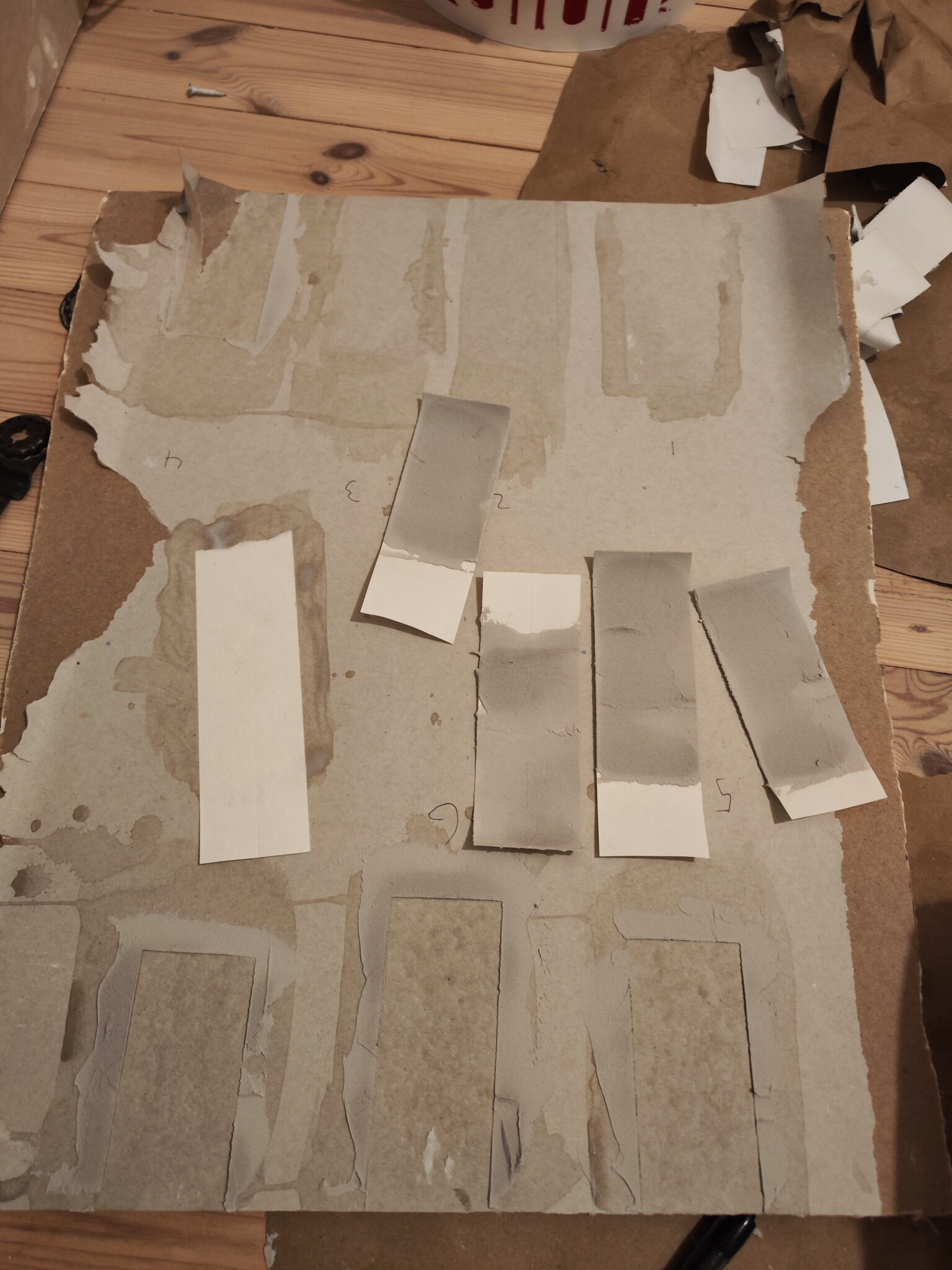
The scientist in me got to work and I test-glued using a bunch of different methods on a leftover drywall, such as:
1: Glue only on the board
2: Glue on board and strip
3: Glue five minutes before, then brush on again.
And so on...
The result was that half of the strips came off immediately. The rest when I put on putty.
Conclusion: Problem with the glue (half right anyway..?). I was annoyed that my glue is runny like water, very difficult to apply on the wall. So I googled for a more creamy glue..
Imagine my surprise when I check the online description of the glue I already bought, and it says:
Consistency: Creamy.
And:
Dilution: Stir before use and can, if needed, be diluted with water.
WTF? It's already water?
Wait, wait now..? Mine isn't creamy at all, and stir before use?
Stir...
Stir the glue and it becomes creamy. Glue a strip. Sticks like a rock already an hour after gluing.
Conclusion: idiot...
Attached is a picture of various methods to glue wrongly.
Short version:
You're an idiot if you don't stir the wet room adhesive before you start.
Long version: Re-glued the strips that came loose, but there were still small bubbles. But good enough.
Made a new room and it was a disaster. Bubbles everywhere!
The scientist in me got to work and I test-glued using a bunch of different methods on a leftover drywall, such as:
1: Glue only on the board
2: Glue on board and strip
3: Glue five minutes before, then brush on again.
And so on...
The result was that half of the strips came off immediately. The rest when I put on putty.
Conclusion: Problem with the glue (half right anyway..?). I was annoyed that my glue is runny like water, very difficult to apply on the wall. So I googled for a more creamy glue..
Imagine my surprise when I check the online description of the glue I already bought, and it says:
Consistency: Creamy.
And:
Dilution: Stir before use and can, if needed, be diluted with water.
WTF? It's already water?
Wait, wait now..? Mine isn't creamy at all, and stir before use?
Stir...
Stir the glue and it becomes creamy. Glue a strip. Sticks like a rock already an hour after gluing.
Conclusion: idiot...
Attached is a picture of various methods to glue wrongly.