
16,723 views ·
41 replies
17k views
41 replies
Own logs to the village sawmill for timber

Of course, it makes you tempted. And the price is quite okay considering what it can do.
I'm wondering how fast it is... If you end up standing all day for just a few meters, that's a huge disadvantage.
If anyone has experience with it, it would be very interesting to hear what you think about it.

Haven't tried one, but plan to buy one someday.Mårtesgården said:
Sure makes one tempted. And the price is quite okay considering what it can do.
I'm wondering how fast it is... If you end up standing around for a whole day for just a few run meters, that's a huge disadvantage.
If anyone has experience with it, it would be very interesting to hear what you think about it.
Put it this way: Have you ever seen a used solohyvel on blocket? Nope! And why is that?
No one wants to sell their hyvel.
There's a thread about solosågen, where they've also discussed the solohyvel. Look it up.
Ah...
Found it...
http://forum.byggahus.se/verktyg-maskiner-fordon/19030-kombimaskin-foer-traebearbetning.html
I'm wondering about the dimensions one can split in. Can you move the blade towards the center, or does it only have its place and then you move the blocks you dimension with? If so, there should be a max width, and it doesn't look big if you look at the pictures...?
Found it...
http://forum.byggahus.se/verktyg-maskiner-fordon/19030-kombimaskin-foer-traebearbetning.html
I'm wondering about the dimensions one can split in. Can you move the blade towards the center, or does it only have its place and then you move the blocks you dimension with? If so, there should be a max width, and it doesn't look big if you look at the pictures...?

There is technical data etc. on logosol's website.
www.logosol.se
It states, among other things, 230 mm planing width and 52 mm thickness.
/Kent
www.logosol.se
It states, among other things, 230 mm planing width and 52 mm thickness.
/Kent
The only application I advise against using self-sawed timber for is load-bearing structural components, such as beams, trusses, etc. This is because the sorting rules are strict, and the allowable stress is reduced in so-called unstamped timber. Therefore, it is not profitable to take larger dimensions instead of buying slender standardized timber, to be on the safe side. You don't even know if you meet the lowest strength class with self-sawed/unsorted timber with certainty.
________________
Byggaren
________________
Byggaren

I have been sawing with a solosaw and planing with SH230 for a few years and think it works well, have also made a small website about it
check here http://hem.passagen.se/byggboy/
check here http://hem.passagen.se/byggboy/
What is it that says a controller/stamper at a sawmill trying to earn as much as possible would be more meticulous than a rural sawyer who may have extensive experience in inspecting lumber from logs and earns money based on the time it takes to saw??
I've come across some examples where they've used the stamp a bit too much....
I got a little curious about stjärnsågat, does anyone know which saws use the method? I read about it a few years ago, about how one could maximize yield from a log, and it reminded me of that. In that case, they sawed to get heartwood for windows using some old method, seems like they knew what they were doing back then.....
I've come across some examples where they've used the stamp a bit too much....
I got a little curious about stjärnsågat, does anyone know which saws use the method? I read about it a few years ago, about how one could maximize yield from a log, and it reminded me of that. In that case, they sawed to get heartwood for windows using some old method, seems like they knew what they were doing back then.....
Firstly, sawmills do not accept just any timber to saw construction timber from. It must, for example, be felled with harvesters and not manually, as this causes a fracture in the fibers when the trees hit the ground.79:an said:What suggests that an inspector/stamper at a sawmill trying to make as much money as possible would be more meticulous than a small-scale sawyer who might have extensive experience in selecting timber from logs and earns money based on the time it takes to saw?? I've come across some cases where they've used the stamp a bit too liberally...
-----
The tree must also not have been 'incorrectly' cultivated. It should be pruned during its lifetime, especially in its younger years. A few larger knots in the logs are enough for everything to go for paneling and other less durable timber. And this sorting is handled by the machine operator as soon as the tree is felled, limbed, and cut into logs. (It can also become pulpwood.)
Moreover, it is not about extracting the most possible from a log but extracting the best possible, so a good portion of the sapwood is discarded.
Even after that, sorting is required concerning knots and other weaknesses that result in the timber being sorted into different strength classes. Then the timber is stamped, and it is also known how much it can withstand in terms of significant strength value, which is 95% of empirically determined breaking strength.
Few small-scale sawyers can manage this. They have to be content with having the timber approved at the lowest significant strength value class. Previously known as Ö-virke, i.e., other timber.
If the load is as it is, and you are going to build with this timber, the designer must increase the dimensions considerably to meet the standards. It doesn't help, for example, that the bending resistance in a 45x195 is the same in both the lowest strength class and the highest one. How much it can withstand depends on the class, which is multiplied by the bending resistance. Therefore, in the end, it becomes uneconomical with self-sawn timber for the same construction. As a designer, you simply have to increase the dimensions massively for the self-sawn timber compared to the standardized/stamped timber.
________________
The Builder
Well, then let's not forget that there are quite a few older wooden houses that have survived both the test of time and hurricanes, all without stamped lumber. Old-time sawyers and carpenters clearly knew what they were doing, and harvesters haven't been used for that many years.
Star-sawing is also used to prevent the wood from warping, with the annual rings aligned in the same direction in all the sawn timber. It's possible to tweak those saw cuts with, for example, a solo saw.
/Kent
Star-sawing is also used to prevent the wood from warping, with the annual rings aligned in the same direction in all the sawn timber. It's possible to tweak those saw cuts with, for example, a solo saw.
/Kent
Sure they do. But then it often turns out to be lumber that was felled in the right season, carefully selected for its purpose, and where they didn't skimp on dimensions. If you look at an older wooden construction, they often didn't have much idea about bending resistance. They took as much as they could from the log, often square timber or timber with a large width relative to height. Today, the focus is more on maximizing strength, allowing for slimmer timber (less width relative to height). As everywhere else, it's about economic aspects, but also increased knowledge in statics and strength of materials, which did not exist in earlier times.snickarboden said:Well, let's not forget that there are quite a few older wooden houses that have survived both the test of time and hurricanes, all without stamped lumber. Old-time sawyers and carpenters clearly knew what they were doing, and harvesters haven't been used for so many years.
Quarter sawing is also used to prevent the wood from warping, as the growth rings are oriented in the same direction in all the sawn timber. You can tweak the saw cuts with, for example, a Solo saw.
/Kent
You can, for example, try to get one of today's designers to explain how this can hold up.
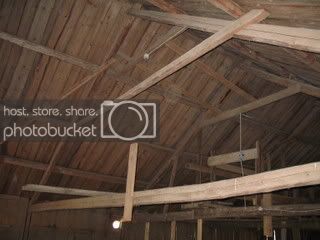
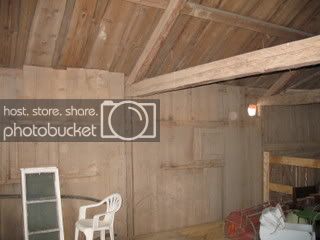
The images are taken in a barn building over 100 years old with a 10 m span. The dimension is 6"x6" and whole timber. The roof trusses have a spacing of about 3 meters. The roof originally had shingles, later covered with 40 tons of tiles (removed), and now has an aluminum roof (4 tons), all over the original shingle covering. And as you can see, not much effort has been made at the eaves to keep the bottom and top chords together at the joints.
Even today I encounter village carpenters who do things in their time-tested way, and it holds. But how large the safety margin is until failure, none of them know, for instance.
Quarter sawing is a new term for me, and I think you mean what's called quarter sawing (as opposed to through sawing)? In quarter sawing, the log is turned for each cut so that the growth rings are 90 degrees to the blade.
_____________________
Byggaren
I think it can be said that it largely depends on whether you should base your work on the blueprint or reality...
In some construction projects, it is not appropriate to deviate from the blueprints, while in others, you solve problems as they arise. In the first case, stamped lumber is a must, whereas in other cases, you let reality, the lumber, etc., guide you. Just different ways of working, simply put.
The term kvartersågning is used differently; in some cases, it only means cutting out four pie-shaped pieces from the log, which are then cut down to subjects in the correct dimensions. In other cases, it means that all subjects are cut so that the annual rings are radial.
/Kent
In some construction projects, it is not appropriate to deviate from the blueprints, while in others, you solve problems as they arise. In the first case, stamped lumber is a must, whereas in other cases, you let reality, the lumber, etc., guide you. Just different ways of working, simply put.
The term kvartersågning is used differently; in some cases, it only means cutting out four pie-shaped pieces from the log, which are then cut down to subjects in the correct dimensions. In other cases, it means that all subjects are cut so that the annual rings are radial.
/Kent
Take a look at these links about stjärnsågat.
http://www.trainformation.se/pdfnews/1999/3031-199.pdfhttp://epubl.luth.se/1402-1560/2000/06/LTU-YTH-EX-0006-SE.pdf
Imported_Byggaren: The operator in the harvester decides the log to obtain the correct stock; however, the timber is always measured at the sawmills and classified before it is sawn, meaning payment is based on the sawmill's measurements, not the data from the harvester. The operator and the computer do not see internal damages in the tree, only what is superficial. The idea that it should be felled by machine and not by hand is not correct either. There are many cracks and damages when the machine cuts trees and logs, depending on the type of feed rollers the machine has, www.skogforsk.se/templates/SF_DocumentDownload____18353.aspxhttp://www.vmfqbera.com/Kvalitetssystem/A-Cirkular/Virkesmatning/PDF/Cirkular_A-318.pdfhttp://vxu.se/td/sot/forskning/nyhetsbrev/nyhetsbrev_nr2_webb.pdf
Then about the claim that there would be more cracks when falling manually?? Why? When the machine fells the tree, it also presses it down and possibly pulls it closer to the machine, which should result in the tree striking the ground with greater speed and therefore harder, and there may also be some bending since it's only the upper part of the tree hitting the ground. When felling trees manually, one tries to lay them down in the best possible spot, avoiding, for instance, letting them fall over a stone, which could damage the wood. You don't want the root end to hit upwards since you are standing nearby.
Hopefully, the machine operator knows what he is doing. If he sends the wrong stock to the wrong sawmill, it becomes waste, even if it's a so-called knivfura (veneer log).
http://www.trainformation.se/pdfnews/1999/3031-199.pdfhttp://epubl.luth.se/1402-1560/2000/06/LTU-YTH-EX-0006-SE.pdf
Imported_Byggaren: The operator in the harvester decides the log to obtain the correct stock; however, the timber is always measured at the sawmills and classified before it is sawn, meaning payment is based on the sawmill's measurements, not the data from the harvester. The operator and the computer do not see internal damages in the tree, only what is superficial. The idea that it should be felled by machine and not by hand is not correct either. There are many cracks and damages when the machine cuts trees and logs, depending on the type of feed rollers the machine has, www.skogforsk.se/templates/SF_DocumentDownload____18353.aspxhttp://www.vmfqbera.com/Kvalitetssystem/A-Cirkular/Virkesmatning/PDF/Cirkular_A-318.pdfhttp://vxu.se/td/sot/forskning/nyhetsbrev/nyhetsbrev_nr2_webb.pdf
Then about the claim that there would be more cracks when falling manually?? Why? When the machine fells the tree, it also presses it down and possibly pulls it closer to the machine, which should result in the tree striking the ground with greater speed and therefore harder, and there may also be some bending since it's only the upper part of the tree hitting the ground. When felling trees manually, one tries to lay them down in the best possible spot, avoiding, for instance, letting them fall over a stone, which could damage the wood. You don't want the root end to hit upwards since you are standing nearby.
Hopefully, the machine operator knows what he is doing. If he sends the wrong stock to the wrong sawmill, it becomes waste, even if it's a so-called knivfura (veneer log).
No. Star cutting is apparently not the same as quarter cutting, even though the principle is largely the same. The question is, what do you do with the wedges that are left over? Triangles are not typically used as studs, planks, and boards in building constructions, speaking of waste.
It probably depends on who is behind the controls of the harvester how the felling is done. I have seen quite a few operators over the eight years we've lived here (basically two new each year) who have had different ways of handling the machine (also different brands). The younger ones have a hobby of felling trees as quickly as possible. That is, from clamping, felling, debranching and cutting into logs for forwarding and clamping the next tree, they have varied in speed. Those who slam the trees to the ground take about 25 seconds on a 30-meter spruce. Those who fell gently take up to 60 seconds. Often older operators lay the tree down with a drag against surrounding trees, don't raise the head too high above the ground so that the cut log doesn't hit when it is cut off, etc. This also results in no breaks in the wood.
With a hand-felled log, the top always hits the ground. If the ground is not completely flat, but hilly (as it often is in forest terrain here on Orust), a bending of the trunk inevitably occurs when the tree hits the ground, and with the weight the tree has, vibrations usually travel along the entire trunk before the root settles.
_________________
Byggaren
It probably depends on who is behind the controls of the harvester how the felling is done. I have seen quite a few operators over the eight years we've lived here (basically two new each year) who have had different ways of handling the machine (also different brands). The younger ones have a hobby of felling trees as quickly as possible. That is, from clamping, felling, debranching and cutting into logs for forwarding and clamping the next tree, they have varied in speed. Those who slam the trees to the ground take about 25 seconds on a 30-meter spruce. Those who fell gently take up to 60 seconds. Often older operators lay the tree down with a drag against surrounding trees, don't raise the head too high above the ground so that the cut log doesn't hit when it is cut off, etc. This also results in no breaks in the wood.
With a hand-felled log, the top always hits the ground. If the ground is not completely flat, but hilly (as it often is in forest terrain here on Orust), a bending of the trunk inevitably occurs when the tree hits the ground, and with the weight the tree has, vibrations usually travel along the entire trunk before the root settles.
_________________
Byggaren
No, trekantsläkt is not very interesting as construction timber but suitable for cutting down to moldings, battens, etc.
That a bending occurs in the trunk when it is felled is unavoidable, but the same happens during autumn storms and those forces are not gentle either. Moreover, a harvester cannot access everywhere or handle all trees.
/Kent
That a bending occurs in the trunk when it is felled is unavoidable, but the same happens during autumn storms and those forces are not gentle either. Moreover, a harvester cannot access everywhere or handle all trees.
/Kent