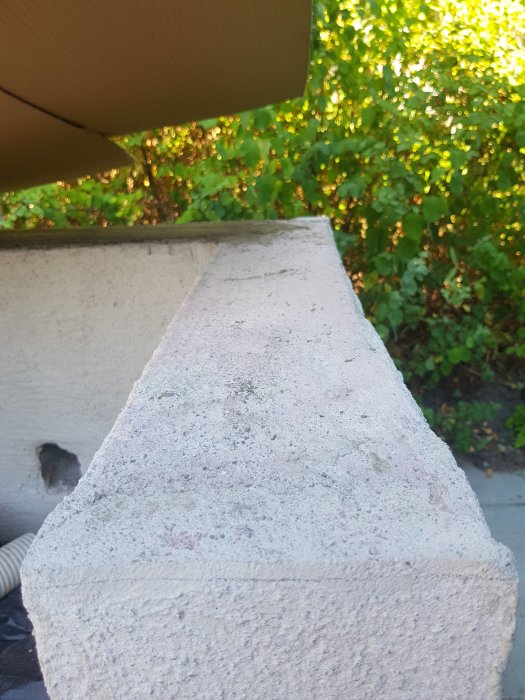
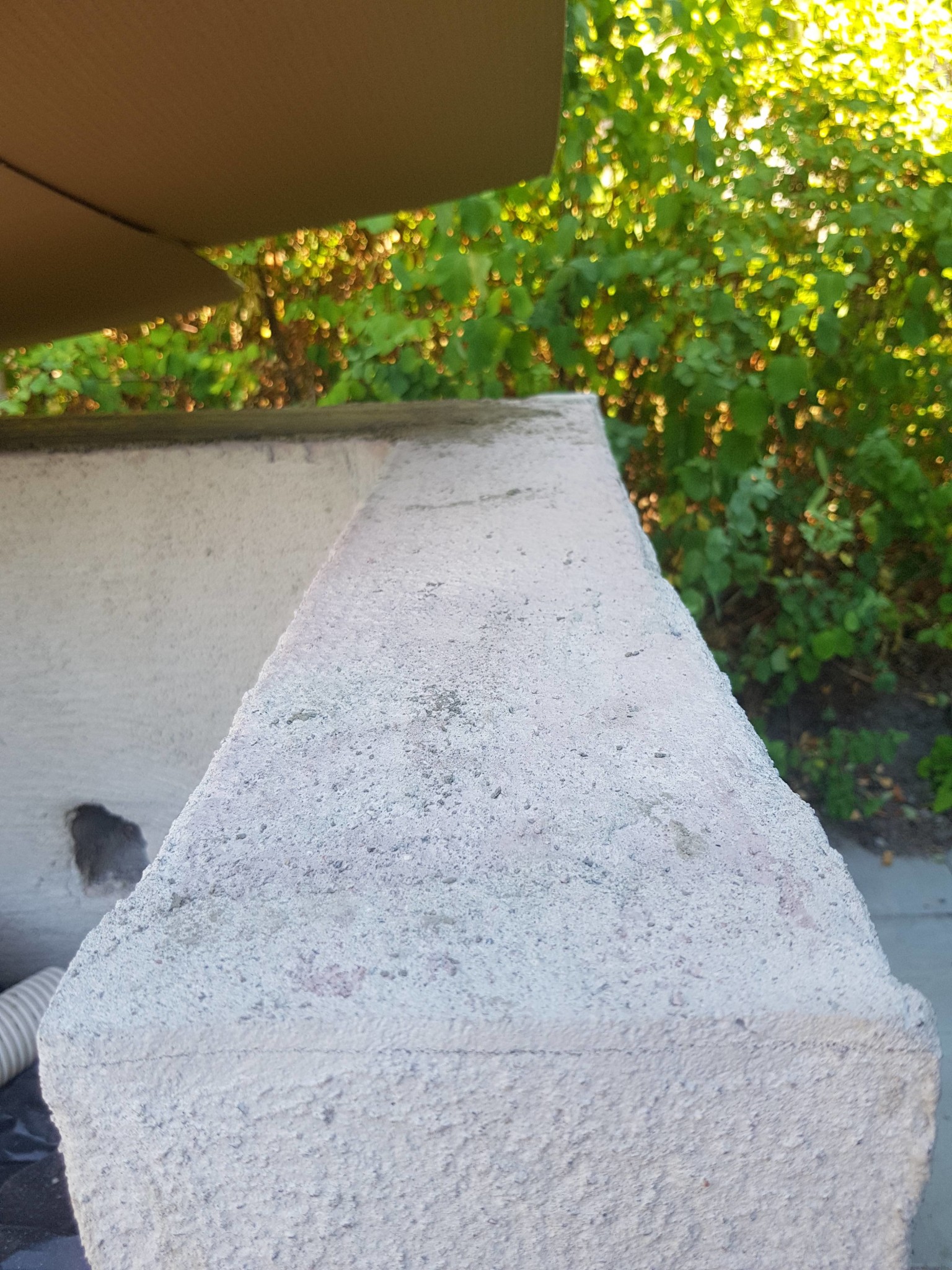
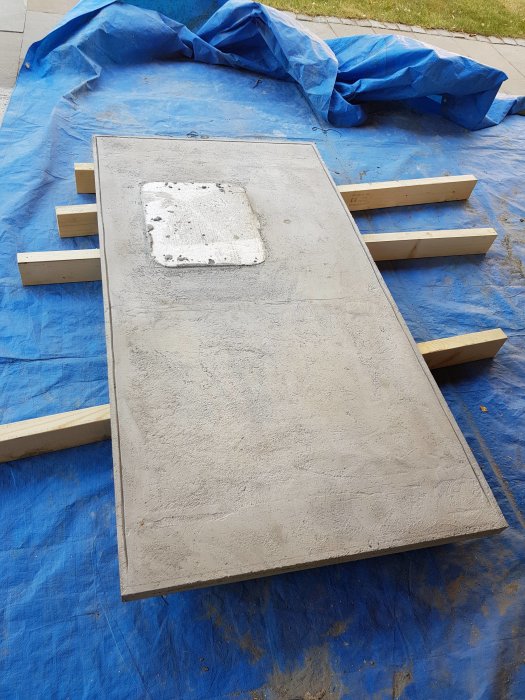
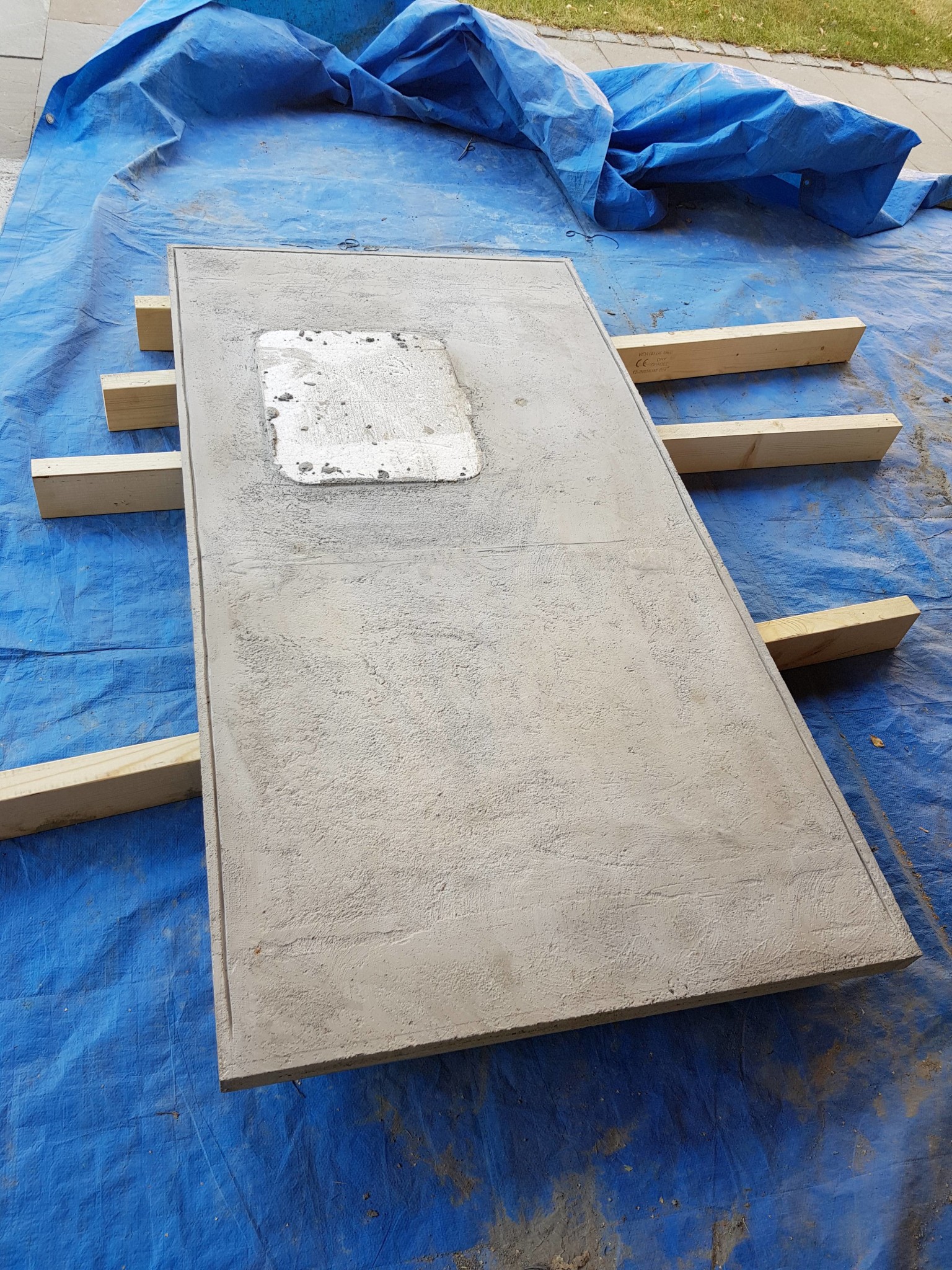
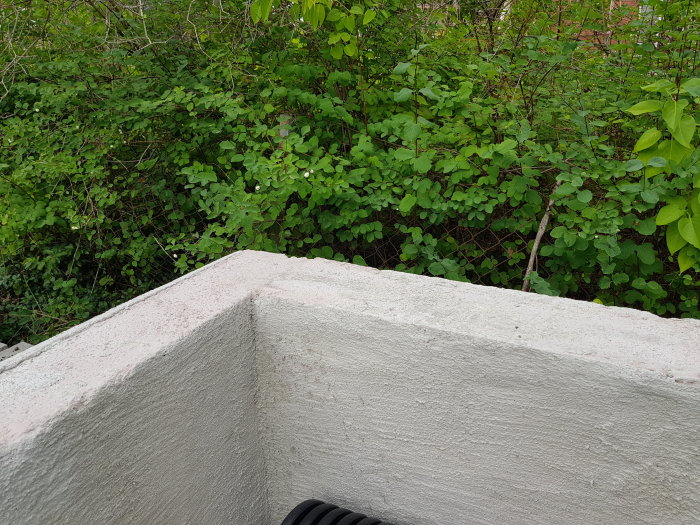
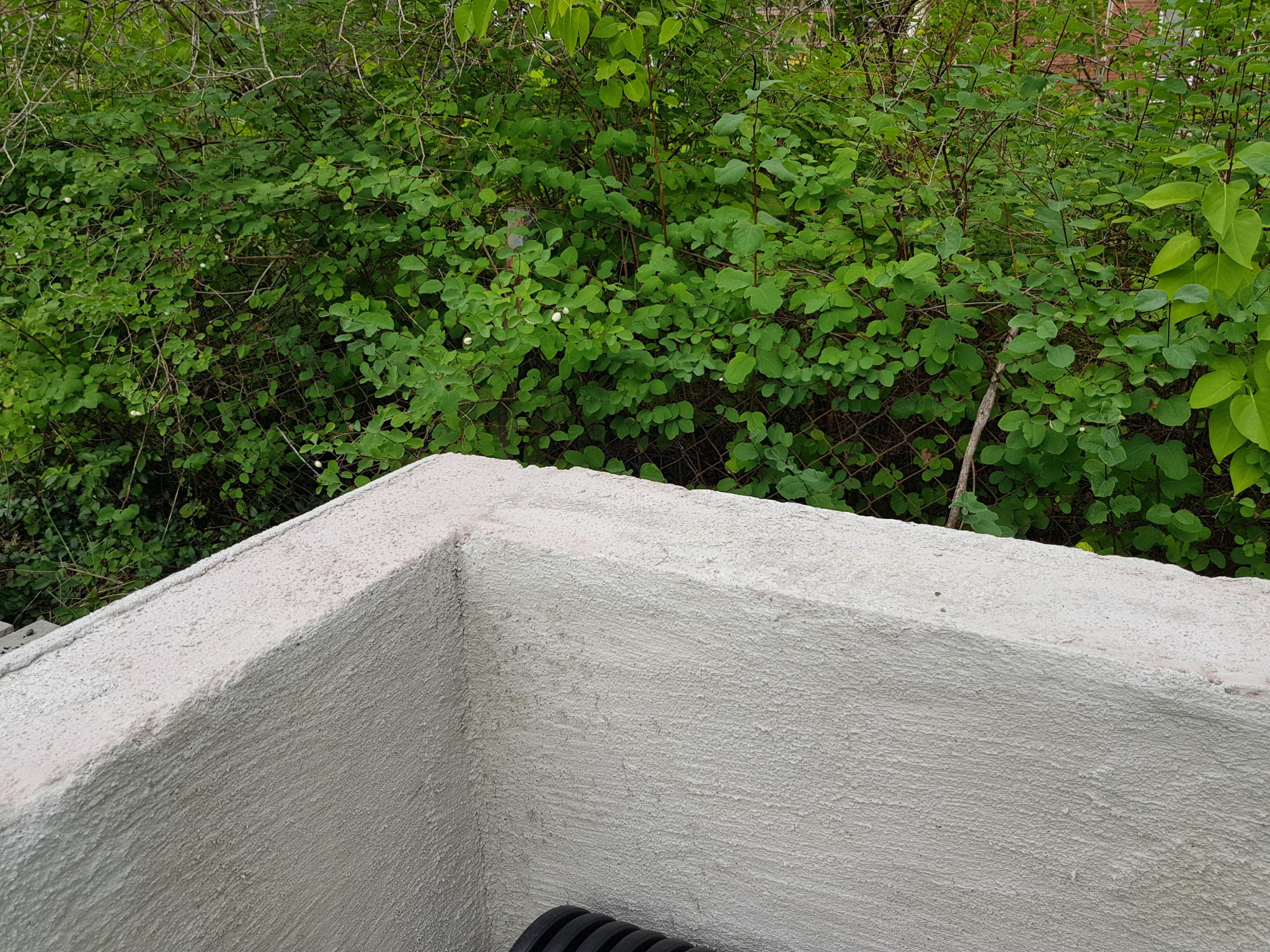
Going to do what the title says. Just wondering how to fill the unevenness on the top of the red-plastered leca wall and also on the underside of the countertop (cast in form plywood with expanding concrete, 160x80 cm).
Sure, I've got it reasonably even with some sanding and filling with a couple of mm of mortar on the wall, but it's coarse mortar and I want the 130 kg slab to be supported by as much area as possible, so I don't want larger gaps of even a mm between the wall and the slab.
The slab is going up today with booked carrying help.
I was thinking of laying a thin layer of fairly thin C-mortar on the top of the wall before the slab is turned up. C isn't so hard if you would want to remove the slab (replace etc.) in the future. Does that seem like an okay idea, or does anyone have a better suggestion? I just want the slab to rest on the entire surface of the wall, not be attached to it, with 135 kg I reckon it will stay put
It both builds up enough to even out irregularities and you get some time before it sets. The problem is probably that it sticks afterwards. Regular foam sealant could be an alternative.
Construct a mold and cast a small plinth on top, sure, but we're going to set the slab tonight, and my experience says that getting it perfectly flat is still difficult, just like the cast slab didn't turn out completely flat on the top side (which becomes the underside when you flip it).
But sure, with a fine mortar and considering how narrow the mold would be, it would be flat enough.
However, it's rarely important to get such flat surfaces; normally you might use self-leveling compound or build on top of a cast surface, or not care about a millimeter difference.
I find it hard to believe that this heavy slab would move and that you would want to glue it for safety reasons?
Foam sealant (alternatively Biltema's stone adhesive, which also seems to be a 5-10% expanding foam), no risk of the slab lifting during curing?
Foam (or Biltema's stone adhesive, which also seems to be a 5-10% expanding foam), is there any risk of the board lifting during curing?
[image]
I don't think so. I've attached the entire pool edge in granite using that stone adhesive. One stone lifted during gluing because we didn't apply pressure on it.
Our stones varied a bit in thickness, so I shimmed the stone with 0.5-1mm acid-resistant metal strips about 15x3cm and let the foam expand in the gaps. Worked well.
The size of the stones is approximately 50x25x5 cm and the bonding surface is about 50x20cm. I laid three relatively thin beads (do not fill the entire surface) and applied pressure on the stone with a bit of body weight.
The stone becomes like a skateboard in all directions, meaning slippery as heck if you don't compress the adhesive together. Generally, it was a breeze, but it adheres quite well afterwards, which you should be aware of.
Ok, so if I have gaps between 0-2mm, would you assess that I can lay three strings (the leca is just over 20cm wide including plaster) and get minimal "lifting" due to the glue's expansion, but still a hold where the gap is largest, say 2mm?
Then I'll simply bring out the big angle grinder the day the sheet may need to be replaced etc
Edit: read now that it didn't lift the stone for you
Follow-up; Went down to Biltema, realized that the stone adhesive requires that kind of foam applicator. Felt a bit too stingy to get one of those, checked Bauhaus where they were supposed to have it, but of course, out of stock.
With the help already waiting at home, I had to go with the original plan using some C-bruk. However, there were still significant gaps in places, so the idea now is to inject stone adhesive afterward, or possibly (so it doesn't stick forever) that low-expanding foam you use when setting frames so they don't get squeezed.
I think there is stone adhesive spray available at both Hornbach and Byggmax. Otherwise, a handle costs just over a hundred kronor at Biltema, and neither the stone adhesive nor the foam sealant is used up as soon as you open it since it can be screwed on/off many times. It's a much better economy (and ergonomics) quite quickly.
Ok, now it's time to mount the next concrete slab on the leca wall. The one that the grill itself will be built on.
And since it's practically very difficult to achieve two completely flat surfaces with 100% contact between the wall-slab, we have the same problem here. Large gaps between the wall-slab, resulting in the concrete slab only being supported at a few points on the wall.
Stone adhesive with caulking gun purchased, so I can follow the tips above. But then I read elsewhere in the forum that the adhesive (type low-expanding pu foam) has no load-bearing capacity. Hmm, if it can't take any load, it's quite pointless to use in this case, right?
The slab is heavy and won't move.
Foam carries poorly but adheres well. I would imagine something like this could work.
Place some moderately strong screws/French screws with large heads; they can sit low so the gap is small.
There will be a few as they need to support the weight of the slab.
Align them precisely (it can differ by a few mm, but it doesn't matter much as long as the others support).
Apply some setting fix so it covers the heads; lubricate the edge of the slab with regular cooking oil,
so the fix doesn't stick but is pressed down to head height; if a small bulge forms on the side,
it's easy to scrape off before the fix has set, creating an even support layer for the slab, supporting it everywhere underneath.
Then you can lift the slab if needed.
I did this when placing stone with a slight slope on a lecamur, but without the cooking oil, and it's held firm as a rock.
Both Weber and Byggmax state that the concrete/substrate should be > 2 months. Possibly less relevant in this case though.
Perfect with a longer working time than the 6 minutes you have with stone glue.
Searching among these. You want as light a consistency as possible so that the mass is fully pressed out and only fills gaps without building anything in height otherwise.
You can basically take whatever you want for fix and mix it to a thick consistency, it shouldn't flow on its own and will press down regardless of consistency, as the board is heavy. Then place it along the entire edges so it forms a frame around it, and don't be stingy. Think that it bulges out on the inside, so moderation is best and that there's oil a bit inside the board. You should probably wait a day or two for it to harden properly. Then you can try lifting slightly at one end to check if it’s stuck. But be careful so it doesn't break, if there's a risk, avoid doing it. Feel free to come back with information about the result.
Click here to reply
Vi vill skicka notiser för ämnen du bevakar och händelser som berör dig.