
71,369 views ·
259 replies
71k views
259 replies
Newly laid floor flexes on 3 floors and in all rooms

I installed this exact light ash 3-strip Barlinek floor myself in May. The substrate is concrete, Platon mat (with ventilation "under," so-called mechanical ventilation floor), gray felt paper, the floor. About 18 sqm, a bedroom. The relative humidity has been around 60% since early August.P Peter Petterson said:
I don't have any good suggestions but can give my perspective. The floor lifted on one side during installation, but nothing that bothers right there. Pressed down with skirting board, now the floor has settled. Bed, piano, desk won over the tensions. Creaked a bit for a month, now only a bit of "settling noise" if I've been away for a while. No gaps on the short sides. But it's really not a "click-floor" as it's sold as. Took a lot of manual effort/rubber mallet to get it to click in properly. Glad I've laid a lot of floors and realized it early. Redid the first rows.
Laid another Barlinek parquet in the previous house, in the hallway/bedroom. Same type of "click." It still creaks a lot, but no gaps. On chipboard over the joist on the second floor, with some type of green "foam." I can imagine that it’s due to a slightly "bouncy" substrate, it probably moves a bit at the joints that creak. Maybe a bad floor, that the 3 strips creak or something.. But I'm not a fan of the click technique that the BuildingMax floors have. Good price, though, and nice.
Exactly like that for the first few months! Special feeling, not quite like parquet! But it went away here (see previous post).L Lutte said:
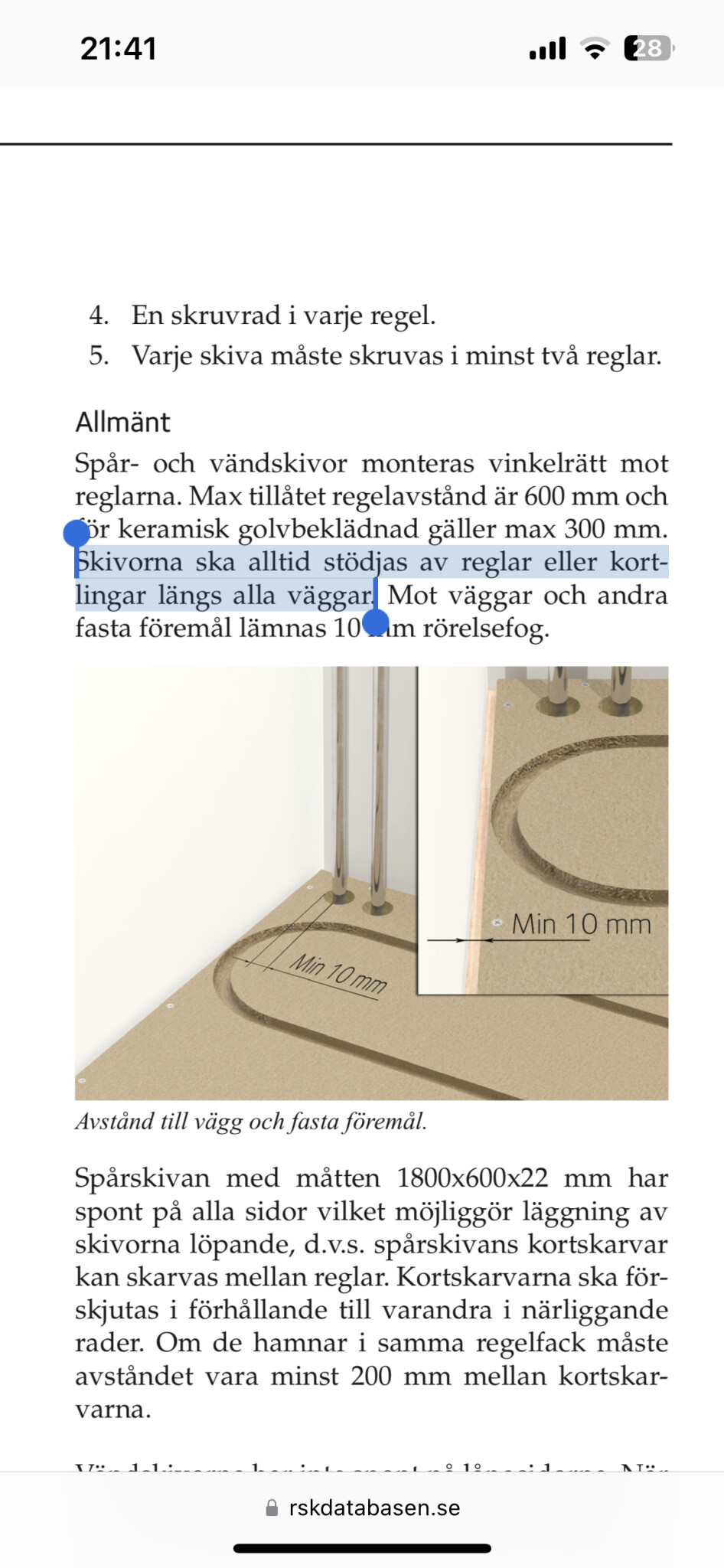
Haven't they installed noggings along the walls? There should be support around the rooms and under the turns.P Peter Petterson said:
Hey!!J Joak said:
Please link to that info, No, there have been no supports/noggings installed. I asked about it, but was only told cc60 was required. I haven't been able to find what you're claiming either when I've searched

There was a requirement not to have 2 joints in the same bay when laying the floor chipboard, and I know they've been aware of and followed that.
Also, the minimum length of floor chipboard

From LKP Peter Petterson said:Hey!!
Please link to that info. No, there haven't been any supports around/short beams installed. I asked about it but was only told cc60 was required. I haven't been able to find what you're claiming when I've searched
Then there was a requirement not to have 2 joints in the same section when laying the floorboards, and I know they have been aware of and followed that.
Also minimum length of floorboards


Self-builder
· Stockholm
· 8 627 posts
Is it possible that there wasn't enough gap between the wall and the floor during installation at those points?P Peter Petterson said:
That is, under the baseboards it's okay, but in certain places it's too tight and is causing the floors to buckle?
In that case, it might be possible to fix it more locally with a multi-tool.
But ultimately: Either you claim warranty or you start troubleshooting/fixing it yourself and resort to "fix-solutions" - because the company will likely not want to deal with it later.
No, fixing it myself is not an option.Is it that there wasn't a gap between the wall and the floor at the conduits just then?
I.e., it's okay under the moldings, but in certain places, there's too little space, and it's pushing up the floors?
Then maybe it can be fixed more locally with a multi-tool.
But in the end: Either you make a complaint or you start troubleshooting/fixing it yourself and have to resort to "fix-solutions" - because the company probably won't want to deal with it later.
I just spoke with an authorized inspector who will come out in Week 39 and provide a written assessment as well as find the cause of the problem; then the responsible party will need to resolve it so we are satisfied!
Do you have a 360 laser? If so, you can set it up and see if the floor is even or not. Without load. Because if the floor is even and the framework is even, then it can only be the floor chipboard (highly unlikely) or plates/pipes not lying correctly.
Not professionally executed is a phrase that you can use. AMA is a standard, but if the material manufacturer says it should be installed with higher requirements than what AMA specifies, then it is the manufacturer's instructions that apply for it to be considered professionally executed. AMA addresses, among other things, the slope and height differences of floors.P Peter Petterson said: