
34,355 views ·
95 replies
34k views
95 replies
New construction - botched job?! Are we being scammed? Worried!!

Homeowner
· Västerbottens län
· 775 posts
The floor plan is our own solution so we can't blame the house supplier for it  the bedroom is intended as an office and we don't want wardrobes there.
the bedroom is intended as an office and we don't want wardrobes there.
It doesn't have to be crucial for the final result. But the risk is greater that cracks may occur at the joints around windows and doors.catherineb said:
What is "wrong" is that it is customary and stated in almost all work instructions I have read that you should place the joints over openings to minimize the risk of cracks. In your case, the joints have been placed right by the door and window.
In one picture also with a joint of a narrow strip of plaster.
A sensible carpenter should have placing the joint over the opening in muscle memory.
I haven’t plastered that many rooms myself but it’s already in muscle memory.
Sorry to say it, but one might wonder how other jobs look?
I have seen many strange models of how the plastic should be fixed in the corners "recently" and the commonality is that, just like in this build, they are not fixed before the drywall is on (which should make it easier and significantly tighter, here, it will never be tight?). In another case, they didn't even save the flaps like here.
Isn't it so that the carpenters intend to fold in the flaps that are saved and then tape on a corner solution before they put on the moldings?
Then I wonder how they intend to deal with the vapor barrier past the wall in discussion? There they have left the insulation open and visible, but poking in the vapor barrier there now will hardly make it tight unless they take down the wall again.

Isn't it so that the carpenters intend to fold in the flaps that are saved and then tape on a corner solution before they put on the moldings?
Then I wonder how they intend to deal with the vapor barrier past the wall in discussion? There they have left the insulation open and visible, but poking in the vapor barrier there now will hardly make it tight unless they take down the wall again.
Self-builder
· Stockholm
· 10 419 posts
There shouldn't be any more vapor barrier on the outer wall, should there? It is presumably under the layer of 45 insulation we see. The vapor barrier should not be directly under the drywall.
Homeowner
· Västerbottens län
· 775 posts
I think there should be a support beam with dimensions like 45x220 over the studs that have been cut out for the distribution cabinet. It's not okay to saw off wall studs in this way if they are load-bearing for the intermediate floor. Then I also wonder if the interior walls stand on plastic, or some other form of insulation against the concrete slab?.Kallebo said:I have seen many strange models of how the plastic is supposed to be fixed in the corners "recently", the commonality is that just like in this build, they are not fixed before the drywall is on (which should make it easier and significantly tighter, here it will never be tight?). In another case, they hadn't even saved the tabs like here.
Isn't it that the carpenters intend to fold in the saved tabs and then tape on a corner solution before they set the casings?
Then I wonder how they plan to deal with the vapor barrier past the wall in question? They have left the insulation open and visible there, but placing the vapor barrier there now will hardly be tight unless they take down the wall again.
[bild]
Then I agree that the plastic in the walls should be fixed around the corners, which are also the hardest to manage, and then sealed against the windows, before the drywall is put up.

That plastic around the window is going to be hard to seal.... you wrap and tape it before the trim, etc., goes on. Right now they probably have to either wrap it up or cut the drywall to make it as tight as possible.
However, it looks like there might be plastic under the studs against the floor... or? Check that, if so, it's okay. Otherwise, moisture could potentially rise over time into the studs against the floor. But I wouldn't cry rivers over wood against the floor. More sealing around windows, etc., is important.
As for the drain in the middle of the wall... not ideal. Unfortunately, we have something similar in this house we're living in (because those who built it earlier didn't think ahead), and what it can lead to is some drain noise, which can be a bit annoying at times.
However, it looks like there might be plastic under the studs against the floor... or? Check that, if so, it's okay. Otherwise, moisture could potentially rise over time into the studs against the floor. But I wouldn't cry rivers over wood against the floor. More sealing around windows, etc., is important.
As for the drain in the middle of the wall... not ideal. Unfortunately, we have something similar in this house we're living in (because those who built it earlier didn't think ahead), and what it can lead to is some drain noise, which can be a bit annoying at times.
Now people need to really get a grip who have no clue and are just guessing.
That the wall, which is most likely load-bearing, can be a problem is one thing, but the rest mentioned you have no idea about.
How do you know the plastic is bad? It looks quite reasonable. Sealing against the frame is not at all a standard in the industry but is done when requested.
Putting drywall joints above the doors as in the pictures doesn't have to be wrong either and works excellently with proper groundwork; how do you know there aren't metal straps behind?
Trim before painting that is supposed to be painted over is obviously not a problem.
That the wall, which is most likely load-bearing, can be a problem is one thing, but the rest mentioned you have no idea about.
How do you know the plastic is bad? It looks quite reasonable. Sealing against the frame is not at all a standard in the industry but is done when requested.
Putting drywall joints above the doors as in the pictures doesn't have to be wrong either and works excellently with proper groundwork; how do you know there aren't metal straps behind?
Trim before painting that is supposed to be painted over is obviously not a problem.
don't you think it's reasonable to recommend that they investigate things because after all, they could be wrong and poorly executed.RoBo said:
but you don't need, as many others in the thread have done, to make a big fuss claiming it's terribly executed and calling them real bunglers, when in fact you have no idea.
in this way, you're unnecessarily scaring the OP.
Homeowner
· Västerbottens län
· 775 posts
Yes! TS is in turmoil!! But on Tuesday an inspection will be carried out, so let's hope it doesn't reveal anything serious..hul said:I don't mean it's reasonable to recommend that they should investigate things since after all it might be wrong and terribly poorly done.
But you don't need to, as many others in the thread have done, bang the drum saying it's terribly bad and real amateurs etc. when you actually have no idea.
That way, you just unnecessarily scare TS
Member
· Etelä Pohjanmaa
· 2 467 posts
Eh, you're worrying unnecessarily. It looks properly done except for the blunder with the drainpipe. You don't need to worry about it affecting the wall's load-bearing capacity in any significant extent.
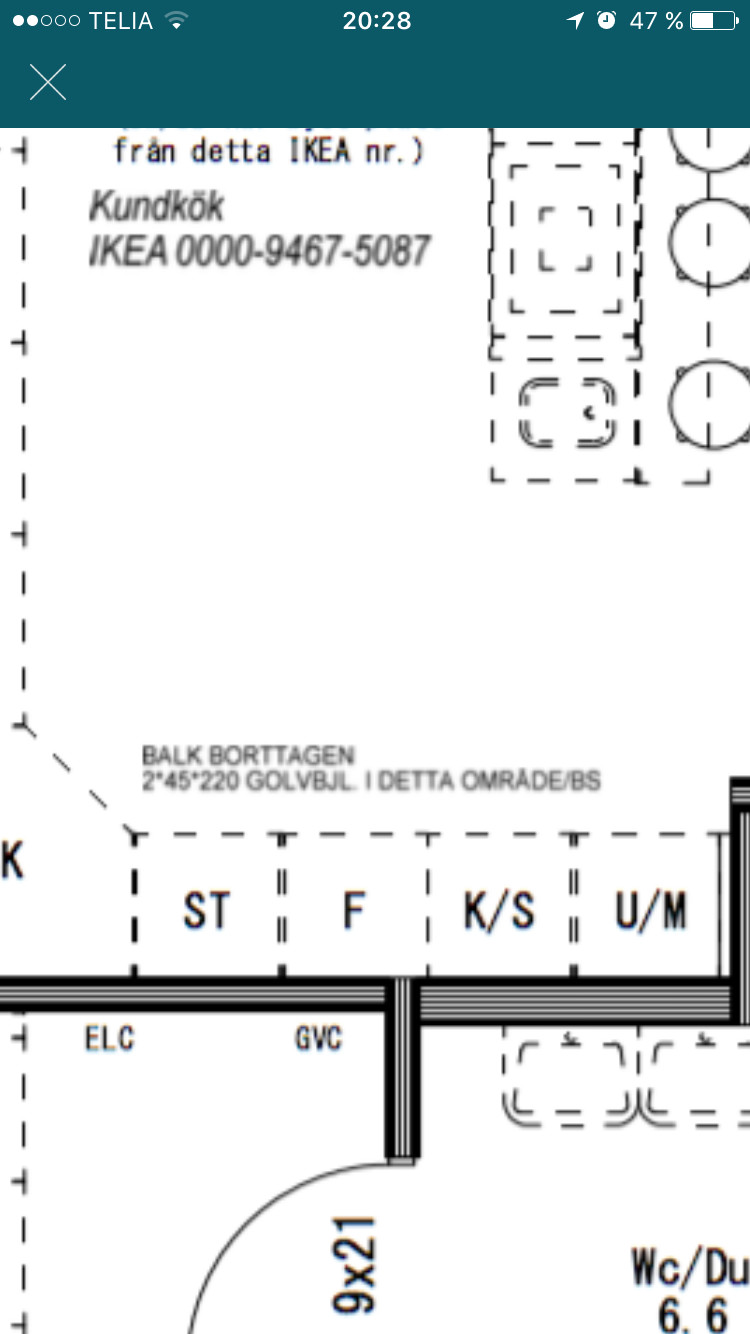
The builder has clearly written that there shouldn't be a beam here but instead a floor structure that is 2*45*220.
I am not an architect, so I can't determine if that's sufficient, but others are paid to figure that out.
The plastic will be taped before pressure testing.
I can't comment on the gypsum.
You hang the kitchen on rails, right? Rails that are screwed into studs? You should have ordered a wood panel for the kitchen since you're installing it yourself. Once you realized you didn't have the knowledge to resolve the issue, you should have consulted the house manufacturer instead of making holes in the wall, as you put it.
During pressure testing, I suggest it is also checked with a thermal camera to see if there are holes in the insulation or doors, etc.
It's good to be proactive and ask your contractor as much as possible. Preferably via email so that you have it in writing. But ask in a curious manner, not claiming it's a botched job.
The placement of the drainage is on your water and sewer drawings. It's dimensioned placement.
I interpret it as there are 2 sinks that the drainage is for? Maybe the drainage should be hidden in the wall? I have no idea, but as I said, the drawing shows where it should be. Feel free to return with a picture if you have that drawing.
As a homebuyer, you should have access to all the drawings, in my opinion. Even if it's a turnkey project, you should get everything for future reference as well.
Last edited: