Considering what you write, it's clear that you obviously don't know what you're talking about. Certainly not an educated engineer or similar; otherwise, you would have known that what you're writing is wrong.
The claim that gypsum shouldn't be joined over the corners of doors and windows is incorrect. There are absolutely no problems with that. The idea that the plastic should overlap by 10 cm is also incorrect; it can be done in many ways from half a meter and downwards.
Using plastic in windows and not sealing against the frame is standard in the industry and not wrong; only with higher demands, like passive houses, specific measures need to be taken to meet those standards.
Moreover, there doesn't need to be plastic under the sill in internal walls.
Considering what you write, it is clear that you obviously do not know what you are talking about. Certainly not an educated engineer or similar, because if you were, you would know that what you are writing is wrong.
Saying that gypsum should not be joined over the corners of doors and windows is wrong. It is absolutely no problem. Saying that the plastic should overlap by 10cm is also incorrect; it can be done in many ways from half a meter and down. Plast covering windows and not sealing against the frame is standard in the industry and not wrong—it's only for higher demands like passive houses that special measures need to be taken.
Additionally, there does not need to be plastic under the sill in interior walls.
You might also want to live in the house after the 10-year warranty period.
Yes, you can use joint plates, but it’s better if you can see if it is correct or not without removing the gypsum http://www.norgips.se/montering
I am a mechanical engineer and civil engineer (electro), so I am an engineer but not within construction.
In this picture, it looks like all the green boxes are set too far into the wall. Either they have set them too far in, or they have used double boards. The front edge of the boxes should be level with the face of the board.
In the best of worlds, all the boxes are flush with the wall, but in practice, it can be difficult to achieve due to different types of boards, surface layers, the customer changing their mind, etc. The worst situation is when the box has come too far out, which can only be solved by cutting it (unless you open the wall, but that's not so fun when it's already wallpapered), and then the mounting ring disappears. Therefore, the box is set slightly in, in a 13 wall at 11-12 mm, a double gypsum wall with a total board thickness of 26 mm is set at 22-25, etc. If you don't know how thick the boards + surface layer will be (and it's not always so easy to find out), you set it inwards.
The picture is nothing alarming, rather someone trying to avoid problems.
Now it seems like some reassuring comments are coming in, THANK YOU! Now I intend to go back to enjoying the house construction! The inspector is still coming next week anyway!
You might want to be able to live in the house after the 10-year warranty period as well.
Yes, you can put joint plates, but it's better if you can see whether it's correct or not without having to remove the drywall [link]
I am a mechanical engineer and a civil engineer (electrical), so I am an engineer but not in construction.
[link]
On page 9 you can see icopal's installation instructions at a window recess, then if you choose not to follow the installation instructions...
Then we have established that you are not trained in the field and I am.
Just because a supplier mentions a certain installation method doesn’t mean it’s industry standard.
There are several different installation alternatives, even for plastic.
I have pressure tested hundreds, if not thousands, of apartments and am very well aware of where the leaks occur and how.
Under normal standards, normal sealing at windows is more than sufficient without taping and sealing
The Million Program and stucco facades without air gaps were also built according to industry standards, and that didn't go so well.
But it's good to know exactly where the line for shoddy constructions is, and you seem knowledgeable about it, but I prefer to have a bit of a margin as well, which is why I do almost everything myself. For the latest house, I had help with the casting and the valley gutter; I set the roof trusses myself, and I've done most of the plumbing too.
But I would like to see the assembly instructions followed to a greater extent. It might also be good if builders disclosed how they do various standard things already at the contract signing, so you know before signing.
It's good that you inspect, hope it's a good inspector.
doesn't mean you can write incorrect things that you obviously have no idea about, yet still present them as facts
It is probably the case that you can write whatever you want as long as you do not violate any of the forum's rules.
However, there are rules that prohibit posts that are off-topic (like this one), and that's why I reported my previous post right away. It also states in the rules that you should treat everyone with respect and justify your opinions.
Freddex
I didn't claim it was a construction drawing. But it is included in the floor plan, and it should be a constructor who made the calculation, regardless of whether it is incorrect or not. I just pointed out that someone has calculated and stated that it should be without a beam and with double 45*220.
Of course, it can be wrong, and then it is a real botched construction. But many other previous claims were about the wall not being load-bearing.
https://youtu.be/8PgosEkDOs0
Here, Fiskarhedenvillan shows how they tape the area around windows. That was my source for the claim. But then Fiskarhedenvillan is also a botched builder if you don't tape against the reveal or tape without overlapping the plastic.
I am neither a builder nor a constructor. But I can back up all the claims I make with a source since I hardly make things up but convey information that I've seen elsewhere, which seems credible to me.
Freddex I did not claim it was a construction drawing. But it's included in the floor plan and it should be an engineer who made the calculation, regardless if it is incorrect or not. I just pointed out that someone has calculated and stated that it should be without a beam and with double 45*220.
You wrote:
vanhaniemi said:
[image] The engineer has clearly written that there should be no beam here but a floor structure that is 2*45*220. I am not an engineer
The engineer writes his references and prescriptions on a K-drawing. So the only true statement is that you're not an engineer. For all we know, it could be anyone who made the notation on the A-plan.
vanhaniemi said:
It could of course be wrong and then it's a real jerry-built. But many other previous claims were about the wall not being load-bearing.
No one knows if the wall is intended to be load-bearing or not. I have also never claimed that it is a jerry-built, but there are clearly poorly executed moments. That is why the advice has been given to bring in an inspector who can go through the documentation and see how the execution is in relation to these, and make a review of the completed work to see if it meets the requirements or not.
vanhaniemi said:
[link] Here, Fiskarhedenvillan shows how they tape the area around windows. That was my source for the claim. But then Fiskarhedenvillan must also be jerry-builders if they don't tape to reveals or tape without overlapping with plastic. I am neither a builder nor an engineer. But all the claims I make can be backed up by a source since I hardly make things up but convey information that I have seen elsewhere which seems credible to me.
You obviously don't understand what you have linked to yourself. The film shows exactly what has been pointed out. The plastic is taped with overlap. The plastic is taped to a sealing profile that is placed in the window opening and seals against the window. An alternative to the sealing profile is that the plastic is connected to a sealant around the window. In the pictures from TS build, the plastic is cut and folded out while the reveals are set, so the plastic can hardly be connected to a sealing profile or sealant except possibly at the bottom where there might not be any window sills on the picture.
vanhaniemi said:
The placement of the drain is on your VA drawings. It is dimensionally placed. I interpret it as 2 sinks the drain is for? The drain might be hidden in a wall? I have no idea, but as I said, the drawing shows where it should be.
The drain extends beyond the sill, so it doesn't matter how dimensionally placed it is if it doesn't fit.
vanhaniemi said:
We are in exactly the same phase as you in our build. However, we choose not to do things ourselves due to lack of time and knowledge.
The "Miljonprogrammet" and plaster facades without an air gap were also built according to industry standards, and that didn't go so well.
But it's good to know exactly where the line for shoddy construction is, and you seem to know that, but I prefer to have a little margin as well, which is why I do almost everything myself, with the latest house I've had help with the casting and the roof valley, I placed the trusses myself, and I've also done most of the plumbing.
But I would probably like to see the installation instructions followed a bit more, so it would be good if the builders reported how they do different standard things already at the time of signing the contract, so you know before you sign.
It's good that you're inspecting, I hope it's a good inspector.
Then it should be added that one-step sealed plaster facades are one of the safest constructions available when built correctly.
Is it just me who notices how they have joined the glesa in the ceiling?
You will surely notice where the plastic is not sealed properly when the house is pressure tested!
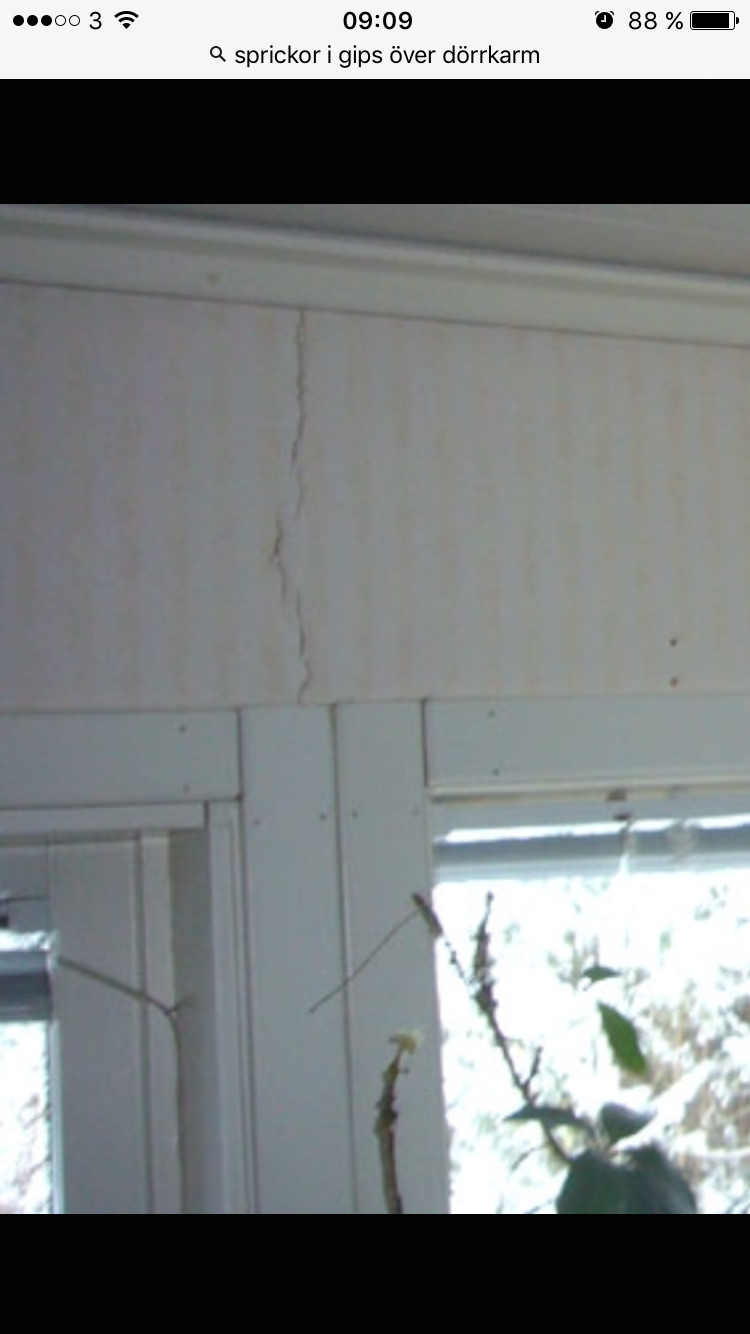
If you join the gypsum as they have done over frames and windows, you will definitely get cracks there in the paint or wallpaper after a year or so.
You always have plastic or sill sealing under the sill on interior walls...
No one thought about the fact that the double 45x220 are lying down instead of standing on edge?
If you look at the drawing, the wall was probably not meant to be thicker except where the sewer comes up, and then it becomes a bit strange to have a 220mm wide plank lying at the top if the rest is supposed to be 70 or 95.
Vi vill skicka notiser för ämnen du bevakar och händelser som berör dig.