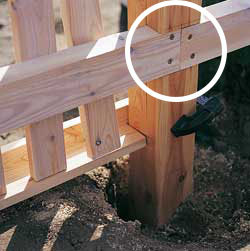
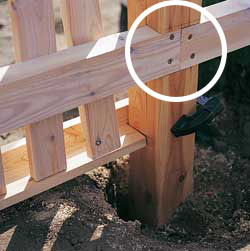
I'm about to start working on building a fence soon. We currently have builders working on a new driveway and some retaining walls for me. They are casting 95x95 posts into the retaining wall so they'll be stable. I will therefore be notching the posts later when they are in place. I want to do it like in the picture below. What's the easiest way to do that? With a reciprocating saw?
I would have taken the jigsaw because it is easier to hold against and get a straight cut. You need to cut from two directions because the blade doesn't reach. Then take what is left with a chisel.
just made a long fence where I notched 95x95 posts (there were a lot!). I used a jigsaw with a long blade - works perfectly.
Edit: If there aren't too many, or if you enjoy handiwork, a handsaw works well. If you're not a pro at sawing with a handsaw: clamp two straight boards on each side of the post, lay the handsaw on the planks for support and saw.
I would rather attach a piece of board with a clamp as a stop and use a router. There are some cheaper used ones available. However, the router bits can cost a bit, but the result is good!
I would have used the circular saw every time, so much faster and easier to get it straight. To easily get rid of the waste, make cuts with ≈2cm spacing, then you can easily knock off the pieces. A little fine-tuning with a chisel and it's done.
It would, of course, have been easier to prepare beforehand to avoid working vertically.
I also vote for the circular saw and make a series of parallel cuts. You can break off the pieces and even do the fine-tuning of the bottom with the circular saw if you have a steady hand...
I also vote for the circular saw and make a bunch of parallel cuts. You can break off the pieces and even do the fine-tuning of the bottom with the circular saw if you have a steady hand...
Above all, if you can set the depth on the circular saw, you get the exact right depth all the time and not 28mm on one side and 30 on the other because the jigsaw wobbles or accidentally tips. Also, the jigsaw blade tends to bend a little depending on the grain of the wood. Works fine in thin materials but cut a thicker beam with knots, and the cut is NEVER straight!
At 6:40 he shows the entire method that useless suggested. I use it sometimes, but the result is better, neater, and safer if you spend 2 minutes with a chisel instead. Since you always have the circular saw marks to follow, it goes quickly and easily.






useless said: