
Hello!
We are planning to build a fairly standard single-story house where one section is about 11m long and 7.5m wide with a 30-degree roof pitch. Since we intended to have an open space up to the ridge, we considered using scissor trusses, but our architect suggested we should instead use a ridge beam made of glulam. Of these 11 meters, everything will be open up to the ridge; however, only 5m will be an "open area" (living room), as the remaining 6m will have a load-bearing wall.
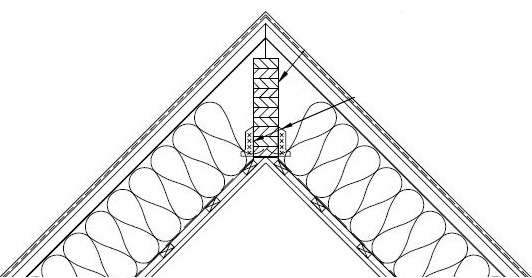
We pointed out that we had decided against it because we always thought a ridge beam would be visible indoors, but the architect mentioned that it's entirely possible and quite common to build the beam in without losing the angle at the ridge. To explain it a bit better, I have attached a borrowed construction image from a cottage (note that there is a steeper pitch than 30 degrees in the picture .
.
To my questions;
We are planning to build a fairly standard single-story house where one section is about 11m long and 7.5m wide with a 30-degree roof pitch. Since we intended to have an open space up to the ridge, we considered using scissor trusses, but our architect suggested we should instead use a ridge beam made of glulam. Of these 11 meters, everything will be open up to the ridge; however, only 5m will be an "open area" (living room), as the remaining 6m will have a load-bearing wall.
We pointed out that we had decided against it because we always thought a ridge beam would be visible indoors, but the architect mentioned that it's entirely possible and quite common to build the beam in without losing the angle at the ridge. To explain it a bit better, I have attached a borrowed construction image from a cottage (note that there is a steeper pitch than 30 degrees in the picture
.To my questions;
- Is it actually possible to do this when building a villa/year-round house?
- Are there any risks?
- I presume a roof insulation space of 400-500 mm is still possible?
Another part of the house is approximately 7.5m long and 7m wide, but there is no real support to have a non-visible ridge beam, and the architect suggested using a steel beam if we want to achieve the same result as above.
- Isn't there any other type of beam that could accomplish this?
Last edited:
Thanks for the quick response! After much consideration, I'm still leaning towards possibly using scissor trusses, partly because it seems simpler from a construction perspective (e.g., easier routing of the FTX ventilation), but with the downside that it might probably cost a bit more.W witten said:
@witten: If, against all odds, one were to go with a ridge beam, do you know if reinforcement is only required along the ridge on the bottom plate or is it also needed at the exterior walls?
It is fully possible and fairly common with a ridge beam if you want to open up to the ridge. I would probably guess that the ridge beam solution will be cheaper than with scissors trusses. The ridge beam solution applies less load on the external walls than scissors trusses, but you will have a column construction at the ends of the ridge beam to take into consideration. If the ridge beam is long or if you want to minimize its dimensions, additional columns may be necessary. Roof insulation of 4-500 mm is possible. I don't quite understand what you are getting at with your question 4, please explain a bit more. Regarding your question about the base plate, all base plates are usually edge-stiffened, i.e. reinforced where loads come down, which happens along the external walls but also at columns required for the ridge beam supports.

A roof construction with a ridge beam has the advantage that you can utilize the space in the roof without being disturbed by tie beams or support legs, etc. The ridge beam rests on two or more columns that transfer the roof loads down to the foundation. The foundation must be designed to withstand the point loads that arise at the column supports. This is not a major problem in connection with a new building. Large beams can also be easily lifted in with a crane. Just because you have a ridge beam doesn't mean you have to have an open space to the ridge everywhere. The ridge beam does not impose any limitation on the insulation thickness in the outer roof. It is possible to achieve quite large spans, though at the cost of hefty dimensions for the ridge beam and roof joists. Scissor trusses are a type of truss that simultaneously allows the use of part of the roof volume. The practical span limitation is 12-15 m. Scissor trusses can be good if you want space for concealed ventilation ducts. They can be placed (properly dimensioned) at a larger c/c distance than normal.
If you want to compare the ridge beam with scissor trusses in terms of price, you should probably calculate it for each specific case. With a width of only 7.5 m, as in the TS case, scissor trusses are probably not the most optimal solution, though that's a guess. I think you should stick to one roof construction per building volume. If you're not very skilled, you probably shouldn't experiment too much with different roof slopes between different building bodies either.
If you want to compare the ridge beam with scissor trusses in terms of price, you should probably calculate it for each specific case. With a width of only 7.5 m, as in the TS case, scissor trusses are probably not the most optimal solution, though that's a guess. I think you should stick to one roof construction per building volume. If you're not very skilled, you probably shouldn't experiment too much with different roof slopes between different building bodies either.
Click here to reply