
2,497 views ·
5 replies
2k views
5 replies
Non-organic base on interior walls?
Hello.
We are in the process of renovating a house built in the seventies. It's a risky construction with an uninsulated slab and compressed treated sills that support a floor joist system.
The floor has held up well, but since we're already doing so much with the house, including new floors, it seems like a good idea to implement a better solution right away.
The floor is being removed down to the slab. Then cleaning, floor leveling (or similar). After that, Ventitex, Platon, foam board, chipboard, cardboard underlay, and then parquet.
Is the situation clear? Good, let's continue to the problem...
The house has been remodeled from a single-story to a one-and-a-half-story, which means that some load rests on a longitudinal interior wall. This interior wall stands on the floor joists (24 inches apart). I do NOT want any organic contact from the interior wall to the slab. So how do we do it?
I have a brother who works in metalworking, which has led me to consider jacking with a hydraulic jack, removing a joist, and replacing it with a standing square tube 70*70 (or whatever it's called?).
Any other suggestions? See image.
We are in the process of renovating a house built in the seventies. It's a risky construction with an uninsulated slab and compressed treated sills that support a floor joist system.
The floor has held up well, but since we're already doing so much with the house, including new floors, it seems like a good idea to implement a better solution right away.
The floor is being removed down to the slab. Then cleaning, floor leveling (or similar). After that, Ventitex, Platon, foam board, chipboard, cardboard underlay, and then parquet.
Is the situation clear? Good, let's continue to the problem...
The house has been remodeled from a single-story to a one-and-a-half-story, which means that some load rests on a longitudinal interior wall. This interior wall stands on the floor joists (24 inches apart). I do NOT want any organic contact from the interior wall to the slab. So how do we do it?
I have a brother who works in metalworking, which has led me to consider jacking with a hydraulic jack, removing a joist, and replacing it with a standing square tube 70*70 (or whatever it's called?).
Any other suggestions? See image.
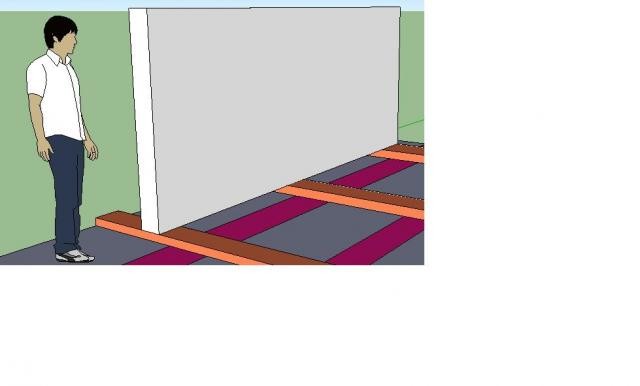

Wonder if there are isodrän/pordrän boards that are hard enough. They are capillary breaking.
Otherwise, maybe EPS concrete or lecablock can be useful. You would have to adjust the height to your other floor.
Otherwise, maybe EPS concrete or lecablock can be useful. You would have to adjust the height to your other floor.
What do you think about a Platon mat up to these potential steel profiles and then ending with an edge uplift intended for interior walls down to the slab?mats_o said:
But, when addressing such things today,
1. You might stamp up
2. Remove the sill.
3. Place tar paper/asphalt strip between the sill and the slab.
This suffices for most people.
If you are really paranoid, you can place a sill of steel, but I would probably still have tar paper against the slab.
1. You might stamp up
2. Remove the sill.
3. Place tar paper/asphalt strip between the sill and the slab.
This suffices for most people.
If you are really paranoid, you can place a sill of steel, but I would probably still have tar paper against the slab.
Well, maybe I am a bit paranoid.
The inner wall is not on a sill, it stands on studs perpendicular to the sill.
My thought and hope were to try to have as few joints in the Platon sheet as possible, and I had a vain hope of being able to lay the Platon sheet even under the mentioned inner wall, with cutouts for steel profiles, steel studs, or other solutions.
I assume that even Lecta stone with tar paper under the inner wall could work, and that I should have an edge lift at the Lecta stone?
The inner wall is not on a sill, it stands on studs perpendicular to the sill.
My thought and hope were to try to have as few joints in the Platon sheet as possible, and I had a vain hope of being able to lay the Platon sheet even under the mentioned inner wall, with cutouts for steel profiles, steel studs, or other solutions.
I assume that even Lecta stone with tar paper under the inner wall could work, and that I should have an edge lift at the Lecta stone?
How have the interior walls been going?
I'm thinking about the same thing myself, lifting the interior walls that are on the base plates in my 70s house - and trying to get plastic in between. For the newly renovated bathroom's studs, maybe one can do as you said, place steel profiles next to the existing studs and then somehow remove the wooden studs.
Additionally, I'm tearing out the entire bottom, laying down Platon and cellular plastic blocks, and on top, installing underfloor heating for the air/water heat pump.
I'm thinking about the same thing myself, lifting the interior walls that are on the base plates in my 70s house - and trying to get plastic in between. For the newly renovated bathroom's studs, maybe one can do as you said, place steel profiles next to the existing studs and then somehow remove the wooden studs.
Additionally, I'm tearing out the entire bottom, laying down Platon and cellular plastic blocks, and on top, installing underfloor heating for the air/water heat pump.
Click here to reply
Similar threads
-
Interior walls in an old basement
Building Materials and Construction Technology -
Thule släpvagn byta botten skivan
Bilar & andra fordon -
Trossbotten har dåligt innertak
Tak & Vind -
Load-bearing interior walls in a villa from 1936?
Building Materials and Construction Technology -
Garo normcentral med bottenlåda i plåt
El