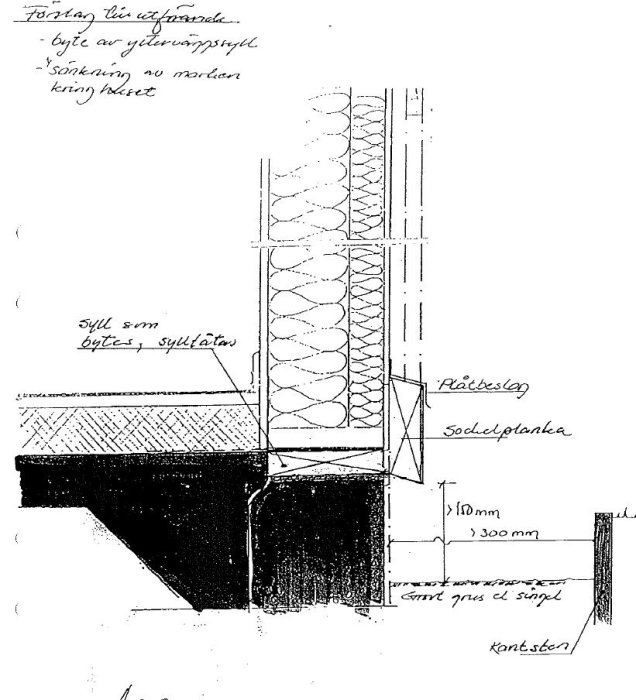
I've been thinking about taking the initiative to fix a couple of exterior walls in my split-level house. The entire lower floor is being renovated with Nivell floors at the moment, and even though the current sill, which lies against the uninsulated concrete slab without sill paper, is almost healthy and dry, it feels wrong to build in such a risk-prone structure when spending so much on the floor joists otherwise.
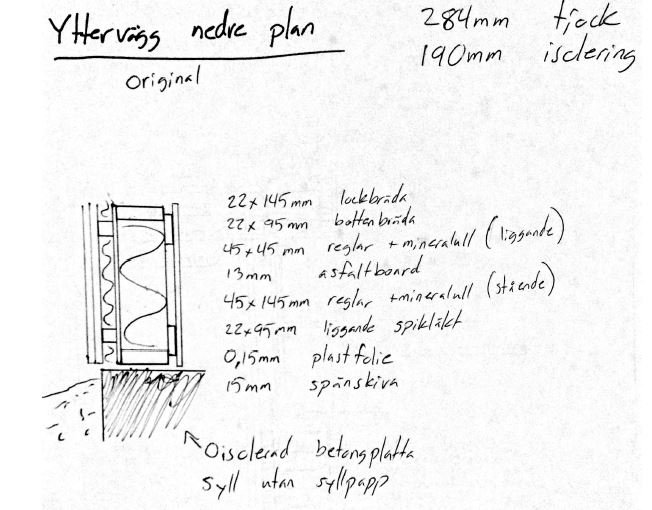
Here is a quick sketch of how the current construction is built:
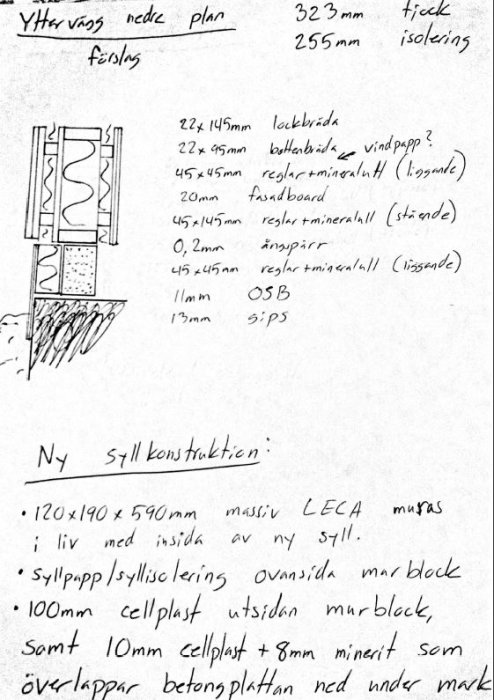
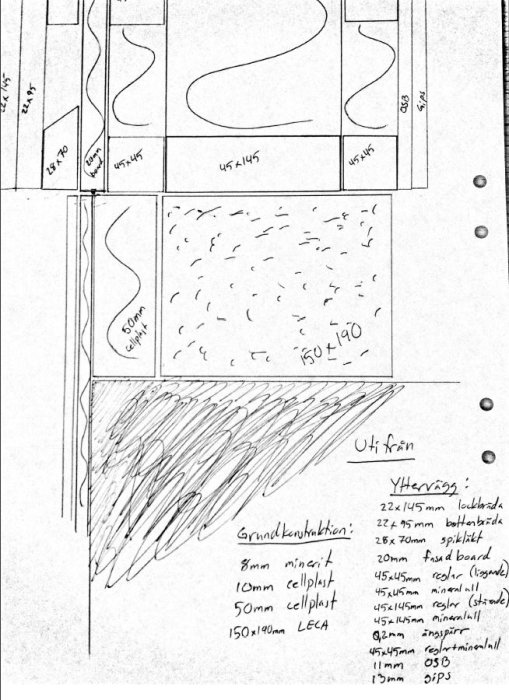
A sketch of how I envision the new solution:
As you can see, I'm making a slight change regarding the wall's construction with studs/insulation, but overall the construction remains similar. What seems backward compared to how a stud wall is built today is that the façade panel should be absolutely outermost?
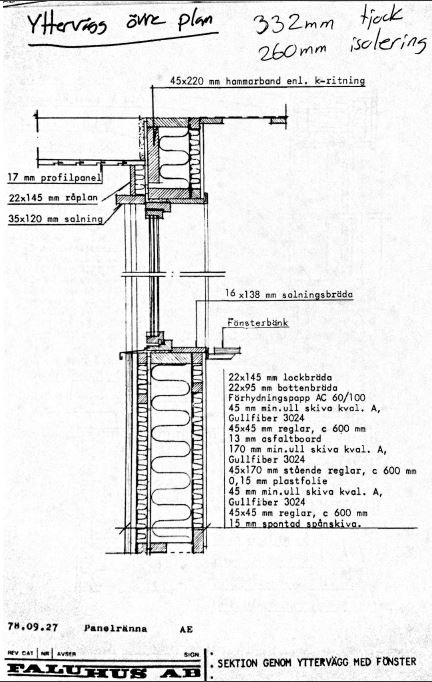
As a curiosity, I'm attaching an image of how the house's upper floor is constructed; it feels much more like "modern" thinking, even though some parts are typically '70s/'80s (asfaboard, chipboard, etc.)
Anyone with opinions on whether I'm on the right track, or am I completely wrong somewhere?
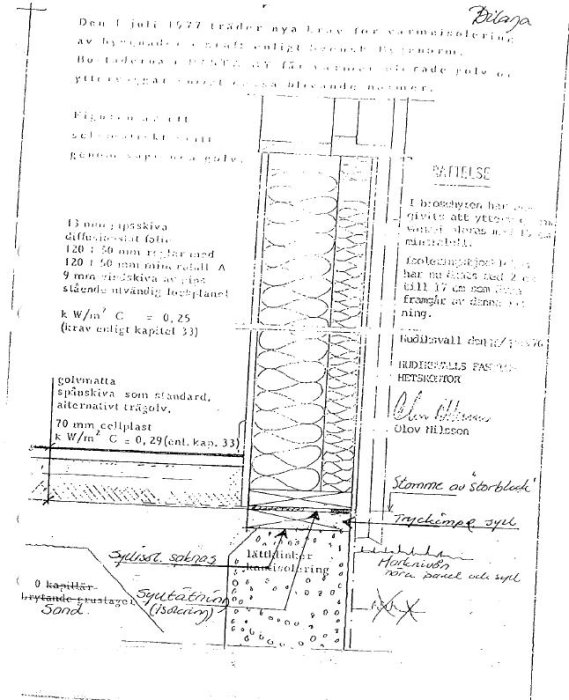
I don't know if it's right or wrong, but this is how previous owners have done it on our house with an uninsulated slab on the ground from -78 with impregnated sills. Inside, there is a ventilated Platon floor.
I don't know if it's right or wrong, but this is how previous owners have done it on our house with an uninsulated ground slab from '78 with impregnated base plates. Inside, it's a ventilated platform floor.
Looks completely right, especially since your house had pressure-treated base plates before. I suspect there was a certain smell from these. Now, thankfully I'm spared from this, but I still feel a drive to make the change on principle alone (it's hard to justify building in a 35-year-old "risk" construction, which, to its credit, has remained fresh for 35 years, but still).
However, I think I will continue down the path of building a course of Leca, as I feel comfortable with the idea of raising the entire wall section further from ground level.
Have been considering more about the construction, it will likely be a 150x190 LECA laid on its side (total build height around 160mm) to better match the total height of the finished Nivell floor, and thereby facilitate near the front door threshold, etc...
At the same time, I'm considering placing the facade board as the outermost insulation layer, to completely break the thermal bridges. Does anyone know if this board completely replaces wind barrier/outdoor gypsum/Asfaboard, etc? According to Isover's description, it should/ought to sit directly behind a ventilated facade, so it feels right? http://www.isover.se/produkter/produktvisning?id=20764
Furthermore, I wonder if the so-called lock panel that I am using (22x95 bottom boards + 22x145 lock boards) is considered fully ventilated if you mount them directly against a wind barrier? Or is additional horizontal nailing battens needed?
Anyone have tips/advice/ideas? There may be no right or wrong about these details but better/worse solutions are surely given, and it's better to get it somewhat right from the start
Click here to reply
Vi vill skicka notiser för ämnen du bevakar och händelser som berör dig.