If you want to question the installer's competence, you can create your own thread. I want help with what is wrong with the installation and what I can do about it.
The charging box should have its own RCD if I am not mistaken.
The charging box should have its own GFDI if I'm not mistaken.
It depends on what kind of charging box it is. But it looks a bit odd. If I interpret correctly, it's the "4" fuse that goes to the charging box. It seems to be powered without any ground fault circuit interrupter at all. Which can be OK if it is a charging box with a built-in GFDI. But a bit strange that it's only single-phase power supply to the box.
That depends on what kind of charging station it is. But it does look a bit odd. If I understand correctly, it’s fuse "4" that goes to the charging station. It appears to be connected without any ground fault breaker at all. Which can be OK, if it's a charging station with a built-in GFB. But it's a bit odd that it's only single-phase power to the box.
Why would 4 not be protected by a ground fault breaker according to the description above and what is odd about having a charging station on a single phase?
Possible that I am interpreting the pictures incorrectly. But the upper residual-current device feeds fuses 1 - 3 with a supply rail. Fuse 4 seems to be fed directly from the phase distribution terminal next to it. In that case, outside the residual-current device. Admittedly, it is an interpretation/guess on my part that the distribution terminals to the right are for phases, and neutrals before the residual-current devices.
Partly the single-insulated conductors outside the central unit. Not sure how best to solve them. Just covering them with a plank is probably not okay.
It's a bit sloppy to label fuses with a pen instead of, for example, a Dymo. But better than no labeling.
Detailed group schedule but unclear about which groups are on (which) residual-current device.
Good to use personal protection circuit breakers on those devices. So not everything goes out. You want to separate the fridge and freezer.
Sugar cube splices are not very neat, and you don't splice outside the central unit. A solution would have been a junction box a bit away and a new piece of cable into the central unit.
Partly the single-insulated conductors outside the central unit. Don't know the best solution for them. Just covering with a plank is probably not okay.
A bit tacky to label fuses with a pen instead of, say, dymo. But better than no labeling.
Detailed group schedule but unclear on which groups are connected to (which) residual current device.
Good to use personal protection circuit breakers on those things. So not everything goes out. You want to keep the fridge and freezer separate.
The sugar-cube connectors aren't very neat and splicing outside the central unit isn't done. A solution would have been a box a bit away and a new piece of cable into the central unit.
Building a box outside allows you to use stripping or sleeve more flexible conduit.
There's probably enough fk to keep the splices inside the central unit.
Now I am not an installer. But if a splice is approved, e.g., terminal strip, it's okay even if others in the thread think it's ugly. The older ones like screw terminals and the new ones like clamp terminals like wago. Nothing is really wrong.
What I think is wrong is that the electrical panel is on combustible material. I put mine on farmacell fiber gypsum.
I had chosen a central with a width of 26 modules and 3 or 4 rows, this way the entire hole in the wall would have been covered, and there would have been spaces left for future expansion.
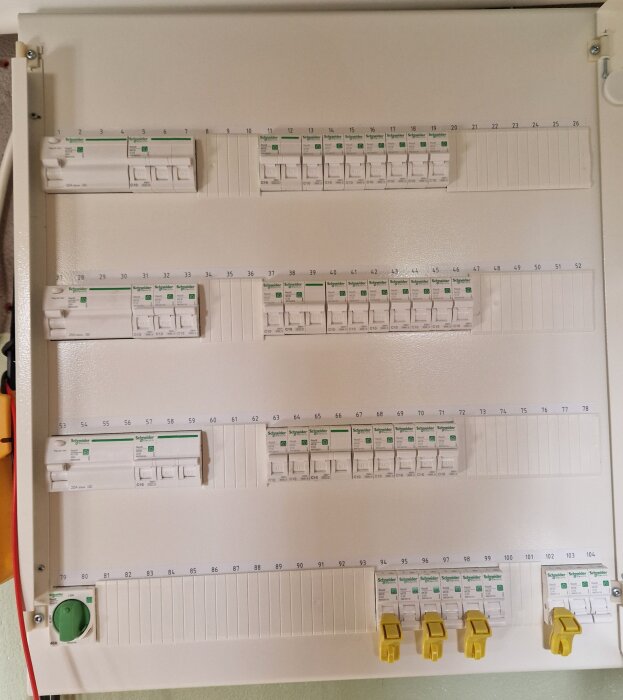
It would also have been possible to make the central more clear with which RCD covers what.
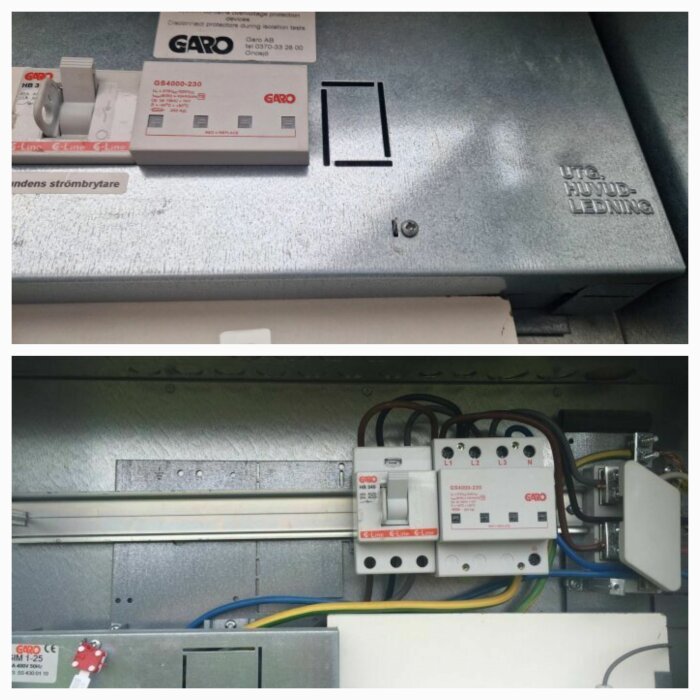
The surge protector loses some of its effect when protected and unprotected conductors run side by side.
This is what our group central looks like after replacing an overcrowded diazed central and an external modular central.
I have left a three-phase space free on each row before the single-phase groups start.
The circuit breakers at the bottom right are extra/reserves.
We have our surge protectors out in the meter cabinet.
I had a new central installed yesterday and I'm wondering if this installation is okay? I guess I'll have to put a cabinet or something over it, but first I want to ensure that this is correct.
I'm a bit surprised by the placement myself, but I don't know if it's safe or not in terms of electrical safety.
Not okay in any way, unfortunately, and moreover, the electrical central must not be directly against something flammable!
I think it looks partly cloudy.. Since it's open above the centralen sugar cubes are added in the coffee. But otherwise, there are no horrors. It's not wrong to not press cases. There are no life-threatening things. fk hanging freely is not good or correct
The Electricians' Unions: only electricians should handle electricity! Only electricians should handle electricity! It should be illegal to sell electrical installation materials to private individuals!
The electricians they want to support: *builds TS panel and goes home*
The scary thing that struck me....
The person who did the installation might have been authorized...
Electricians are not the only craftsmen who never make mistakes; they are always perfect. In addition, they are the only ones who have a patent on their profession.
Last edited:
Vi vill skicka notiser för ämnen du bevakar och händelser som berör dig.






SoderD said:
I had a new central installed yesterday and I'm wondering if this installation is okay? I guess I'll have to put a cabinet or something over it, but first I want to ensure that this is correct.
