
88,686 views ·
96 replies
89k views
96 replies
Building a Vaulted Roof "Root Cellar"

We have a slope on our property that we think would be fun to use for a small root cellar, mostly to have a door in the slope as decoration, and it would be fun if the door leads somewhere, namely to the little root cellar. The function is not the most important thing, and the size is limited due to various obstacles that would make the project unreasonably complicated.
We plan to build the walls using masonry blocks like Leca. Then the roof needs to be constructed as well, and we've considered everything from wood, plastic, metal, and concrete. But then we thought maybe the roof could also be built with masonry, like a vault. Aesthetically, this should be advantageous, we think.
The idea is to build a form to lay the stones (Leca blocks) on, put reinforcement in the joints, and then fill them with mortar. Would that work?
I'm attaching a simple sketch to explain the idea and the dimensions that will be relevant. The depth of the entire construction is limited to 150cm.
We plan to build the walls using masonry blocks like Leca. Then the roof needs to be constructed as well, and we've considered everything from wood, plastic, metal, and concrete. But then we thought maybe the roof could also be built with masonry, like a vault. Aesthetically, this should be advantageous, we think.
The idea is to build a form to lay the stones (Leca blocks) on, put reinforcement in the joints, and then fill them with mortar. Would that work?
I'm attaching a simple sketch to explain the idea and the dimensions that will be relevant. The depth of the entire construction is limited to 150cm.
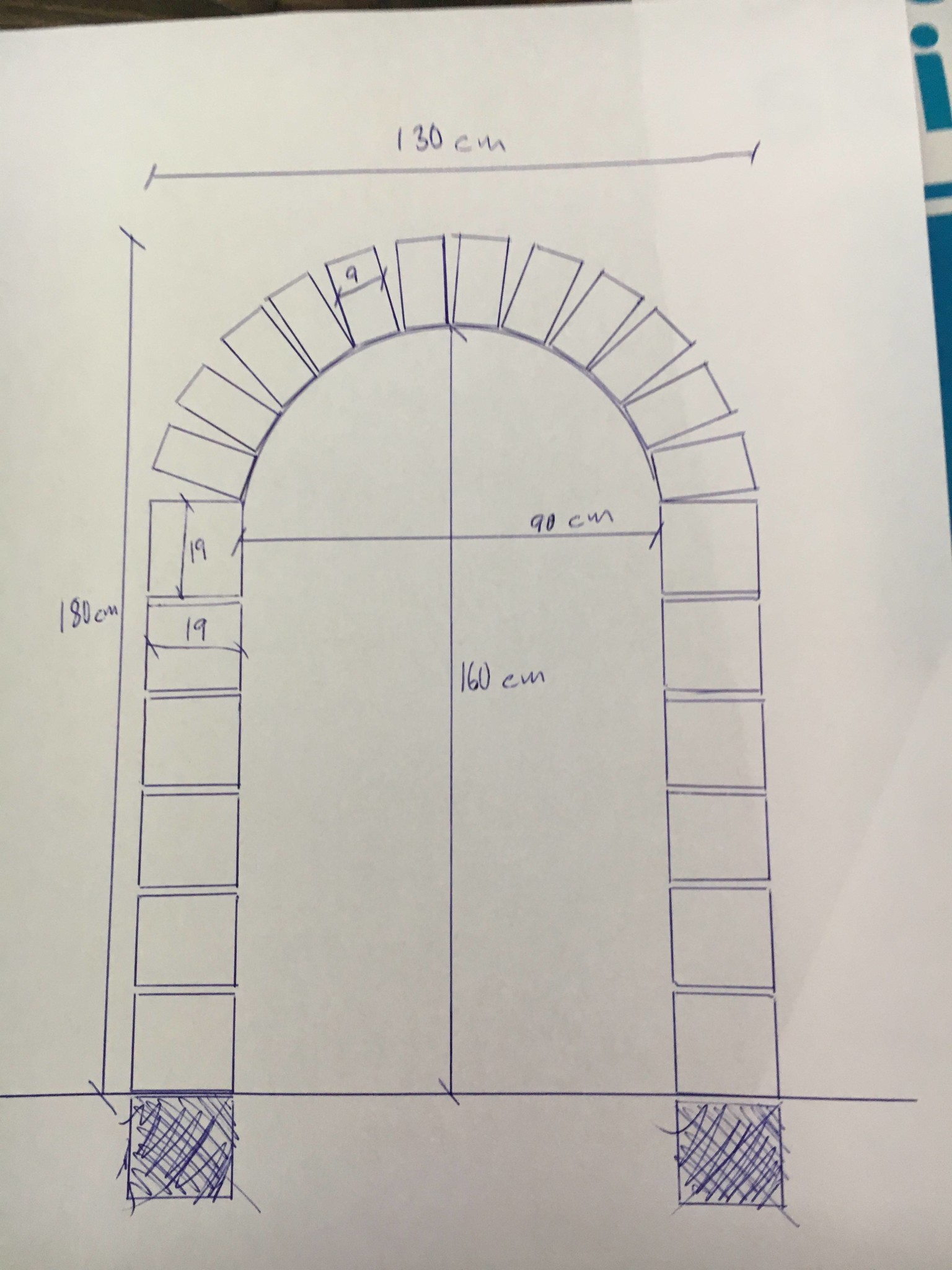
I would use concrete stone instead. Possibly with the exception of the front wall to get some insulation in it.
Concrete blocks are cheaper and more durable. But they insulate worse. As far as I know, you only use leca when you want insulation.

The compressive strength of concrete blocks is about 5 MPa (megapascal) and for standard leca blocks about 3 MPa. 3 MPa is certainly sufficient for the task. The advantage of leca blocks is that they are available in a significantly larger size range. I think it might be advantageous to use narrow stones when building the actual arch. The difference in insulation capability is significant. Compared to mineral wool of the same thickness, leca has about 25% and concrete blocks about 5% of the insulation capability. But that is hardly a decisive issue here.

A major advantage of Leca in this case is that they are quite easy to shape into wedges, so not as much mortar is needed. And probably more stable since it's how old vaults are constructed.
I have now gotten started and am well aware that I'm not doing everything "by the book." I have stable ground (a truck can set down support legs without any significant marks) and therefore didn't pour a concrete footing before I started bricklaying. I'm mixing the mortar by hand until I get a workable consistency. I've built 5 courses high and let the mortar cure for about a day between each course. I've also been working to keep the mortar moist. It feels like the mortar in the first courses has become solid and stable. Now I'm about to start with the arch and I'm wondering a bit if I've cheated too much so that the roof will collapse... 
When I read about how to mix mortar, it says you should mix with a machine for at least 10 minutes. I mix as I see fit with water and dry product. I mix half a bag at a time with a shovel in a bucket. What can happen when I mix incorrectly (the likelihood that I haven't mixed as I should is greater than it being completely right)? Will the mortar dissolve, swell, or what will happen? The blocks are rock-solid when I jump and jiggle them... anyone know?
When I read about how to mix mortar, it says you should mix with a machine for at least 10 minutes. I mix as I see fit with water and dry product. I mix half a bag at a time with a shovel in a bucket. What can happen when I mix incorrectly (the likelihood that I haven't mixed as I should is greater than it being completely right)? Will the mortar dissolve, swell, or what will happen? The blocks are rock-solid when I jump and jiggle them... anyone know?

The risk is that you use too much water when mixing by hand. For a project like this, I would definitely use a cement mixer, but it's easy to say when you have one..
I "only" mix one bag at a time. It takes almost an hour to lay a shift and then my me-time is over . I'm mostly thinking about what could happen if you don't mix it just right. The walls are hardly likely to collapse downwards or outwards. Inwards, I have a future door frame holding it back and in the back wall 1.3 meters from the door, I've laid the blocks staggered. I've reinforced every shift.
. I'm mostly thinking about what could happen if you don't mix it just right. The walls are hardly likely to collapse downwards or outwards. Inwards, I have a future door frame holding it back and in the back wall 1.3 meters from the door, I've laid the blocks staggered. I've reinforced every shift.Holding it does make it secure. It's mostly a matter of convenience. It must be tough to mix by hand when it's 30 degrees hot.
I mix one bag per day and divide it into two or three batches. I mix each batch for a few minutes with a shovel, not particularly demanding. Although of course, it would be nicer to just fetch ready-made mortar.J justusandersson said:

Now the form is ready, and I need to obtain more reinforcement before I start building the roof. Additionally, I have acquired a concrete mixer so that I can mix completely according to the instructions when I build the roof anyway .
Do wedges need to be used in the gaps, or will mortar and reinforcement be enough?? Maybe it's better to shape the entire blocks on top as wedges?
. Do wedges need to be used in the gaps, or will mortar and reinforcement be enough?? Maybe it's better to shape the entire blocks on top as wedges?
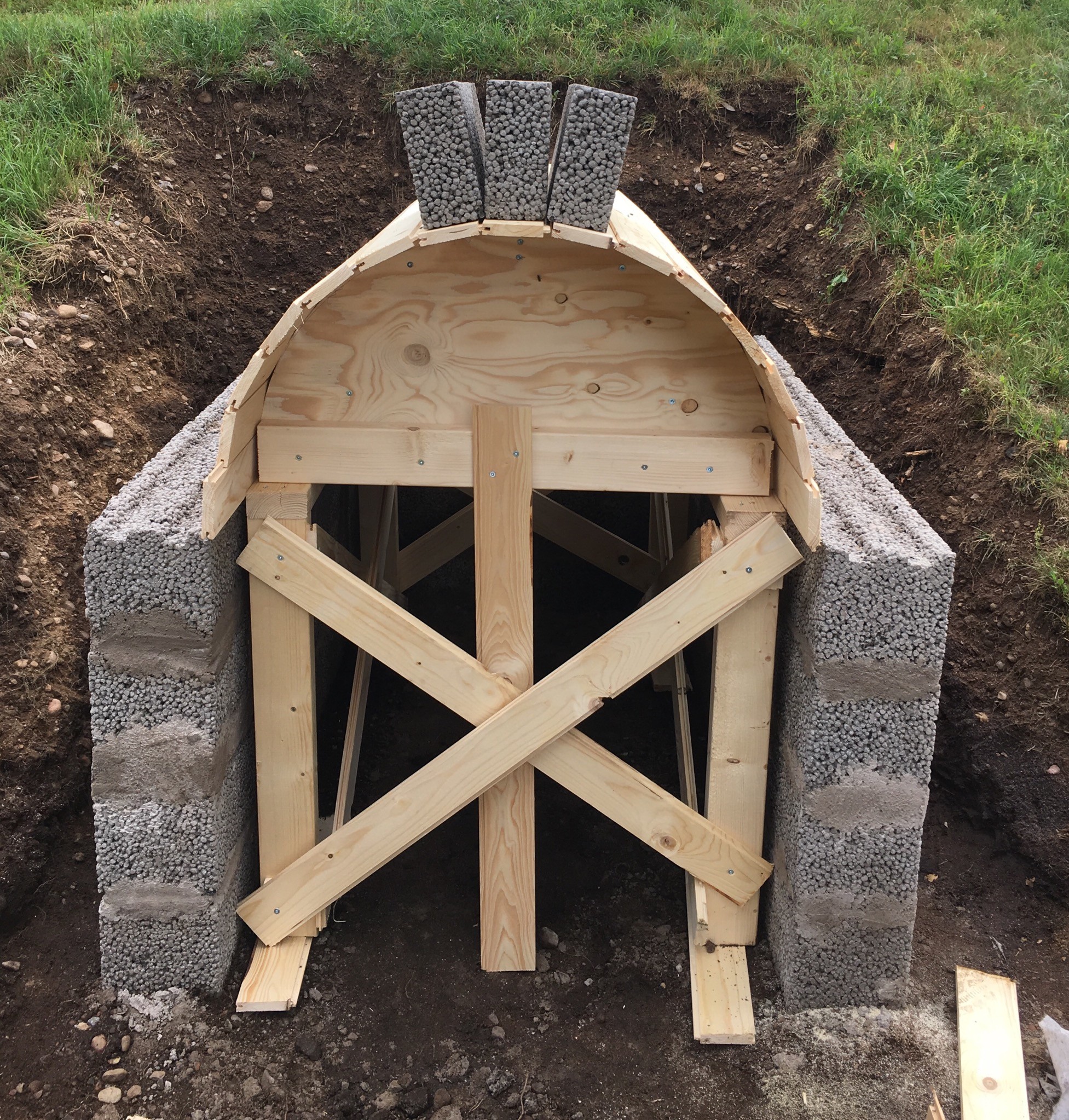
I built one just like that, but significantly larger, 2.5m across.
We just filled the gaps with mortar. It eventually became an earth cellar sauna. We built it in 2007 and it's still standing. We rolled it with asphalt and then placed platonmatta over it for moisture protection.
We just filled the gaps with mortar. It eventually became an earth cellar sauna. We built it in 2007 and it's still standing. We rolled it with asphalt and then placed platonmatta over it for moisture protection.