
4,338 views ·
29 replies
4k views
29 replies
Mullbank with Hasopor and clay-plastered stone foundation - landscape fabric or not?
Exactly, direct contact between the soleplate/clay/foundation as in your picture. It's hard to judge distances in a picture, how far is it between the macadam and the soleplate in your picture? Is that the side where you laid down drainage?ottotorsten said:
I understand. No separation from the soleplate, the clay is in direct contact with the wood?
Sounds convenient with the lecan and it'll probably look great with limestone on the outside.
Yes, it’s a very thin layer of macadam we’ve added. It definitely sounds like the conditions are different. Nice that you have it dry!
I also think we should apply a layer of clay plaster on top as you described.
The drainage pipe you installed, is it just pulled up to floor level and embedded in the clay mortar?
Many questions, but I'm grateful for all the answers that can help clarify my understanding
I placed the drainage pipe at the bottom of the foam glass and then ran it through the basement wall and plugged it there. Without a basement, the question is whether it might have been better to access it via some type of inspection hatch in the foundation? If you're going to connect a fan for radon or moisture to it in the future, you probably don't want it in the living room.
I wonder if the damp macadam is due to humidity condensing on the colder ground...
I usually open up in the stable and other unheated utility buildings in the spring when it's sunny and warm to warm up the buildings a bit faster. Uninsulated concrete floors and stone walls retain the cold well. It's not uncommon for the floors to become quite dark and damp inside the doorways. That phenomenon is due to the humidity condensing on the cooler floor surfaces, especially near the doors where there is the most draft.
The same thing happens in the woodshed, although it has a gravel floor.
We also have clay soil. It's always cold and damp.
It's also good to remember that the conditions for moisture are radically different if the building is unheated or permanently heated to residential standards. If there is insulation on the ground and the space above maintains about +20°C, the air above the insulation will be significantly drier than below. If air can migrate from the ground surface upwards, it will have 100% RH at the ground surface but <50% RH at room temperature. That means any floorboards will not get moisture-damaged as they are in the dry, warm space above the insulation.
If the space above is not heated, however, the humidity will not decrease significantly on its way up, and then the floorboards can become moisture-damaged.
I usually open up in the stable and other unheated utility buildings in the spring when it's sunny and warm to warm up the buildings a bit faster. Uninsulated concrete floors and stone walls retain the cold well. It's not uncommon for the floors to become quite dark and damp inside the doorways. That phenomenon is due to the humidity condensing on the cooler floor surfaces, especially near the doors where there is the most draft.
The same thing happens in the woodshed, although it has a gravel floor.
We also have clay soil. It's always cold and damp.
It's also good to remember that the conditions for moisture are radically different if the building is unheated or permanently heated to residential standards. If there is insulation on the ground and the space above maintains about +20°C, the air above the insulation will be significantly drier than below. If air can migrate from the ground surface upwards, it will have 100% RH at the ground surface but <50% RH at room temperature. That means any floorboards will not get moisture-damaged as they are in the dry, warm space above the insulation.
If the space above is not heated, however, the humidity will not decrease significantly on its way up, and then the floorboards can become moisture-damaged.
It's great that you're taking care of an old house! I'm doing the same and have updated an old mullbänk with Hasopor.
My thought process became clear when I dug out the old stuff. I started digging in late July (a few years ago) and despite the presence of some moisture in the soil (earth, crushed stoves, mussel skeletons, etc.), all the floor joists were completely healthy. This, in combination with the fact that the basement (half the house has a basement) was dry despite nonexistent drainage, made me decide to go ahead with Hasopor without any sheets. It should be added that my foundation is quite high, so I have a good distance between the ground and the bottom edge of the floor joists.
Now it has been in place for about a year, so it’s impossible to say anything about durability over time yet for many years.
What I'm trying to say is that the only guidance you can really rely on is the house's history and condition. It says more than others' experiences.
You write that it's been dry where there haven't been vinyl floors; in my eyes, that speaks against using sheets. Do you have any other signs that point in any direction?
My thought process became clear when I dug out the old stuff. I started digging in late July (a few years ago) and despite the presence of some moisture in the soil (earth, crushed stoves, mussel skeletons, etc.), all the floor joists were completely healthy. This, in combination with the fact that the basement (half the house has a basement) was dry despite nonexistent drainage, made me decide to go ahead with Hasopor without any sheets. It should be added that my foundation is quite high, so I have a good distance between the ground and the bottom edge of the floor joists.
Now it has been in place for about a year, so it’s impossible to say anything about durability over time yet for many years.
What I'm trying to say is that the only guidance you can really rely on is the house's history and condition. It says more than others' experiences.
You write that it's been dry where there haven't been vinyl floors; in my eyes, that speaks against using sheets. Do you have any other signs that point in any direction?
In that picture, it's about 30 cm between the gravel and the beam. It's not on that side where the drainage pipe is, there is already a more natural slope away from the house on this side.E Elspet said:Exactly, direct contact between beam/clay/foundation like in your picture. It's hard to judge distances in a picture; how far is it between the gravel and the beam in your picture? Is that the side where you have laid drainage?
I placed the drainage pipe at the bottom of the foam glass and then took it through the basement wall and plugged it there. Without a basement, the question is if it might have been better to access it via some type of inspection hatch in the foundation? If you're going to connect a fan for radon or moisture to it in the future, you probably don't want it in the living room.
Ok, thanks for the description. You're so right about that!
Yes, I've been considering making some type of inspection hatch, I just haven't figured out where yet.
I recognize what you're describing! I have the same phenomenon in one spot in the barn where there's a concrete floor. Dark spots just inside the doors in certain weather conditions.Oldboy said:
I wonder if the moist macadam is due to humidity condensing against the cooler ground...
I usually open up in the barn and other unheated utility buildings in the spring when it's sunny and warm to heat up the buildings a little faster. Uninsulated concrete floors and stone walls retain cold well. It's not uncommon for the floors to become very dark and damp just inside the doorways. This phenomenon occurs because the humidity condenses against the cooler floor surfaces, especially at the doors where there's the most draft.
The same thing happens in the woodshed, though there's a gravel floor there.
We also have clay soil. It's always cold and damp.
It's good to remember that it's radically different conditions for moisture if the building is unheated or permanently heated to residential standards. If there is insulation on the ground and the space above holds around +20C, the air above the insulation will be significantly drier than below. If air can travel from the ground surface upwards, it will have 100% RH at the ground surface but <50% RH at room temperature. In other words, any floorboards will not become moisture-damaged since they are in the dry, warm space above the insulation.
However, if the space above is not heated, the humidity won't decrease significantly on its way up, and then floorboards can become moisture-damaged.
Thank you for your descriptions. It could definitely be that it's the humidity condensing against the cold ground. It's like a cross breeze deluxe in the house now with open drafts a bit everywhere, both in the foundation and elsewhere.
I've thought that the conditions will be different when the house is heated, but to get there, all these decisions have to be made, and you want to make them as correctly as possible.
Thanks again!
Thanks the same!K KMNelhas said:Nice that you want to take care of an old house! I'm doing the same and have updated an old mullbänk with hasopor.
My thought process became clear when I dug out the old one. I started digging in late July (a couple of years ago) and despite there being some moisture in the soil (earth, crushed tiled stoves, musskeletons, etc.), all the floor beams were perfectly healthy. This, combined with the fact that the basement (about half of the house has a basement) was dry despite nonexistent drainage, led me to just go ahead with hasopor entirely without membranes. It should be added that my foundation is quite high, so I have a pretty good distance between the ground and the bottom edge of the floor beams.
Now it has been there for about a year, so it's impossible to say anything about the durability over time for many years.
What I am trying to say is that the only guidance you can truly rely on is the house's history and condition. It says more than others' experiences.
You write that it has been dry where there haven't been plastic mats, in my eyes that speaks against using a membrane. Do you have any other signs that point in any direction?
I strongly recognize everything found in the foundation.
How nice that it was dry and fine for you and sounds like a wise reasoning.
Have you laid any drainage pipe in the hasopor as described earlier in the thread, or made an inspection hatch?
Yes, exactly, more than half of the ground floor was dry and fine, but there is a part where the ground level has been very high and at the corner of the house almost sloped inward towards the gable. Despite oak sills, the wood was partially bad there, and parts of the floor, as mentioned, really bad under the plastic mats.
Now we have dug away some and lowered the ground level there outside (it is still higher than at the back, but that's how the plot looks) and laid down drainage pipe and diverted the roof water. So I imagine and hope that it will help a lot. But I'm still a little nervous about this side where we also plan to have a toilet and laundry room.
No, no pipe and no hatch. I have sensors down in the foundation but I haven't got them working yet and now it may turn out that I've used too weak a cable for them, so it might never be possible to get them operational.
how did it go? Plastic or not under the hasopor? I'm facing this dilemma myself within a week's time and keep going back and forth.
Ok! Thanks for the answer. I skimmed through the thread and you seemed to have quite moist ground. Did that persist or was it condensation as someone possibly thought? What made you decide not to use plastic? Was it something specific or more generally that it's usually recommended to have diffusion openness in older houses?
My ground feels very moist, where the ground consists largely of clay. Drainage is done to the best of our ability. If the ground conditions had been dry, I probably wouldn't have hesitated on the matter, but now it's more on the moist side.
My project is an expansion of an entrance/hall where I'm making a modern mullbänk so I don't have any previous ground climate to base it on.
It might have been some condensation, but also ground moisture. I actually don't know. Now the gravel is covered with foam glass, and you can't see if it's moist. It rained the day we filled it in, so the foam glass was moist in itself. We've compacted the lowest layers with a vibratory plate and have now framed for the floor. Since it was moist when we laid it in, we haven't filled up the gaps yet, but wanted it to "dry" a bit first.G Gurra_Science said:Ok! Thanks for the response. I skimmed through the thread and you seemed to have quite moist ground. Did this persist, or was it condensation as someone might have guessed? What determined your decision to go without plastic? Was it something specific or more generally that it's generally recommended to have diffusion openness in older houses?
My ground feels very moist, consisting largely of clay. Drainage has been done to the best of my ability. If the ground conditions had been dry, I probably wouldn't have hesitated on the matter, but now it's leaning towards the more humid side.
My project is an extension of an entrance/hall where I'm making a modern mullbänk, so I don't have any previous ground climate to base on.
The decision ultimately not to have plastic was probably mostly based on keeping it as diffusion open as possible. There was no plastic at the bottom before, and the house has stood in its place for more than 300 years. Of course, we're now changing some of the conditions, but any damage to a floor was probably more about the plastic mats on top of the floor and poor maintenance. Now we won't cover the floors in that way, and I hope any moisture will be able to migrate through.
I think it feels better, although of course, it can feel a bit scary not knowing what is right
What type of foundation do you have for the rest of the house?
What are you planning for the flooring in the extension?

Thanks for the answer!There may have been some condensation, but also ground moisture. I really don't know. Now the crushed stone is covered with foam glass, and you can't see if it's damp.
It rained the day we filled it in, so the foam glass was damp in itself. We compacted the lower layers with a plate compactor and have now framed for the floor. Since it was damp when we installed it, we haven't filled up the sections yet; we wanted it to "dry" a bit first.
The final choice not to use plastic was mostly based on keeping it as diffusion-open as possible. There was no plastic at the bottom before, and the house has stood in its place for more than 300 years.
Of course, we are now changing some conditions, but any damage to a floor probably had more to do with the plastic mats on top of the floor and poor maintenance. Now we won't cover the floors in that way, and I hope any moisture will be able to migrate through.
I feel better about it, even if, of course, it can feel a bit scary not to know what is right
What kind of foundation do you have in the rest of the house?
What are you planning for flooring in the extension?
We have a basement under most of the house and a crawl space under a small part. In the basement, water seeps in when it rains a lot but dries out quickly again when the weather is better. So, it's definitely moist ground in the area.
The house is 102 years old, and much of the original materials are still in good condition.
I think it will turn out well no matter what I do, but you always want to do it as correctly as possible. Uploading a picture of how the foundation looks currently.
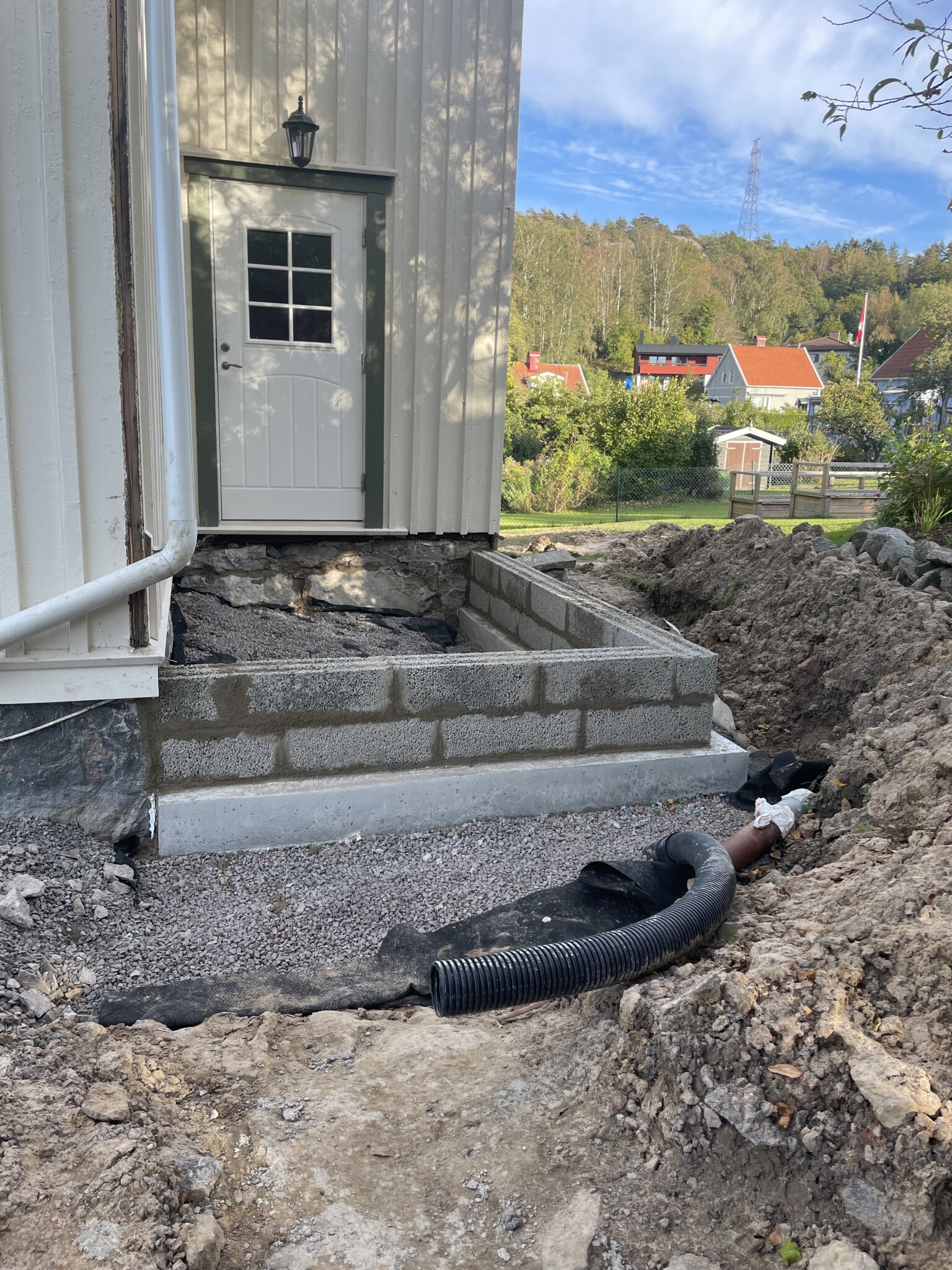
Click here to reply