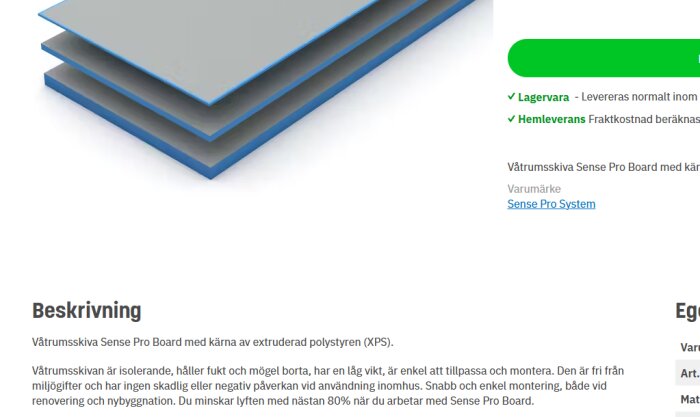
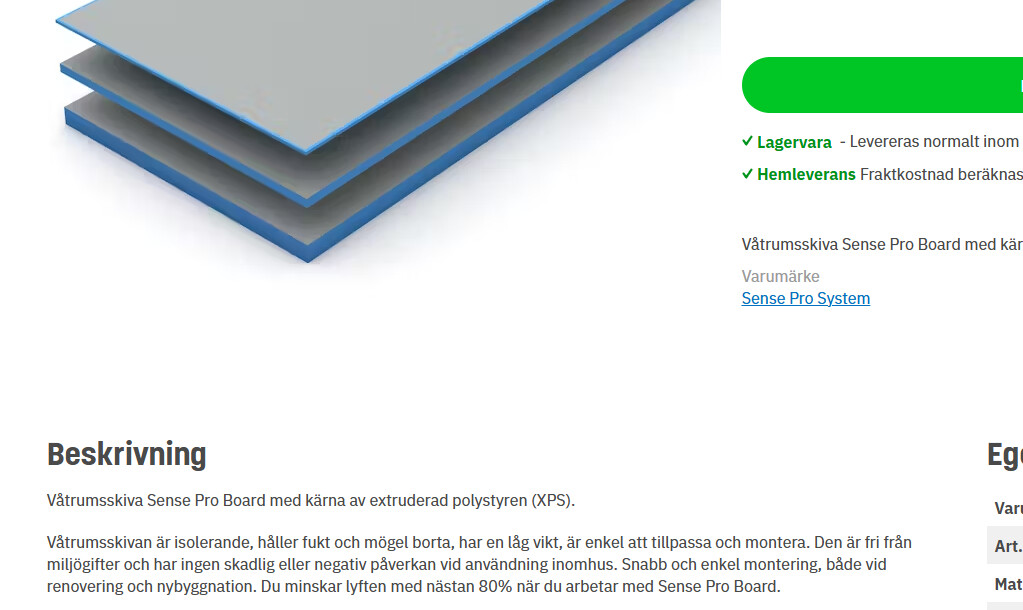
Does anyone have experience with such a board, and would it work to install it on the exterior wall (inside) in the basement, to provide a good surface for tiling? It seems like a superb choice compared to fiber cement board, moisture-resistant gypsum.
It is, after all, inorganic, slightly insulating, though the foundation outside is insulated after drainage.
According to the installation, it should be screwed directly to the wall with a dice-patterned adhesive that screws to the wall... or should one use metal studs after all? No risk of mold at the back compared to other materials if using metal studs... but it does build up a little... how would you have done it?
Doesn't it seem strange to have built-in moisture sensors in a layer that will be exposed to moisture without it being a problem?
It is meant to detect any moisture. Which you hopefully avoid. Helpful to avoid tearing down potential tiles that inspectors tend to do. Thinking more about the function of the board itself, versus steel studs/fiberboard. More moisture resistant after all
I have that record in my bathroom, just because it was free. But if you're going to have it against an exterior wall in a damp basement, you'll get elevated values if you want to measure.
I have that board in my bathroom, just because it was free. But if you are going to have it against an outer wall in a damp basement, you will get elevated values if you want to measure.
So it's better to tile directly against the outer wall without a board then
So it's better to lay tiles directly against the exterior wall without a board then
If the walls are good enough to tile onto, I wouldn't bother with installing boards. It all depends on your skill level. But you need to know what the underlying surface is first. Is it pure concrete or plaster? If it's, for example, a lime-based plaster, the adhesive might have too strong tensile strength, which can cause it to break.
If the walls are good enough to install tiles on, I wouldn't bother with putting up boards. It all depends on how skilled you are. But you should know what the surface is beforehand. Is it raw concrete or plaster? Because if it's, for example, a lime-based plaster, the adhesive is too strong in tension, and it can cause it to break.
Tiles have been on the wall for probably 20 years, which I have torn down and want to renew; it's a house from the fifties, so it's hollow concrete with plaster, I thought maybe using such boards could work to get a nice new surface but maybe I should reconsider.
There have been tiles on the wall for probably 20 years, which I have torn down and want to renew, it is a fifties house so it is hollow concrete that is plastered, I thought it might work with such boards to get a nice new surface but maybe I should reconsider
Absolutely, those boards would work, it would be optimal. But is it the leveling function you're aiming for? Because it will be affected in a damp basement. If you're good at plastering, it's more economical to plaster. But you'll never be able to compare the time. And if you're going to "modernize" the basement with something like rectified 60x60, you have quite strict requirements for the substrate, and then boards are perfect
Absolutely, such boards would work, it would be optimal. But is the reading function what you're after? Because it will fail in a damp basement. If you're skilled at plastering, it's more economical to plaster. But you'll never be able to compare the time. And if you're going to "modernize" the basement with, for example, rectified 60x60, you have pretty strict requirements on the substrate and then boards are perfect
I don't care about the reading function; I want material that won't get damaged by the environment in the basement, and that allows large, beautiful tiles to stay up without the risk of them falling due to possible plaster peeling.
So, what is the downside of screwing such boards onto the wall with dice pattern adhesive, as opposed to having steel studs and drywall as some suggest? In both cases, there's a form of air gap behind so the wall can breathe. The board is not susceptible to mold and moisture, which I think is good, plus you avoid the need for studs. After all, it's a basement, so moisture will occur no matter what I do in a bathroom in a basement environment...
I don't care about the readout function; I want materials that won't be damaged by the basement environment and that allow large, beautiful tiles to stay in place without the risk of them falling due to potential plaster detachment.
So, what is the downside of screwing up such boards on the wall with a grid pattern adhesive, compared to having steel studs and plasterboard as some suggest? In both cases, it will create a form of air gap behind so the wall can breathe. The board is impervious to mold and moisture, which I think is good, plus you avoid using studs. After all, it's a basement, so moisture is likely to appear no matter what I do in a bathroom in a basement environment.
You can absolutely screw it up, but it has hardly any load-bearing capacity; it is designed to be glued with mortar on the existing substrate, so I think you should skip the studs, an air gap is not needed. Why have an air gap when you're not using mechanical ventilation anyway; it's just unnecessary.
Click here to reply
Vi vill skicka notiser för ämnen du bevakar och händelser som berör dig.


BirgitS said: