
1,911 views ·
9 replies
2k views
9 replies
Moisture barrier solid herringbone parquet
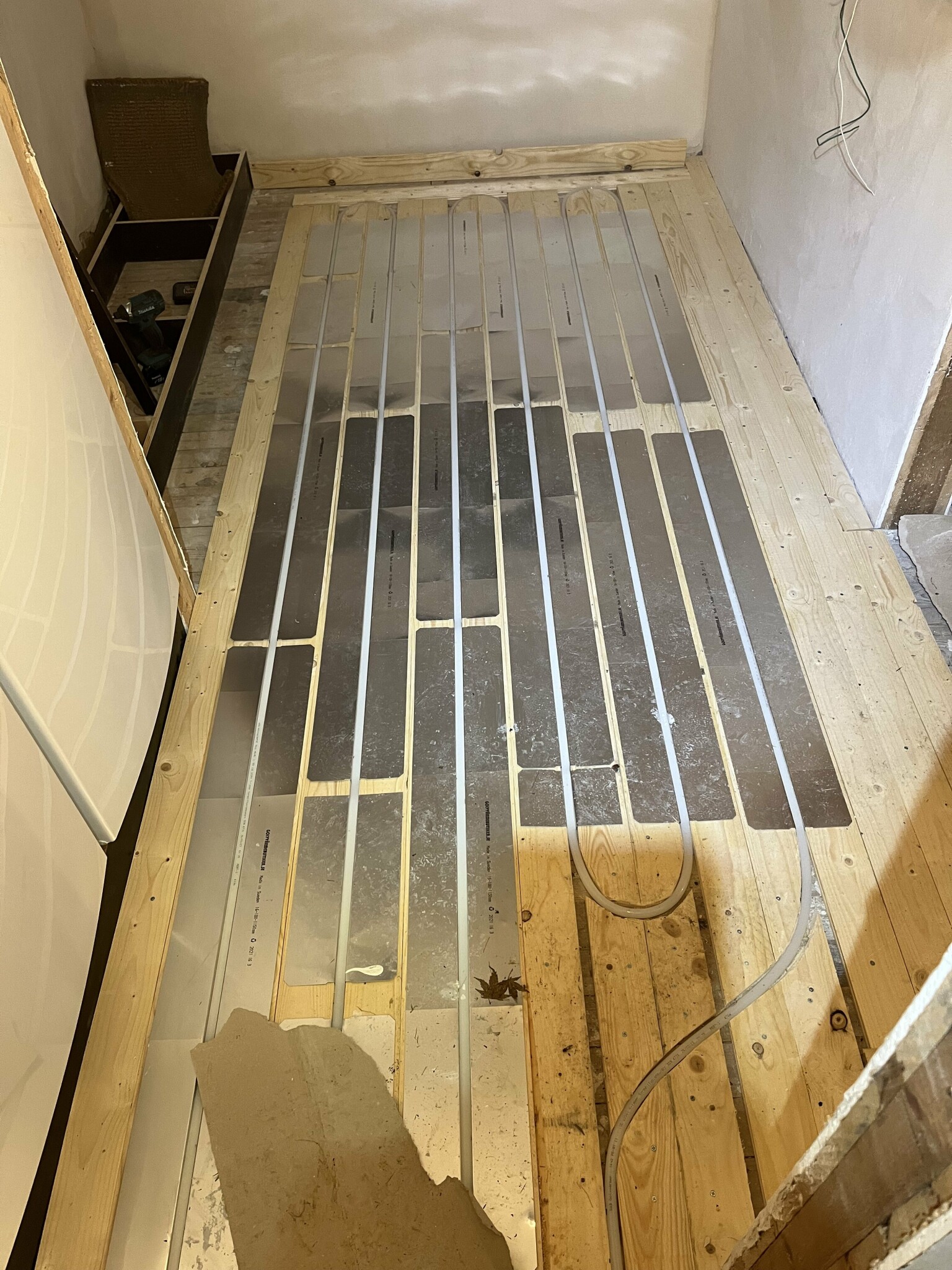
The following construction. Concrete floor consisting of 600mm U-shaped concrete elements, with insulation in each element, topped with wooden battens, 22mm slotted floor chipboard with hydronic underfloor heating, 12mm plywood, parquet adhesive, and 16mm solid herringbone parquet. This is the living floor of the house and below is a finished basement that has recently been drained.
I read in the GBR regulations that a moisture barrier is required for solid wood flooring above underfloor heating? Is it really necessary and should I place the barrier between the battens and the chipboard? That would mean I cannot glue the chipboard to the battens...
Thanks for your input.
I read in the GBR regulations that a moisture barrier is required for solid wood flooring above underfloor heating? Is it really necessary and should I place the barrier between the battens and the chipboard? That would mean I cannot glue the chipboard to the battens...
Thanks for your input.
The barrier should be placed on the underfloor heating before your 12mm plywood in your case. Never underneath...G goosen said:The following construction. Concrete floor consisting of 600mm U-shaped concrete elements, with insulation in each element, above it framed with wooden beams, 22mm notched chipboard with waterborne underfloor heating, 12mm plywood, parquet adhesive, and 16mm solid herringbone parquet. This is the living floor of the house and below there is a finished basement that has recently been drained.
I read in the GBR regulations that a moisture barrier is required for solid wood flooring above underfloor heating? Is it really necessary and should I place the barrier between the beams and the chipboard? That would mean I can't glue the chipboard to the beams...
Thanks for your inputs.
Yes, otherwise there is an imminent risk of swollen plywood and therefore a risk that the glue to the parquet will come loose and you will get a big damage...G goosen said:
Preferably a 0.2mm age-resistant foil between the underfloor heating and the plywood board...
Okay, thanks for the feedbackRejäl said:
Hi. We are in exactly the same situation. What we've heard from experienced parquet floor layers is that if you have underfloor heating, you need a moisture barrier under the plywood for the warranty to be valid. However, you can lay it yourself if you want at your own risk. Apparently, the problem is that the parquet has higher density, causing the glue to detach from the parquet. It's not the plywood that's the problem, but rather the connection between the glue and the parquet strip. This also applies to click parquet and all other types of flooring.
We had nailed parquet that laid without a moisture barrier for over 50 years (1950s house) without a problem. But now with underfloor heating, we haven't figured out how to lay a floor. Incorporating a moisture barrier is completely wrong, as the rest of the house is built without moisture barriers and brakes, and it's bone dry. If you think that underfloor heating generates moisture, which I don't quite understand how that would happen, then that moisture will migrate upwards and get trapped in the plastic under the plywood. And that's certainly where you don't want any moisture, right?
It can be added that our house is from 1950 and under the plank is very dry and nice, no plastic or brakes anywhere. The attic has about 20cm of wood shavings over the plank.
Crawl space
Cast concrete slab about 300mm
Joists with wood shavings about 200mm
Plank about 25mm
17mm floorboards with gaps for underfloor heating pipes
Pipes and plates
Tightly screwed thin plywood.
We had nailed parquet that laid without a moisture barrier for over 50 years (1950s house) without a problem. But now with underfloor heating, we haven't figured out how to lay a floor. Incorporating a moisture barrier is completely wrong, as the rest of the house is built without moisture barriers and brakes, and it's bone dry. If you think that underfloor heating generates moisture, which I don't quite understand how that would happen, then that moisture will migrate upwards and get trapped in the plastic under the plywood. And that's certainly where you don't want any moisture, right?
It can be added that our house is from 1950 and under the plank is very dry and nice, no plastic or brakes anywhere. The attic has about 20cm of wood shavings over the plank.
Crawl space
Cast concrete slab about 300mm
Joists with wood shavings about 200mm
Plank about 25mm
17mm floorboards with gaps for underfloor heating pipes
Pipes and plates
Tightly screwed thin plywood.
I also don't understand where the moisture would come from, I assume that when the underfloor heating is turned on and off, it can generate moisture. What kind of plywood are you thinking of screwing into the floorboard? Some claim that you must have birch plywood and that regular construction plywood doesn't have sufficiently good tensile strength in the outermost layer. Birch plywood is more expensive than the herringbone parquet...Biggle said:
Hello. We are in exactly the same situation. What we have heard from experienced parquet floor layers is that if you have underfloor heating, you must have a moisture barrier under the plywood for the warranty to be covered. However, you can lay it yourself if you want at your own risk. Apparently, the problem is that the parquet has higher density, and then the glue fails from the parquet. So, it's not the plywood that's the problem, but the junction between the glue and the parquet slat. This also applies to click parquet and all other types of flooring.
We had nailed parquet that was laid without a moisture barrier for over 50 years (1950s house) without problems. But now with underfloor heating, we haven't figured out how to lay a floor. Building in a moisture barrier is completely incorrect, as the rest of the house is built without moisture barriers and stops, and it's bone dry. If you think that the underfloor heating generates moisture, which I don't quite understand how it would work, then that moisture will rise upward and get trapped in the plastic under the plywood. And that's not where you want any moisture, right?
I can add that our house is from 1950 and under the raw boards it's very dry and nice, no plastic or stops anywhere. The attic has about 20cm of wood shavings over raw boards.
Crawl space
Pour concrete slab about 300mm
Joists with wood shavings about 200mm
Raw boards about 25mm
17mm planks with gaps for underfloor heating pipes
Pipes and plates
Thin plywood tightly screwed.
Foamed plastic over the pipes and the grooved chipboards. There will be condensation from the pipes, so the surface must be protected. Then I would not have chosen to glue the parquet. Regular parquet is laid directly on the foamed plastic. 12 mm plywood removes some of the heat. 12+16mm almost 3 cm that the heat has to rise through.G goosen said:The following construction. Concrete slab consisting of 600mm U-shaped concrete elements, with insulation in each element, then framed with wooden joists, 22mm grooved chipboard with waterborne underfloor heating, 12 mm plywood, parquet glue, and 16mm solid herringbone parquet. This is the residential floor in the house and below is a furnished basement that has recently been drained.
Reading in the GBR standards, you must have a moisture barrier with solid wood flooring above underfloor heating? Is it really necessary and should I place the barrier between the joists and the chipboard? That would mean I can't glue the chipboard to the joists...
Thanks for your inputs.
Last edited:
How can condensation occur? If you have a continuous temperature of around 25-27, then the surrounding metal and the plywood above are also about 27. Condensation requires temperature differences, right?
We tightly screwed regular 4 mm plywood. I've also heard that you should use Björk. But it was expensive enough with regular plyfa
We tightly screwed regular 4 mm plywood. I've also heard that you should use Björk. But it was expensive enough with regular plyfa
we skipped the subfloor boards, felt too sensitive to moisture when we don't have moisture barriers. And regular 17mm tongue-and-groove boards were much cheaper…H HEM2121 said:Plastic-covered foam over the pipes and the grooved subfloor boards. Condensation will form on the pipes so the surface must be protected. Also, I wouldn't choose to glue down parquet. Regular parquet is laid directly on the plastic-covered foam. 12 mm plywood takes away some of the heat. 12+16mm is almost 3 cm for the heat to pass through.
Of course, you can lay a floating click parquet, but if you want the option to work more with patterns etc., then solid wood is superior.
Click here to reply