

Hello I am in the process of renovating a room with a sauna and shower. This room is located in the basement, which is below ground level. The house was drained properly in 2005, with Platon matting and everything.
In a previous thread, I was advised to replace the floor drain, so I will do that. What I am considering is the moisture barrier, as I will be laying tiles on the entire floor (concrete floor). I intend to lay these tiles directly on the concrete. I have heard that you should not have a moisture barrier because it prevents the concrete from breathing.
To prevent any water from seeping into the timber-framed sauna wall, I am thinking about letting the tiles go up a decimeter on the wall: Behind this decimeter, I should have some moisture barrier, and also some other material on the outside of the wood. I've heard you should not apply a moisture barrier directly on organic material.
Then I am thinking about tiling the entire outer wall as well as the other two walls in the shower area. I plan to put fabric on the walls in the changing area. Then I assume I should have a moisture barrier on the two interior walls in the shower corner with the floor drain, but not on the outer wall to allow it to breathe.
My questions then are:
1/ Should a moisture barrier be applied to a concrete floor that is on the ground?
2/ Can you apply a moisture barrier to an organic material, if not, what should be used so you can put a tile trim at the bottom by the floor?
3/ Should a moisture barrier be applied to an outer concrete wall that has been recently drained on the outside?
4/ Should a moisture barrier be applied to the two interior concrete walls?
Thankful for all comments and answers
Micke
In a previous thread, I was advised to replace the floor drain, so I will do that. What I am considering is the moisture barrier, as I will be laying tiles on the entire floor (concrete floor). I intend to lay these tiles directly on the concrete. I have heard that you should not have a moisture barrier because it prevents the concrete from breathing.
To prevent any water from seeping into the timber-framed sauna wall, I am thinking about letting the tiles go up a decimeter on the wall: Behind this decimeter, I should have some moisture barrier, and also some other material on the outside of the wood. I've heard you should not apply a moisture barrier directly on organic material.
Then I am thinking about tiling the entire outer wall as well as the other two walls in the shower area. I plan to put fabric on the walls in the changing area. Then I assume I should have a moisture barrier on the two interior walls in the shower corner with the floor drain, but not on the outer wall to allow it to breathe.
My questions then are:
1/ Should a moisture barrier be applied to a concrete floor that is on the ground?
2/ Can you apply a moisture barrier to an organic material, if not, what should be used so you can put a tile trim at the bottom by the floor?
3/ Should a moisture barrier be applied to an outer concrete wall that has been recently drained on the outside?
4/ Should a moisture barrier be applied to the two interior concrete walls?
Thankful for all comments and answers
Micke
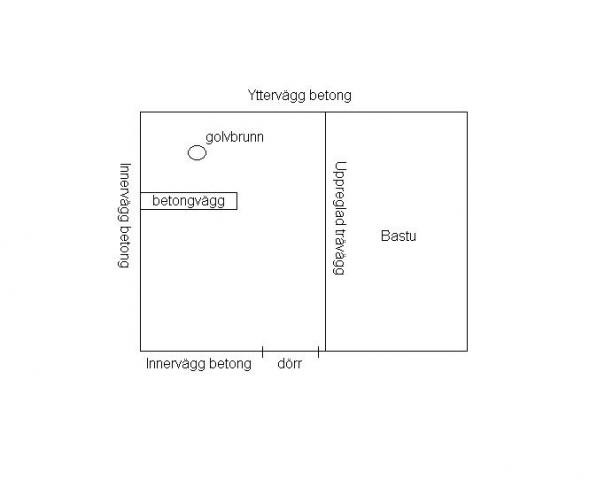
There you go, you bring it up here.
I can only tell you how I did it in my similar project.
Basement from 1951 but re-drained and exterior insulation in 2006.
Sealing layer in the shower corner about 1m2 on the floor (90*90 shower walls) and on walls, 1 exterior wall and a brick wall towards the sauna.
Otherwise, I have no sealing layer except on the new framed wall between the sauna and bathtub. No plastic in the sauna, just insulating the inner walls (and the ceiling), only air gap and panel on the exterior walls.
Two new floor drains, the one in the shower with clamp ring etc., but the one for the bathtub completely without sealing layer.
I can only tell you how I did it in my similar project.
Basement from 1951 but re-drained and exterior insulation in 2006.
Sealing layer in the shower corner about 1m2 on the floor (90*90 shower walls) and on walls, 1 exterior wall and a brick wall towards the sauna.
Otherwise, I have no sealing layer except on the new framed wall between the sauna and bathtub. No plastic in the sauna, just insulating the inner walls (and the ceiling), only air gap and panel on the exterior walls.
Two new floor drains, the one in the shower with clamp ring etc., but the one for the bathtub completely without sealing layer.

Isn't it possible that water could seep down and under the waterproof layer if you only do 1m2? I'm about to do the same thing soon.
Upon further reflection, I think I'll also take the opportunity to install a floor drain in the sauna from the one in the shower. Then I think I will have waterproofing on all the interior walls in the shower room and the floor in the shower. Otherwise, there will be no waterproofing at all. Except for a small strip out from the sauna's wall towards the shower.

A tip might be to install a floor drain in the shower with an inlet from the waste outlet (located above the water trap) and connect it to a waste outlet in the sauna. A waste outlet lacks a water trap.Micke78 said:
Then you won't have a water trap in the sauna that dries out and starts to smell if the sauna isn't used for a while.
what is a spygatt?
the sauna will be used fairly frequently, many pilsners have already been had there. now one is impatiently looking forward to it being finished, so more can be had.
Problem when working full-time and having a family, hard to find enough time.
the sauna will be used fairly frequently, many pilsners have already been had there. now one is impatiently looking forward to it being finished, so more can be had.
Problem when working full-time and having a family, hard to find enough time.
Click here to reply