Hello!
After an incident where the entrance to the living room was supposed to get an "open floor plan," the ceiling fell about 2cm and was hanging that way until I propped it up and reinforced it with a T-steel beam across the span, about 1.60m long.
It seems the ends of the beams rested on something I removed. No one needs to tell me how stupid I am for I already know
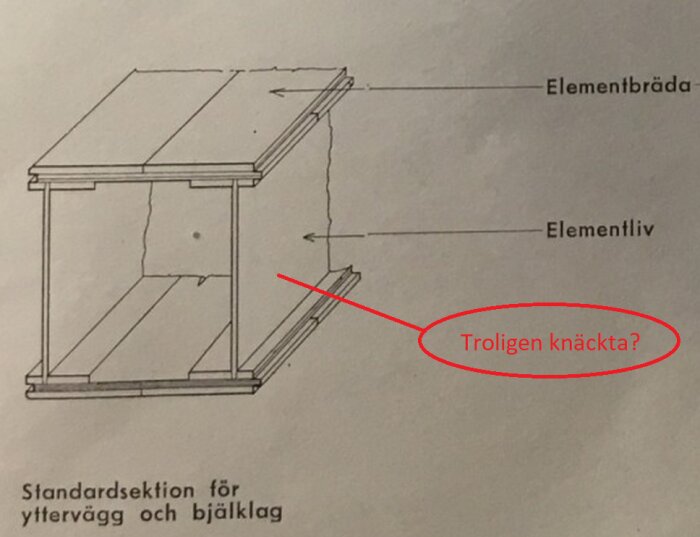
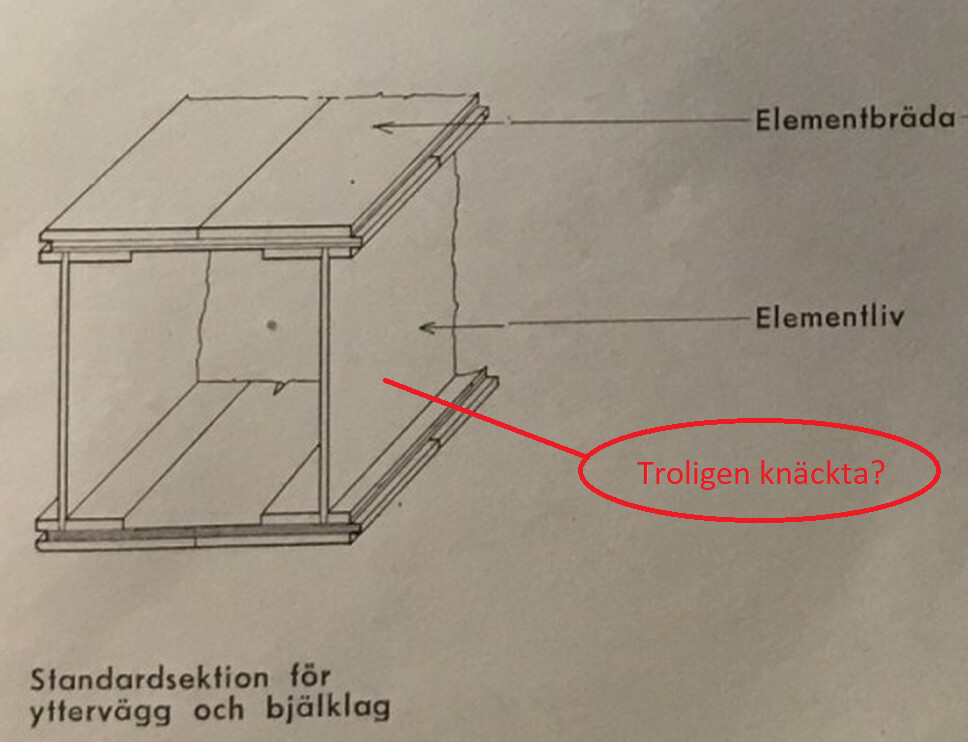
I have scoured threads here on the forum, and with proper terminology, my conclusion is that my "beam life" has collapsed as the distance between the ceiling/floor "beam board" is no longer the same.
This defect seems to extend about 1.50m lengthwise (I have not removed the click floor and checked yet) on as many beams as the beam is long. That is, 1.60 divided by 20cm, so 8 beams. The floor, of course, sags the most on the beams that are in the middle of the beam as they naturally hung down more than the others.
On the other side of the T-beam, beams were laid with the long sides, so nothing happened there.
The T-beam is now inserted from below at the joint between the short sides and the long side and carries both. The beam rests securely on joists at the ends.
My consideration is how to fix this, of course, without needing an entirely new floor structure, which is a "bit more extensive" job.
The first thing that comes to mind is laying plywood flooring on top of the beams and thereby pulling up the beam boards with screws/glue against the plywood. I can live with the floor being slightly higher in the room above.
Is it a dead end?
Another way would be if I could open up the beams from above with surgical incisions here and there and somehow insert blocks that restore the distance between the beam boards. But I have no good ideas on how that would be done - anyone?
You could say that if I knew how mysterious a construction I had, I might have kept the unopened floor plan...
They say you learn as long as you live. If nothing else, perhaps you can console yourself with playing the role of a cautionary example for future element house renovators. Anyway, it doesn't feel as if
There are generally two reasons why the floor might sag.
1. The elements themselves have collapsed in one way or another. This is the scenario you describe. What is called "elementliv" (element life) in your drawing is a 3 mm hardboard, and it can break (or in the case of water damage - the glue can give away).
2. The elements that were hanging in the air have settled. The elements (the elongated boxes) are tongued and grooved into each other, so even if the support at one end is removed, they can stay in place through the tongue and groove, but they will sag a bit.
Now, it's not entirely clear from your description - you say you have propped up the floor joist again and added a beam. Is the ceiling height in the living room back to original levels? Or were you unable to prop up the sagging floor joist as much as it had settled? The click floor (which I guess is on the upper floor) - does it bounce above where the joist had settled, or does it lie solid? Get back to me with more information (and preferably a drawing, if you have one), and I can come up with ideas for you.
Now, it's not entirely clear from your description - you say you've jacked up the floor joists again and installed a beam.
Yes, the transition between the living room and hall consists of two ceiling sections where the elements are perpendicular to each other, so what was sagging in the living room met with longitudinal elements in the hall. In the gap, there was a crack of about 1cm, so I cut a sturdy T-beam and inserted it into the gap upside down. This rests on the joists at the ends, so the ceiling looks good, straight, and no longer sags.
Is the ceiling height in the living room back to original levels?
Yes
Or were you unable to jack up the sagging floor joists as much as they had settled?
Yes, good now
The click flooring (which I assume is on the upper floor)
Yes
- does it spring above where the joists settled, or is it solid?
It springs, feels like there's a 1 cm gap between the click flooring and the real floor.
Now I understand a little better, also why you think the boxes might have collapsed. Nice solution with the T-beam, by the way.
Now that you've done pretty much what you can from underneath, the best way to proceed is of course to remove the click flooring and look at how it looks. It may require a minor intervention, or perhaps something bigger is needed.
If the element lives have cracked, they can be replaced with something else, but it requires some work. You need to saw open the elements (preferably one at a time, along the direction of the elements) and cut a stud to the right height, and then fiddle/hammer it in and screw it in place (I think the correct height is 160 mm). Then you need to close up the opening in the element again. Another alternative, as you suggest, is to screw plywood on top of the floor joist. Even if the top of the elements doesn't fully return to the original height, plywood + click flooring should still make the floor fairly firm.
Feel free to return with a picture or two when you've removed the floor, or if you have more questions.
Cutting it up is something I've been considering... seems like the best but most challenging option. I'll think about this for a while, but I'm leaning towards an extra floor layer, thinking that right where the problem is, I can have plywood for support, and it should be enough with two boards 2.40x1.20, and where it's still good, fill around with chips to the right level. 22mm maybe to be safe, it still feels like the simplest solution. Then glue and secure the floor properly to the plywood with screws. Some clever screw similar to molly plug in function would almost be needed, so you can fasten it properly, the tongues in the elements aren't particularly thick and might not provide a good grip for screws.
Suggestions for screws? Which glue, PU maybe??
I'm thinking, or rather worrying, if the tongues have slid out so there's nothing binding the elements together anymore and maybe even preventing them from being properly lifted up against the plywood. But that'll be noticeable...
One might think it would be enough to cut off the outermost 3-5 cm of the elements across the eight elements, and then replace with a beam cut to fit between the element boards. Then place a 20 mm board on top as a "surface layer."
But there are a thousand and one ways to solve problems like this. Start by removing the click floor so you can inspect properly, and we can brainstorm from there. I want to believe there are simpler ways than adding an extra layer of flooring in an entire room/on a whole floor.
Click here to reply
Vi vill skicka notiser för ämnen du bevakar och händelser som berör dig.