
37,147 views ·
12 replies
37k views
12 replies
Minimal roof overhang, pros/cons?
We're not discussing appearance or opinions about it, just functionality.
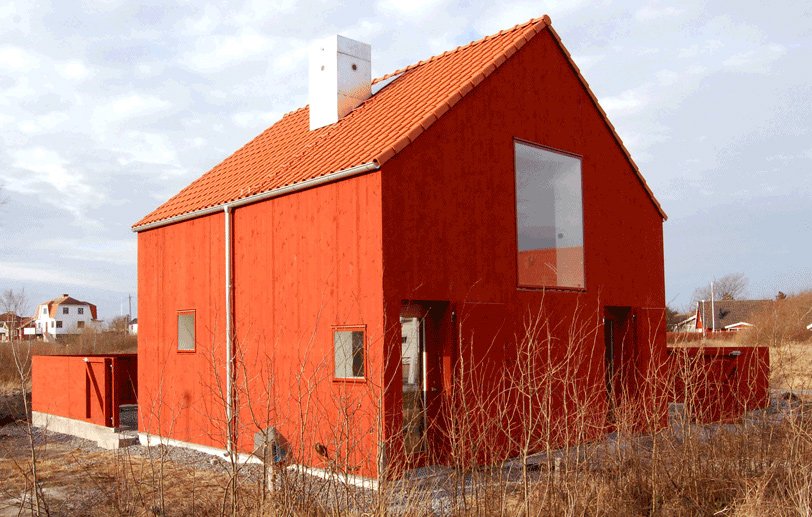
A bit curious about what disadvantages there are with a minimal roof overhang like the photo of the red house below?
Is it something that's a bit exaggerated, it's just a little extra roof that sticks out 50cm from the facade. It will still rain on the facade, the sun will still hit the facade. What's so fantastic about this little extra roof overhang? I have metal above the windows to protect them. My house is a single-story villa in the Stockholm area and not near water and is quite wind-protected.
What do you say?
An opinion.
More opinions
A bit curious about what disadvantages there are with a minimal roof overhang like the photo of the red house below?
Is it something that's a bit exaggerated, it's just a little extra roof that sticks out 50cm from the facade. It will still rain on the facade, the sun will still hit the facade. What's so fantastic about this little extra roof overhang? I have metal above the windows to protect them. My house is a single-story villa in the Stockholm area and not near water and is quite wind-protected.
What do you say?
An opinion.
Where did the roof overhang go? Here, the already sensitive facade becomes even more exposed to rain than if an adequate roof overhang were built. Windows and the details around the windows, which are so important for sealing, are not protected in the least.
Architecture, design, and savings on building materials (synonymous with costs) take precedence.
Houses have previously been constructed like this to some extent, with poor results. Now we're back to square one again.
Overall, we're talking about a real façade mess.
More opinions
In a windy and rainy climate like in the archipelago, you should have substantial roof overhangs to protect the facade. Prioritizing design doesn't seem very smart from a long-term perspective.
[bild] Anonym 12 October 2010 16:29
What a discussion! Roof overhangs are the most overrated thing out there. They don't protect at all, the rain blows onto the facade from the side, it doesn't rain straight down. You protect the facade a few centimeters at the top with a roof overhang, nothing more.
[bild] Anonym 13 October 2010 10:01
So different people can be. It's the absence of roof overhangs that appeals to me most with this house, along with the overall feeling when everything is in red.
[bild] Anonym 14 October 2010 21:39
Roof overhangs cost a lot of space when they become more than what's not included in the building area - would have loved to have a 1-meter roof overhang on our build but then the house becomes unattractive as the floor plan suffers instead
[bild] Anonym 15 October 2010 08:22
I think the house was very nice.
But perhaps a bit more roof overhang to protect the wall...
[bild] Anonym 15 October 2010 10:40
Walls dry best at the top after rain. If the roof overhang still causes water to hit the wall further down, (as happens if it happens to blow at the same time), nothing is gained. The coastal New England style in the USA traditionally has no or small roof overhangs.
Last edited:

Adequate eaves protect, for example, the overlying window trim so that rain cannot get behind them. You can also block unnecessarily harsh sunlight. That is, in the morning and evening when the sun is low, it can shine in, but in the middle of the day during summer when it is at its strongest, you can use the eaves as a fixed awning.

Advantages of minimal roof overhang, I can't think of any. A disadvantage mentioned earlier is protecting the facade (how much/little it contributes I have no idea about). Then, it must be a very special, architect-designed house for it to work without overhang. Otherwise, my personal opinion is that it looks terrible without. It looks bare and a bit silly. At least, that's what I think 
In the event that the gutter becomes clogged with ice, leaves, or other debris, there is a risk that rainwater will flow directly down the facade if there is no roof overhang, which can hardly be good...
Oops, just noticed the bold text about not commenting on appearance so ignore the last thing I wroteGoteborg said:Advantages of minimal roof overhang, can't think of any. Disadvantage as mentioned earlier is protecting the facade (how much/little it contributes I have no idea). Then it must be a very special, architect-designed house for it to work without overhang. Otherwise, my personal opinion is that it looks terrible without it. Looks bare and a bit silly. Just my opinion anyway

I have seen some areas where they built a number of dozens of identical small houses with minimal roof overhangs a few years ago, and it's quite easy to see which ones have extended the roof overhang afterward, and which ones have replaced the siding on the house, and it is so common that it must be because the function has been too poor (that is, the facade needs to be replaced because it has been damaged too severely).
It must be a considerable amount of rain that falls in a year that falls down at a few degrees angle, this effectively protects a facade against it with a roof overhang. However, as mentioned, during a storm it doesn't matter.

Advantages.
* Less material is needed, such as roof tiles/sheet metal and others.
* The architectural expression (if desired for the building in question).
(And houses with a high eave, not a complete story, where a wall window and a roof window are aligned just above the wall-roof angle would probably look significantly better)
* On the margin, a minimal eave may be a slightly lesser obstacle for vertical convection-driven air flow along the wall side, but this effect should not be overestimated.
* More of the roof construction is heated by the house, but I have never heard of general moisture/mold/rot problems in our protruding eaves, so it probably doesn't matter.
* If you plan to make a roof with exterior insulation on rough sheathing, it may be advantageous not to have an eave to consider structurally and aesthetically.
Disadvantages.
* No eave to protect the facade and facade details partially during rain.
For example, windows on the long side of single-story houses have pretty good protection from a half-meter eave; rain generally does not reach the connection to the facade at the top, and it typically does not rain frequently or heavily on the window itself.
* It is better to have a long distance between ground/facade considering splashing water.
* Falling snow has a greater tendency to form a snow heap against the facade.
* Falling snow and ice have a slightly higher chance of damaging windows, facade, window sills, etc.
(depends a lot on the roof slope as well)
* Does not look good if one is a traditionalist or building a traditional Swedish wooden house.
These were a few things I thought of in haste.
I would argue that the differences are not so significant that they need to be considered.
Simply build the house with the desired appearance.
If one is absolutely without opinion on appearance, choose an eave of 30-50 cm.
* Less material is needed, such as roof tiles/sheet metal and others.
* The architectural expression (if desired for the building in question).
(And houses with a high eave, not a complete story, where a wall window and a roof window are aligned just above the wall-roof angle would probably look significantly better)
* On the margin, a minimal eave may be a slightly lesser obstacle for vertical convection-driven air flow along the wall side, but this effect should not be overestimated.
* More of the roof construction is heated by the house, but I have never heard of general moisture/mold/rot problems in our protruding eaves, so it probably doesn't matter.
* If you plan to make a roof with exterior insulation on rough sheathing, it may be advantageous not to have an eave to consider structurally and aesthetically.
Disadvantages.
* No eave to protect the facade and facade details partially during rain.
For example, windows on the long side of single-story houses have pretty good protection from a half-meter eave; rain generally does not reach the connection to the facade at the top, and it typically does not rain frequently or heavily on the window itself.
* It is better to have a long distance between ground/facade considering splashing water.
* Falling snow has a greater tendency to form a snow heap against the facade.
* Falling snow and ice have a slightly higher chance of damaging windows, facade, window sills, etc.
(depends a lot on the roof slope as well)
* Does not look good if one is a traditionalist or building a traditional Swedish wooden house.
These were a few things I thought of in haste.
I would argue that the differences are not so significant that they need to be considered.
Simply build the house with the desired appearance.
If one is absolutely without opinion on appearance, choose an eave of 30-50 cm.


If we talk about reducing to about 30cm roof overhang for a slightly more discreet appearance, the difference compared to 50cm must be marginal in function?
Has anyone seen examples where there is a minimal roof overhang and no fascia board used at all? Or maybe about 20-30cm roof overhang without fascia board and visible rafters?
Is being without the fascia board a construction problem, i.e., are you removing something that has a good function?
Has anyone seen examples where there is a minimal roof overhang and no fascia board used at all? Or maybe about 20-30cm roof overhang without fascia board and visible rafters?
Is being without the fascia board a construction problem, i.e., are you removing something that has a good function?
In Sotenäs municipality, in the old wind-swept fishing communities by the sea, the roof overhang is around 20 cm.Suhagg said:
We're not talking about appearance and opinions but only functionality.
A bit curious about what disadvantages there are with a minimal roof overhang like the image of the red house below?
Is it something that's a bit exaggerated? It's just a bit of extra roof extending 50cm from the facade. It will still rain on the facade, the sun will still shine on the facade. What's so fantastic about this little extra roof extension?
I do have metal above all windows to protect them.
My house is a single-story villa in the Stockholm area, not near water, and is quite sheltered from the wind.
What do you say?
An opinion.
[bild]
[bild]
[bild]
More opinions
So your thesis doesn't hold.

Diversearbetare
· Göteborg
· 11 183 posts
It's because the houses shouldn't bump into each other. There's simply no more space between the houses on the crown islets. 🤓😉E Erik Salhammar said:
I would say that in Bohuslän, there are completely normal roof overhangs.
...so your observation doesn't hold
Click here to reply