
17,925 views ·
33 replies
18k views
33 replies
mathiss - has anyone tried and has experiences
The problem with bypassing security features like door switches is that when, for example, the grandchildren are playing, it can hurt quite a bit! Measuring the current for control will probably be an expensive affair. Limit switches allow for building cheaply with, for example, some door switches* that cut the phase when you open the door, and one at the bottom of the lift that cuts when the lift reaches the same position at the top. This is how simple lifts and lift tables typically function. Pinch protection becomes redundant with a door with a switch. *the same type used to turn on the light when you open the refrigerator or wardrobe.

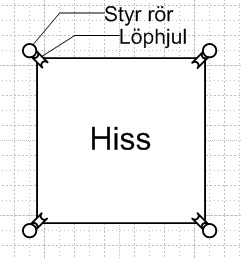
Have drawn a little sketch of the control, very simplified of course... It's important that the distance between the pipes is equal, otherwise the elevator will derail, and as someone mentioned, a large motor is not needed if you use counterweight balancing, the counterweight should then weigh as much as the entire elevator. The load to be moved in that case is "only" what you put in the elevator. Safety, as also mentioned, is important, with safety switches on the doors to the shaft, limit switches, etc... Definitely feasible, but a bit more complicated

//Jante
Thanks for all the feedback, it gives energy to complete the elevator project. Why should one die curious? Now it's time to build an "elevator box," but it might be best to find the components first so that we can size it correctly. To facilitate the project, it seems like a good idea to buy a ceiling winch despite the cost. It is, after all, a proven solution. Then it's about finding components for the "control" like Jante's suggestion. If I can solve these difficulties, maybe the electrician will become interested again. I've given up hope on the carpenter. I gladly welcome further opinions and suggestions.ps
I contacted the ceiling winch company and they said the winch was well-suited for the task. It stops automatically when it reaches the top (sensors) and can be programmed for how far it should go down. Moreover, I would be able to buy a returned new unit for a cheaper price. Looks like it will be an interesting autumn. Imagine sending up mulled wine to the living room for Christmas.
One of the problems (biggest?) will probably be getting the pipes that the wheels will run against into the shaft, as it was already built, right? Maybe wires can be used instead, tightly tensioned? Or you could have wheels that go against the walls, maybe that could work. An additional problem arises if there are safety switches on the doors and someone forgets to close the door on "the other" floor, then you have to run and close the door before you can operate the elevator This can of course be solved by ensuring the doors can’t be opened when the elevator isn't there, but that involves some mechanical locks, or via some wire mechanism that can remotely close the doors on "the other" floor. Finally, if a counterweight is to be used, it should perhaps run in its own shaft, again, wasn't yours already built?
So, my suggestion would be:
Buy the winch you linked to, with an extra remote control. Mount the winch at the top of the shaft and attach a remote control at each door. Program it to not go too far down. Build a "box" with wheels both at the top and bottom on all four sides. It's important that it fits perfectly in the shaft. Add "some mechanical lock" to the box, so the doors can't be opened when the box isn't there. Forget about a counterweight, guide pipes, and guide wires.
/ Fredrik
This can of course be solved by ensuring the doors can’t be opened when the elevator isn't there, but that involves some mechanical locks, or via some wire mechanism that can remotely close the doors on "the other" floor. Finally, if a counterweight is to be used, it should perhaps run in its own shaft, again, wasn't yours already built?So, my suggestion would be:
Buy the winch you linked to, with an extra remote control. Mount the winch at the top of the shaft and attach a remote control at each door. Program it to not go too far down. Build a "box" with wheels both at the top and bottom on all four sides. It's important that it fits perfectly in the shaft. Add "some mechanical lock" to the box, so the doors can't be opened when the box isn't there. Forget about a counterweight, guide pipes, and guide wires.
/ Fredrik
The simpler the betterTornhill 2 said:So, my suggestion is:
Buy the winch you linked to, with an extra remote control. Mount the winch at the top of the shaft and stick a remote control by each door. Program it so it doesn't go too far down.
Build a "box", with wheels both at the top and bottom, on all four sides. It's important that it fits perfectly in the shaft. Fix "some mechanical lock" on the box so that the doors can't be opened when the box isn't there.
Forget about counterweight, guide pipe, and guide wires.
/ Fredrik
, if it's possible to guide the elevator in the existing shaft, that's of course the simplest solution !!!//Jante
Thanks for the advice and actions. It seems to only get easier and easier (at least in theory) Yes, I'll have to build a suitable box and find suitable wheels, though in reverse order. Open to tips on suitable wheels so I can celebrate (h)jul with a dumbwaiter.
Maybe something like http://www.clasohlson.com/se/Ottomanrulle/Pr309741000?
16 pieces, one "top left", one "bottom left", one "top right" and one "bottom right", on each side.
It should be important that the box fits in the shaft with as small a margin as possible. Reduces the risk of it tilting and getting stuck.
/ Fredrik
16 pieces, one "top left", one "bottom left", one "top right" and one "bottom right", on each side.
It should be important that the box fits in the shaft with as small a margin as possible. Reduces the risk of it tilting and getting stuck.
/ Fredrik

Just don't make it too tight, if you have wheels on all edges as Tornhill2 suggests, it will take a lot for it to get stuck. Depending on how you make the elevator cage, it might need a weight for you to achieve the smoothest movement possible.
Thanks for the tips, but in light of your suggestions, I've found an immediate problem. The shaft down in the kitchen has a regular cabinet door. This is where the dumbwaiter is supposed to be loaded. The problem is that when you open the cabinet door, it's completely open and there's nothing to hold the wheels. In other words, there's only a shaft wall on three sides. The cabinet door is on the outside of the shaft and cannot be used as a stopper. I hope you understand. I'll have to think more about this. Possibly the wheels need to go into a track that somehow "locks" the wheels in place when the lift box is down in the kitchen. However, it works with wheels on all sides on the upper floor since the shaft there is designed with sides on all sides.

Yes, those were simple solutions, thanks for that. I'll head home and see which solution is the easiest. The first cold of the fall is on its way. So it seems I'll have a day to think about the continuation between coughing fits. But more ideas are gratefully received. I'll try to document the project and post on this thread once I get started. I just received an email that the roof winch can be delivered in three weeks. It fits well in time, so by October I should be able to get started.

It doesn't have to be rollers. Sliding guides are also common on real elevators. In fact, there are usually only two guides instead of four. On old elevators, the guides can sometimes be made of wood, so they could probably be for you too. What are the measurements of the shaft?
Erik
Erik
Might take some flak when you read my post here.
I think you're all overcomplicating things and have been influenced by the "Overprotection Agency."
A long smooth board on each side of the shaft. Against that board sits the box with some simple rubber wheels and steering. It can be quite loose. A block in the ceiling and an ordinary rope that goes from the top of the box, around the block, and to a counterweight. Another rope hangs from the bottom of the box to be able to pull the box down from the ground floor.
Safety is simple. On the ground floor, it stops with a board, the box can't go further down. Upstairs, if the counterweight isn't enough, you can slide in a latch, a strip that holds it all. If you're satisfied with that function, you can skip the counterweight! (Of course, you must remove the latch when the elevator is supposed to go down.) The holes in the walls are covered with a regular door. If a kid opens it, they'll get told off; otherwise, you can put a lock on it when the grandkids come. A simple, cheap lock like the ones for kitchen cabinets for 40:- works just fine.
That's it.
I've seen plenty of such simple elevators as a child.
Don't make it more complicated than it needs to be.
I think you're all overcomplicating things and have been influenced by the "Overprotection Agency."
A long smooth board on each side of the shaft. Against that board sits the box with some simple rubber wheels and steering. It can be quite loose. A block in the ceiling and an ordinary rope that goes from the top of the box, around the block, and to a counterweight. Another rope hangs from the bottom of the box to be able to pull the box down from the ground floor.
Safety is simple. On the ground floor, it stops with a board, the box can't go further down. Upstairs, if the counterweight isn't enough, you can slide in a latch, a strip that holds it all. If you're satisfied with that function, you can skip the counterweight! (Of course, you must remove the latch when the elevator is supposed to go down.) The holes in the walls are covered with a regular door. If a kid opens it, they'll get told off; otherwise, you can put a lock on it when the grandkids come. A simple, cheap lock like the ones for kitchen cabinets for 40:- works just fine.
That's it.
I've seen plenty of such simple elevators as a child.
Don't make it more complicated than it needs to be.