
2,029 views ·
14 replies
2k views
14 replies
Make a room out of the basement storage
In the basement, there is a room that will now have three walls fixed + floor.
What should we put on the walls - metal or wooden studs? The same question for the floor, wood or metal and preferably why.
We are getting different advice from those around us, and since this is our first attempt at fixing the house, it's hard to say yes/no to the family.
Plasterboard on the walls - yes or no?
Paint or wallpaper on the walls?
We are planning to install click flooring, but is there anything I should consider?
Since we have a very warm house, we've almost decided not to put anything between the wall and the panels for insulation and heating the room. Is this good or not so good considering the risk of mold?
Hoping for several responses and that everyone agrees with each other so it becomes easy for us.
What should we put on the walls - metal or wooden studs? The same question for the floor, wood or metal and preferably why.
We are getting different advice from those around us, and since this is our first attempt at fixing the house, it's hard to say yes/no to the family.
Plasterboard on the walls - yes or no?
Paint or wallpaper on the walls?
We are planning to install click flooring, but is there anything I should consider?
Since we have a very warm house, we've almost decided not to put anything between the wall and the panels for insulation and heating the room. Is this good or not so good considering the risk of mold?
Hoping for several responses and that everyone agrees with each other
so it becomes easy for us.
Hi, no our basement is not damp. Drained 15+ years ago.MaZtoR said:
Outside the basement storage, the previous owners have already made a room with tiles on the floor. The disadvantage of that room is that it's very cold on the floor but that's the only problem we have there.

Studs and boards in the basement = moisture and mold, i.e., ABSOLUTELY NO STUDS AND BOARDS!!
On the floor, only something that can withstand being constantly a bit damp, i.e., tiles or similar.
On the floor, only something that can withstand being constantly a bit damp, i.e., tiles or similar.
Okay, what should one do instead?Fotografen said:
What about a click floor with a wood core on the floor?

You cannot lay wooden flooring on concrete, it's like asking for trouble. At least not without insulation, underfloor heating etc.
Hello MariaMinas,
I don't think you've chosen the simplest project to start with; you're likely to get as many different answers as there are people you ask. All basement rooms that have molded in cellars are the result of what happens when you let moisture from the basement walls condense in a layer of insulation without proper ventilation. This is also what Fotografen and others are saying in their responses.
BUT, it doesn't have to be a problem in every case, as it depends on the amount of moisture coming through the wall/floor and how well you have managed to ventilate the space between the slab/wall and the inner walls. Our basement room has survived since the 1960s, for example. We have also insulated the basement walls on the outside (isodrän), which also helps.
Sometimes it's truly the case that you want to try making a room even if it won't be the technically best construction. If you want to try even though it won't be "foolproof," I would focus on ventilating the space between the inner wall and the basement wall as well as possible, and ventilate between the floor and the concrete slab. There are systems for this, e.g.:
http://www.nivellsystem.se/sv/
I would also bring in an experienced inspector with a moisture meter to get some data before you start building. With a skilled inspector, you can also get some advice before renovations. If you choose a system like Nivell, you should, of course, also ask for their assistance. Lastly, I would ensure to measure the moisture in the space between the new wall and the basement wall after a year or so to see that it works as intended.
Best, Daniel
I don't think you've chosen the simplest project to start with; you're likely to get as many different answers as there are people you ask. All basement rooms that have molded in cellars are the result of what happens when you let moisture from the basement walls condense in a layer of insulation without proper ventilation. This is also what Fotografen and others are saying in their responses.
BUT, it doesn't have to be a problem in every case, as it depends on the amount of moisture coming through the wall/floor and how well you have managed to ventilate the space between the slab/wall and the inner walls. Our basement room has survived since the 1960s, for example. We have also insulated the basement walls on the outside (isodrän), which also helps.
Sometimes it's truly the case that you want to try making a room even if it won't be the technically best construction. If you want to try even though it won't be "foolproof," I would focus on ventilating the space between the inner wall and the basement wall as well as possible, and ventilate between the floor and the concrete slab. There are systems for this, e.g.:
http://www.nivellsystem.se/sv/
I would also bring in an experienced inspector with a moisture meter to get some data before you start building. With a skilled inspector, you can also get some advice before renovations. If you choose a system like Nivell, you should, of course, also ask for their assistance. Lastly, I would ensure to measure the moisture in the space between the new wall and the basement wall after a year or so to see that it works as intended.
Best, Daniel
I thought underfloor heating was a big no-no in basements(?)ThomasLindgren said:
I'm getting half crazy soon. There are different opinions everywhere you turn.
How would you do it? It's a small room with a high window. Low ceiling. Painted white ceiling and blue walls. The floor is painted blue. The part of the room that shouldn't be "fixed" is a wall with sliding doors. Underneath there's a floor drain. On the wall, there's a vent without a cold air shield, which the previous owner had stuffed with a disgusting, grimy thing that made all the allergy sufferers in the house react. Once it was gone, no one has breathing problems down there. I've planned to install a Pax fan there.
I thought we would put up studs on the walls, add panels, plaster, and wallpaper/paint. But that's apparently not good?
We would, of course, prefer to expand, but the price difference is enormous, so that will have to wait until the right lottery ticket is bought
d_nilsson
Thanks for the response! I have copied the text and emailed it to my husband so he can read through it as well.
Yeah, it wasn't really intended to make a room, but the situation with two older children sharing a room has become a complete disaster. Taking the opportunity to replace the kitchen at the same time. I don't want to be off during the summer :-D
Thanks for the response! I have copied the text and emailed it to my husband so he can read through it as well.
Yeah, it wasn't really intended to make a room, but the situation with two older children sharing a room has become a complete disaster. Taking the opportunity to replace the kitchen at the same time. I don't want to be off during the summer :-D
Regarding waterborne underfloor heating in basements, there are two different ways to do it. One involves simply grooving the existing concrete slab and laying down some heating pipes in these grooves. This will give a warm floor, but a large part of the heat will travel down under the house, and if you let this happen, there may be moisture problems if you want to turn off the heating on this floor later. I wouldn't recommend this, but I know some who have done it.
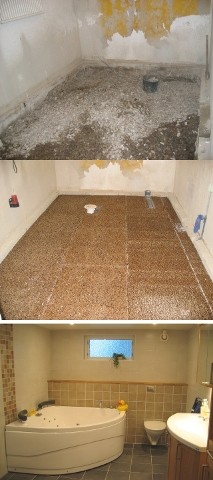
The other method involves insulating under the concrete slab, just like in a new house. This is what we did in our bathroom, and I wouldn't directly recommend anyone to take this on either It's a lot of work, breaking up the existing floor, insulating, reinforcing, and pouring a new slab. But a cold tiled floor in our new bathroom was simply not an option... So it is possible to do it right, attaching a photo series.
Then there are intermediate solutions as well, insulating on top of the concrete, etc.
The other method involves insulating under the concrete slab, just like in a new house. This is what we did in our bathroom, and I wouldn't directly recommend anyone to take this on either
It's a lot of work, breaking up the existing floor, insulating, reinforcing, and pouring a new slab. But a cold tiled floor in our new bathroom was simply not an option... So it is possible to do it right, attaching a photo series.Then there are intermediate solutions as well, insulating on top of the concrete, etc.
We had the same problem with the teenagers. We did it in the basement because we see it as a "temporary" room. We painted the walls, laid a platon mat (which is used for drainage) on the floor, and on top of that, a click floor. We put small pieces of wood behind the baseboards so they are about 0.5 cm from the wall (top section, tight against the floor).
So far it has worked well, no smell, no condensation on the windows, etc. In a year or two, we will tear everything out because we haven't planned to have a room in the basement.
So far it has worked well, no smell, no condensation on the windows, etc. In a year or two, we will tear everything out because we haven't planned to have a room in the basement.
What kind of walls do you have if you just painted them? I've been thinking about skipping building walls and just washing and painting them anew in fresher colors, but the walls are very "rispiga."mirakelasta said:We had the same problem with the teenagers. We did the same in the basement because we see it as a "temporary" room. We painted the walls, laid platonmatta (which is used for drainage) on the floor, and on top of that a click flooring. We put small wooden pieces behind the baseboards so they are about 0.5 cm from the wall (the top part, close to the floor).
So far it has worked well, no smell, no condensation on the windows, etc. In a year or two, we will tear out everything since we don't intend to have a room in the basement.
Which click flooring did you choose? (just curious here)
d_nilsson, What a nice bathroom you got there. But it seems like an incredible amount of work.
We will also close off the v-rummet and fix another room on the entrance floor, so the one in the basement is just for a year or so.
Well, now we have started clearing out the room and it's not the most fun! Oh, the stuff you accumulate after ten years together! I've looked more at the walls. Nicely painted in blue on, yes, is it concrete. It will probably turn out well.
Writing here again.
I spoke with a guy at a local hardware store, and he said something like this.
Lay Platon mat, sound insulation, and the floor. Make sure it's airy against the walls and buy special baseboards or small spacers.
If the floor is uneven, we can use lumppapp to level it out.
So this means we don't need studs. (?)
It also sounded like it doesn't really matter what kind of floor you lay. Can that be true?
We have found laminate flooring from 59:- and floating floors from 249:- (Pergo flooring)
Of course, a cheaper floor is more appealing than a more expensive one, but I don't want to make a bad purchase. What do you all think in here?
I spoke with a guy at a local hardware store, and he said something like this.
Lay Platon mat, sound insulation, and the floor. Make sure it's airy against the walls and buy special baseboards or small spacers.
If the floor is uneven, we can use lumppapp to level it out.
So this means we don't need studs. (?)
It also sounded like it doesn't really matter what kind of floor you lay. Can that be true?
We have found laminate flooring from 59:- and floating floors from 249:- (Pergo flooring)
Of course, a cheaper floor is more appealing than a more expensive one, but I don't want to make a bad purchase. What do you all think in here?
Hi,
The solution proposed is the one that mirakelasta has used, so it is at least documented that it works in some cases. I tried this myself on a house I owned in the USA for a short time but didn't live there long enough to evaluate it. It's so difficult to advise, though, when you don't know how damp your floor is and what air exchange you can expect to get. Therefore, my continued advice is probably to do a moisture measurement first and at least check the price of a system like nivell. Children are going to live there, mold is not very healthy... I understand that the cost of a nivell system might be high, but I would have checked this first. The advantage there is that you secure air exchange with warm air under the floor; warm air can transport moisture, which cold air cannot do as well.
Platon+Soundproofing+Laminate flooring will probably become very cold in Norrbotten in the winter. Maybe worth considering.
/Daniel
The solution proposed is the one that mirakelasta has used, so it is at least documented that it works in some cases. I tried this myself on a house I owned in the USA for a short time but didn't live there long enough to evaluate it. It's so difficult to advise, though, when you don't know how damp your floor is and what air exchange you can expect to get. Therefore, my continued advice is probably to do a moisture measurement first and at least check the price of a system like nivell. Children are going to live there, mold is not very healthy... I understand that the cost of a nivell system might be high, but I would have checked this first. The advantage there is that you secure air exchange with warm air under the floor; warm air can transport moisture, which cold air cannot do as well.
Platon+Soundproofing+Laminate flooring will probably become very cold in Norrbotten in the winter. Maybe worth considering.
/Daniel
Click here to reply