When I see the calculations above, it seems like 240 for the beams are using 45x220, and then I plane them down to 200 with plenty of margin. Should I add any reinforcement from below, like in the crawl space, for example? I did it under the living room, which I thought was a bit shaky, and it turned out great.
Yes, it's no small job. Difficult to plane along edges/walls and then get the studs completely even. It takes a bit of fiddling. Regarding the utilization rate, I'm a bit unsure, but there are some good threads on the forum. It shows how well it is dimensioned. The closer to 0%, the more over-dimensioned, and the closer to 100%, the more well-dimensioned.
No, exactly, it's common in housing projects to lower the bathroom studs to e.g., 45x195 instead of the remaining floor joists 45x220 to meet threshold levels for handicap requirements.
If you want to further strengthen the floor, you can screw steel strapping across the studs on the underside or, for example, 28x70 to stiffen it up.
the big job is still to dismantle everything, then lower and rebuild again. Don't want any extra threshold at 15 there since it was previously level with the hallway.
Very difficult to estimate. It completely depends on the resources one has. With the right machinery and good, experienced craftsmen, it certainly makes things easier.
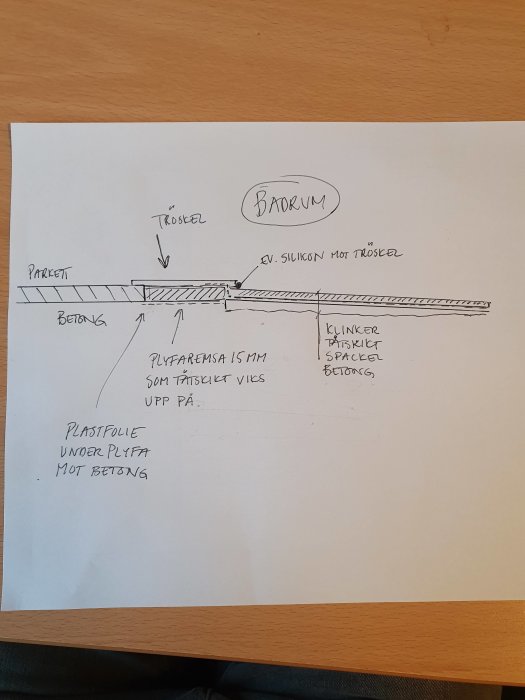
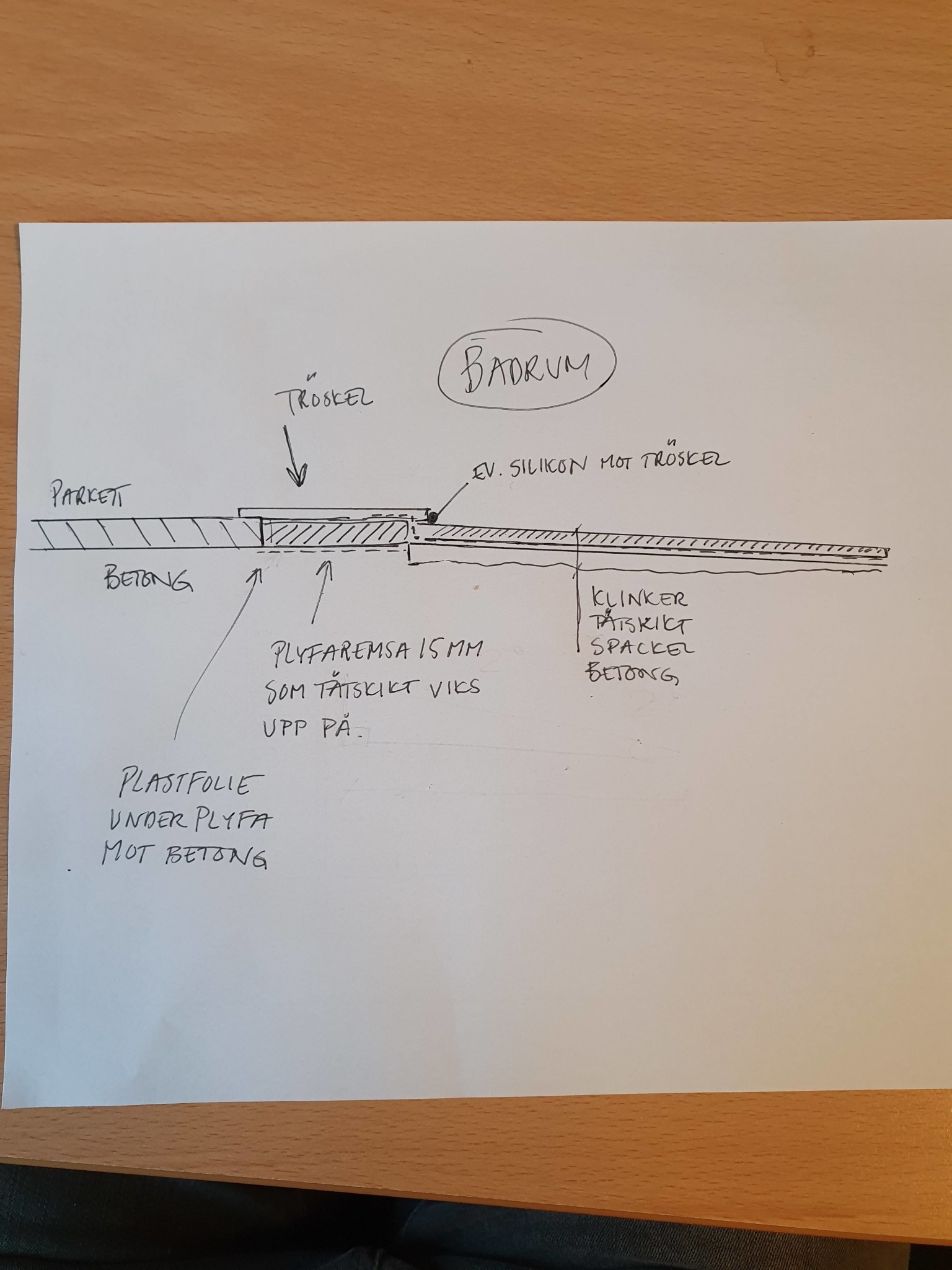
Attaching a sketch to help. It currently applies to slab on grade, but the procedure is roughly the same with träbjälklag. However, it doesn't hurt to have a slightly higher threshold with an upturn in case there is water accumulation in the future.
Thank you, it looks good just the way I want it. Now, the tile is 15 above the parquet, and it's irritating and moreover, my wife trips over the unnecessarily high threshold. Is there any disability requirement on maximum threshold height?
Actually got hold of my old carpenter, very knowledgeable, 30+ in the industry - he mentioned that it is also possible to mill out the flooring chipboard into the joist and then cast and reinforce directly on it - if I understood correctly, it would then be level with the parquet and you wouldn't need to plane and fine sand - has anyone tried this method? The filler is directly on the beams then - is there any difference in load-bearing capacity/rigidity?
The short answer is yes, there will be a difference in the rigidity and bearing capacity of the floor joist and chipboard. However, your span and spacing are small, so overall it probably won't matter.
I actually got in touch with my old carpenter, very knowledgeable, 30+ in the industry - he mentioned that it is also possible to mill into the floor chipboard down to the joists and then cast and reinforce directly on it - if I understood correctly, it then levels with the parquet and you don't need to plane and finish - has anyone tried that method? The filler is directly on the beams then - does it make a difference in load-bearing/capacity?
Does he mean that the floor chipboard is placed between the joists so that it aligns with the top edge and then "saves" 22 mm? Can't answer that, but it feels like you lose the whole point of screwing the chipboard to the joists to make it stiff.
Thanks, sounds reasonable, a bit too simple otherwise - but he mentioned something about placing kortlingar underneath and hålspikband (?), but sure it can't be the same thing. Then we're back to the hyvligen.
What documentation/drawing should I order for the somewhat reluctant builder so that he is free from any potential liability if I order this from him, i.e. planing? It is mainly the strength that he does not want to guarantee, but when I look at the program and cc 300, I have a maximum of 240 cm in the joist spacing, so it doesn't make any significant differences.
If you provide a written disclaimer releasing the craftsman from responsibility concerning the strength and rigidity of the floor joists, shouldn't this be sufficient?
Vi vill skicka notiser för ämnen du bevakar och händelser som berör dig.