
5,946 views ·
12 replies
6k views
12 replies
Load-bearing walls on the upper floor in a 1.5-story house?
I know nothing about building techniques, but I have a wall on the second floor of my 1.5-story wooden house from the ~60s that I would really like to remove, and I would need some general advice. The wall is indeed perpendicular to the roof trusses and runs a couple of meters along the center of the house—which is a bit scary! At the same time, the lower part of the truss is essentially the ceiling/floor between the floors and should be well relieved, considering the house has stood for 60 years. And the upper part of the framework (the roof on the second floor) is not burdened with more than its own weight and a little insulation.
I understand that no one wants to take responsibility for me ruining my house, and I won't start cutting it just based on advice from an online forum, but maybe someone still has a thought to share? Is there something specific one can look at to feel more confident? Getting hold of the blueprints is probably out of the question, I'm afraid.
I understand that no one wants to take responsibility for me ruining my house, and I won't start cutting it just based on advice from an online forum, but maybe someone still has a thought to share? Is there something specific one can look at to feel more confident? Getting hold of the blueprints is probably out of the question, I'm afraid.


It is unlikely that a house built in 1960 is a plank house; rather, it probably has a stud frame. Planks are solid tongue-and-groove pieces of wood with approximate dimensions of 75x150 mm. Until 1950, it was a common building method, but not thereafter.
A mid-wall on the upper floor of a 1.5-story house that runs perpendicular to the roof trusses is usually not load-bearing. To confirm this with certainty, measurements of the collar ties that support the upper floor’s ceiling are needed.
A mid-wall on the upper floor of a 1.5-story house that runs perpendicular to the roof trusses is usually not load-bearing. To confirm this with certainty, measurements of the collar ties that support the upper floor’s ceiling are needed.
It's a plank house. We discussed the matter with the previous owner and a building engineer who inspected the house before purchase and who was also surprised that the house was built with such an old-fashioned technique. But the previous owner was involved in building it as a young person and has lived in it for 60 years, so I can't help but trust him. It's a house in the countryside, which might be worth mentioning.
I'll see if I might be able to climb up and take some pictures and do some measurements so maybe someone can make a further estimate.
I'll see if I might be able to climb up and take some pictures and do some measurements so maybe someone can make a further estimate.
Unusual still, even for a house in the countryside. However, it does not affect the question you asked.
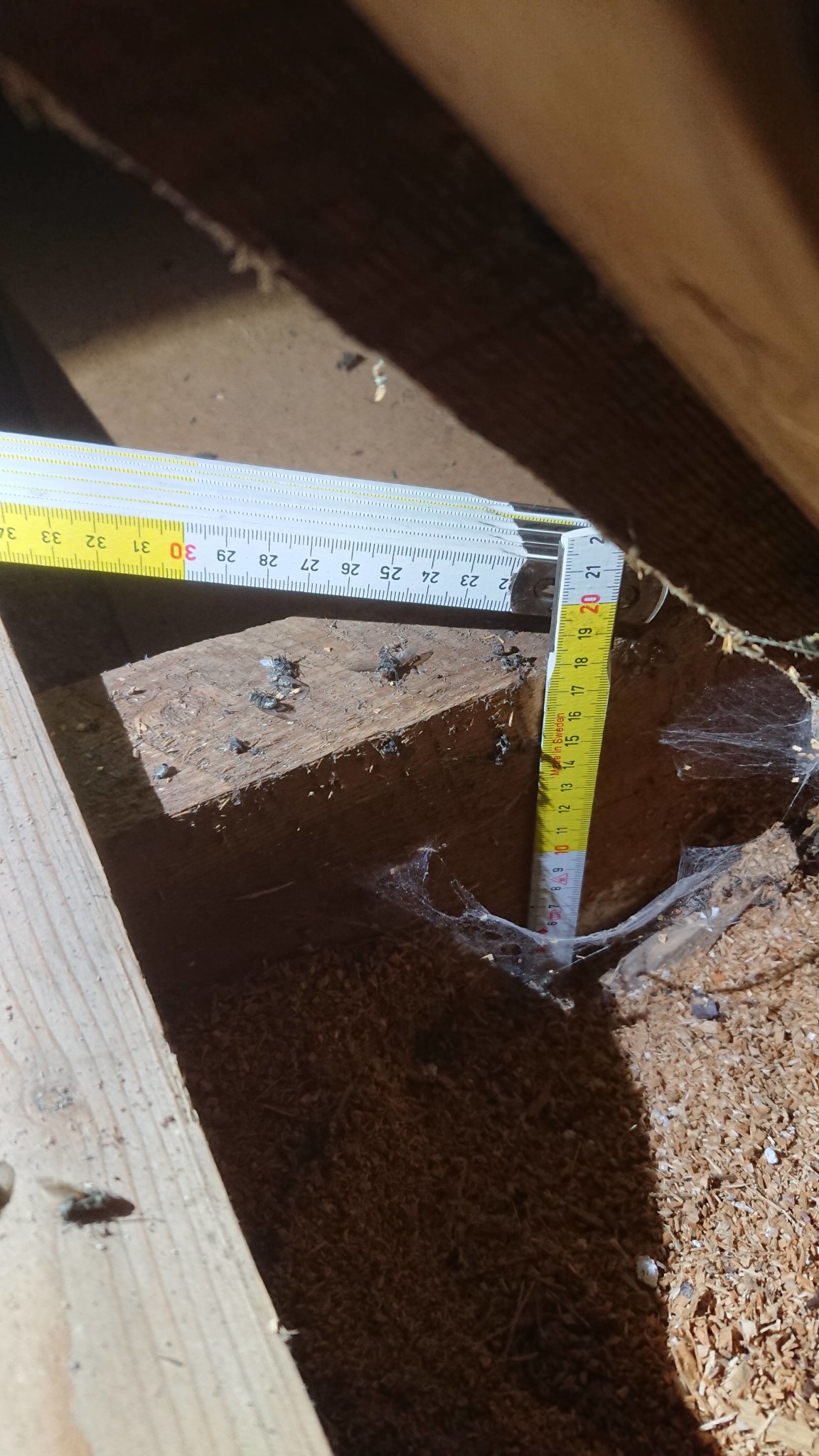
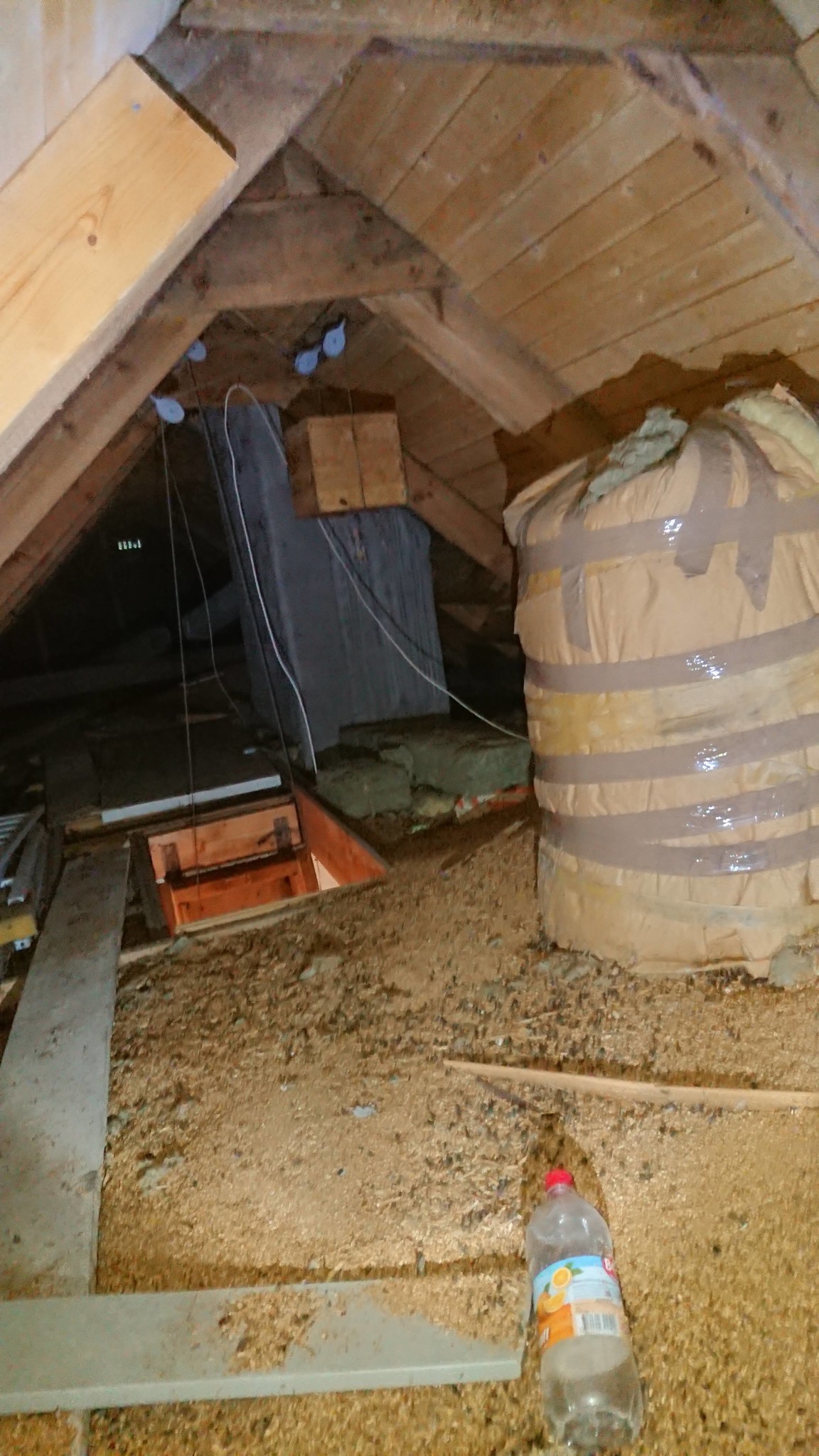
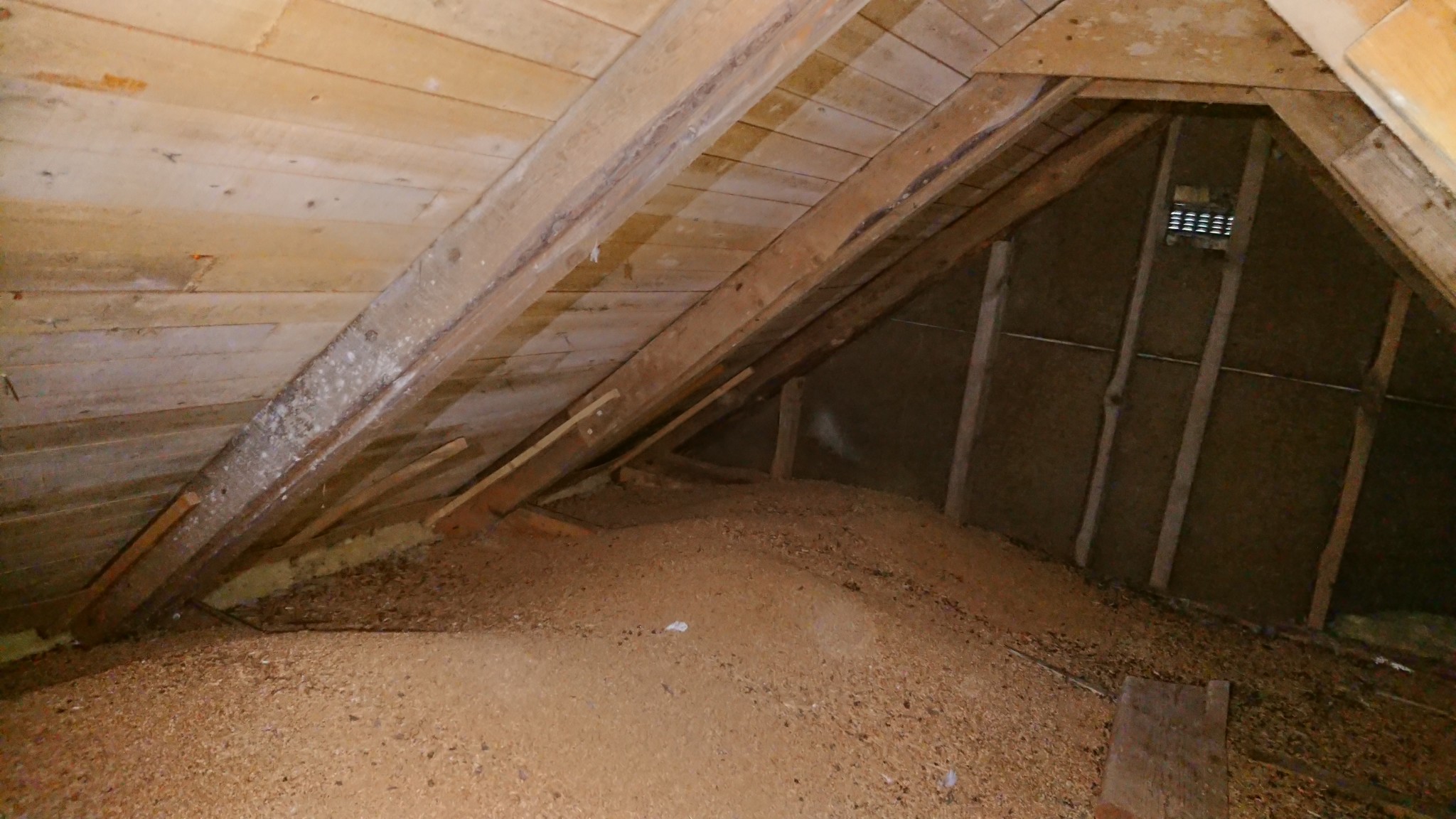
How long is the hanbjälke?
Best answer
No, it's not a problem. The hanbjälkar only support themselves, the sawdust, and the roof on the underside.
Awesome! Thank you for getting involved.
Follow-up question - does it do any good at all if you fully brace by, like, placing a board with some m12 bolts from the top of the ridge down to the bottom of the collar tie?
- Can it prevent the roof from sagging that centimeter?
- Does it make absolutely no difference because it won't bend in the slightest anyway?
- Am I doing more harm than good?
Follow-up question - does it do any good at all if you fully brace by, like, placing a board with some m12 bolts from the top of the ridge down to the bottom of the collar tie?
- Can it prevent the roof from sagging that centimeter?
- Does it make absolutely no difference because it won't bend in the slightest anyway?
- Am I doing more harm than good?
I got the deflection to about 6 mm. The actual wood quality is probably higher than I estimated, judging from the pictures. I probably wouldn't make any other arrangements. But don't use the attic for storage (Christmas items are probably OK).
Click here to reply