
10,857 views ·
5 replies
11k views
5 replies
Load-bearing walls in older timber houses?

Currently renovating a log house from approximately the 1930s, which is about 6.8 x 8.5m in size and has an upper floor with a support beam roof. As I understand it, the roof rests on the gable walls.
I wanted to check if it might be possible that the walls on the lower floor do not need to be load-bearing, since the intermediate joists are large logs lying across. I'm mostly wondering if that's possible or if construction was done this way in the past.
I know that a wall along the gable sides was added later and is not load-bearing, but it's possible the other crossing wall side is load-bearing.
It's probably very tricky to answer in my case, but I wonder if the possibility exists?
The upper floor is currently under renovation with, among other things, floorboards + final flooring, renovation plasterboard on walls, which surely adds some weight. It felt like that when carrying the "stuff" up the stairs anyway but maybe it doesn't affect much?
I wanted to check if it might be possible that the walls on the lower floor do not need to be load-bearing, since the intermediate joists are large logs lying across. I'm mostly wondering if that's possible or if construction was done this way in the past.
I know that a wall along the gable sides was added later and is not load-bearing, but it's possible the other crossing wall side is load-bearing.
It's probably very tricky to answer in my case, but I wonder if the possibility exists?
The upper floor is currently under renovation with, among other things, floorboards + final flooring, renovation plasterboard on walls, which surely adds some weight. It felt like that when carrying the "stuff" up the stairs anyway
but maybe it doesn't affect much?
If you have a span between the outer walls of 6.8m, I would say that a wall on the ground floor is load-bearing (wall perpendicular to the floor beams).
A floor with that span would feel shaky even if it was possible to get it to hold with a LARGE timber in the beams.
Why are you asking? (Curious!)
/The Engineer
A floor with that span would feel shaky even if it was possible to get it to hold with a LARGE timber in the beams.
Why are you asking? (Curious!)
/The Engineer
I want to change the layout to make it more practical, i.e., open up new passages, for example. I have wanted to and sketched quite a bit, also considered expanding but decided to remodel the existing rooms instead, partly for economic reasons but also because it's just the two of us adults, so in terms of space, we're doing well as it is now.
Of course, I will consult with a carpenter first before I attempt to open up walls. It's a bit tricky to find craftsmen up here, though. I have 2 new windows that I thought I would get help with for the upstairs from a craftsman, but it seems there was no time available.
Attached are 2 rough sketches, one of how it looks now and the planned solution.
Of course, I will consult with a carpenter first before I attempt to open up walls. It's a bit tricky to find craftsmen up here, though. I have 2 new windows that I thought I would get help with for the upstairs from a craftsman, but it seems there was no time available.
Attached are 2 rough sketches, one of how it looks now and the planned solution.
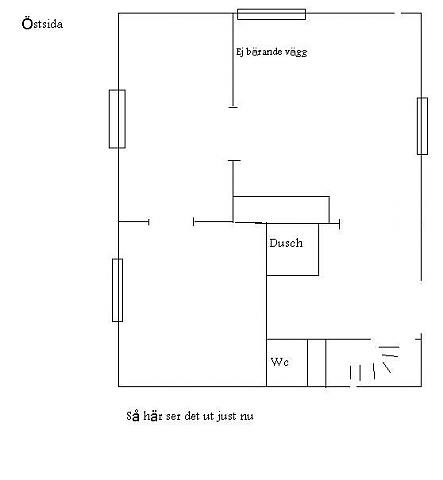
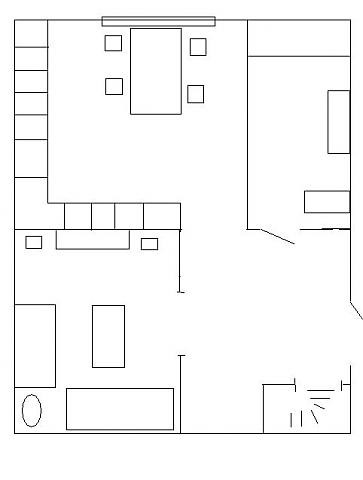
The wall you marked as "Non-load-bearing wall" should, according to my theory, be load-bearing...
Are you completely sure it was installed afterwards?
What are the dimensions of the timber in the joists?
Have you seen any joints anywhere, or are the beams 6.8m long? If they are unbroken, you can theoretically move the load-bearing wall to a mirrored position. However, this requires that the load can then be transferred to a new foundation wall etc.
/Ingenjören
Are you completely sure it was installed afterwards?
What are the dimensions of the timber in the joists?
Have you seen any joints anywhere, or are the beams 6.8m long? If they are unbroken, you can theoretically move the load-bearing wall to a mirrored position. However, this requires that the load can then be transferred to a new foundation wall etc.
/Ingenjören
Haven't seen the intermediate floor yet, but I guess I'll have to break open the ceiling and take a look when we start that phase. I do know that the floor is solid up there. Of course, it depends on how thick the beams and logs are, as well as the distance between them. cc60 can't really be relied upon precisely.
I'm not completely sure, but I've heard others say it used to be completely open there before, but then a partition was put up to create a small bedroom.
There's also a chimney that's centered, but maybe there's a ridge beam on each side of the chimney...
My planned layout depends on whether it can even be carried out as intended according to the sketch. In any case, I need to find someone who can give me tips and advice, thought I'd start here first
I'm not completely sure, but I've heard others say it used to be completely open there before, but then a partition was put up to create a small bedroom.
There's also a chimney that's centered, but maybe there's a ridge beam on each side of the chimney...
My planned layout depends on whether it can even be carried out as intended according to the sketch. In any case, I need to find someone who can give me tips and advice, thought I'd start here first

Of course, it's hard to say, but I'm quite sure it's not load-bearing, at least it doesn't support the roof; however, the wall that goes across might have a function to hold the house together in the middle, so it doesn't become a "sagging stomach." But creating larger openings in it shouldn't be a problem either as long as you keep the top beam intact. (meaning across the wall)
Click here to reply