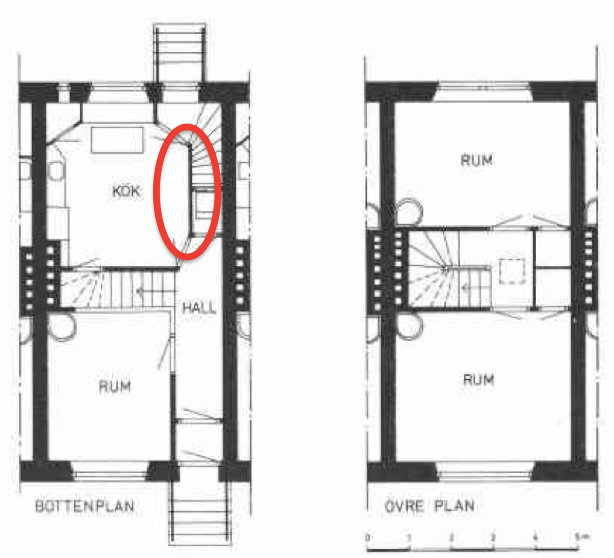
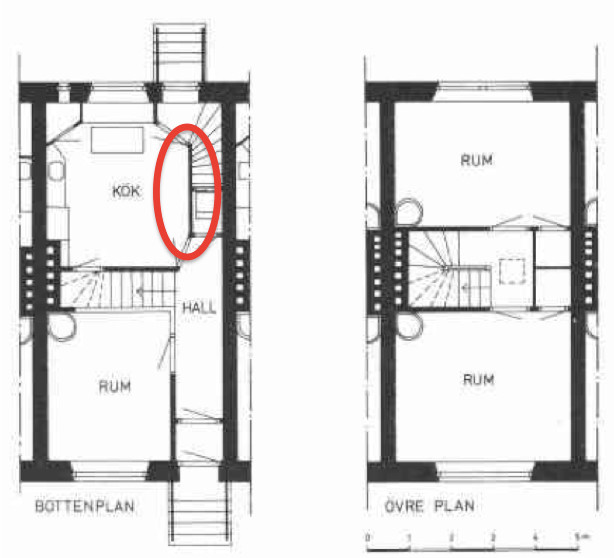
I was planning to make an opening and install a cabinet door in a kitchen wall, but I realized it is extremely stable, solid wood at least 10 cm thick with plaster on both sides. But can it really be load-bearing when it stands so close to a thick brick wall? On the other hand, why so extremely stable otherwise? Just ordinary over-dimensioning? The house is a townhouse from 1909 with brick walls as exterior walls and between the houses.
See drawing.
But can you be sure it's not load-bearing?
Thanks!
everything is more or less load-bearing in older constructions, whether you can take it down or not is a bit difficult to determine. The wall is in the longitudinal direction, so the floor joists are likely resting on it, so what will happen is hard to guess, but at the same time, plank walls hold together well, you might want to make a header if you're unsure.
I agree with leby. The floor joists for the upper floor are likely supported and spliced over the two load-bearing walls that run across the house. A plank wall can be considered as a panel construction that can be perforated without anything dramatic happening. Larger openings need to be reinforced with a horizontal plank. The question is whether it's worth the trouble. It will require many bags of plaster. Then, you need to repair what has undesirably fallen down with the correct plaster mix...
OK, thanks for the response!
If I want to make an opening of 60x80 cm, can't I just reinforce the wall with a wooden beam above the opening on the back of the wall?
Yes, but I understood it as though this surface was also plastered. The best approach is to recess a wooden beam into the plank opening and hold it in place with strong angle brackets. You can probably use timber from what you have already cut away.
In the past, they would inset the load transfer into the nearest whole plank on the side of the hole. Imagine you cut the end of the "beam," which is a horizontal plank, at about a 30-degree angle. Do this on both sides in opposite directions and place the long side downward. When cutting the side plank, cut it correspondingly without cutting it completely; some material should remain. I'm not sure if that made sense? It basically results in the same shape on the "beam" as a rafter tie.