
2,417 views ·
6 replies
2k views
6 replies
Load-bearing wall with multiple offsets?

Hello,
I have a dream of organizing the laundry room. To sort out the floor plan, I want to move and recess the electrical panel and water meter into a load-bearing wall.
It's a 1.5-storey modular house from 1977. The wall consists of 45x90 studs with 30 cm centers. I need two sections with 60 cm centers to fit the electrical cabinet and water meter cabinet.
1. How do I best replace a stud in the wall? Is a vertical 45x120 enough?
2. Do I need double vertical studs for the replacement?
3. Can I in good conscience replace two different sections in a 2-meter wall?
4. How much can you safely drill/take out of the "top stud" in a load-bearing wall to get water to the upper floor, for example?
As I write this, maybe it would be possible to have the electricity and water meter in the same section (above/below each other). Are there any rules against this? I guess it might not be ideal to run water upward behind the electrical panel to the upper floor? On the other hand, there are only two pipes going up since I plan to place the manifold in the bathroom there, so it might fit beside the electrical panel.
What thoughts and ideas do you have? Maybe it's more work than it's worth?
I have a dream of organizing the laundry room. To sort out the floor plan, I want to move and recess the electrical panel and water meter into a load-bearing wall.
It's a 1.5-storey modular house from 1977. The wall consists of 45x90 studs with 30 cm centers. I need two sections with 60 cm centers to fit the electrical cabinet and water meter cabinet.
1. How do I best replace a stud in the wall? Is a vertical 45x120 enough?
2. Do I need double vertical studs for the replacement?
3. Can I in good conscience replace two different sections in a 2-meter wall?
4. How much can you safely drill/take out of the "top stud" in a load-bearing wall to get water to the upper floor, for example?
As I write this, maybe it would be possible to have the electricity and water meter in the same section (above/below each other). Are there any rules against this? I guess it might not be ideal to run water upward behind the electrical panel to the upper floor? On the other hand, there are only two pipes going up since I plan to place the manifold in the bathroom there, so it might fit beside the electrical panel.
What thoughts and ideas do you have? Maybe it's more work than it's worth?


It's the heart wall, does it have a top plate? I'm not completely sure about all the terminology 
The little I've seen (haven't opened the wall yet, just a bit in the ceiling) indicates that it has a 45x90 lying on top (what I called a ceiling joist). But you mean it should have an equivalent top plate under that?
The intermediate floor is at cc60, i.e., on every other wall stud.
I have some drawings, I'll see what I have digitally and can upload.
The little I've seen (haven't opened the wall yet, just a bit in the ceiling) indicates that it has a 45x90 lying on top (what I called a ceiling joist). But you mean it should have an equivalent top plate under that?
The intermediate floor is at cc60, i.e., on every other wall stud.
I have some drawings, I'll see what I have digitally and can upload.
The intermediate floor/underframe on the roof truss is 8190mm long and should be 48x195 T200, whatever that means.
In the picture, I have marked the heart wall with blue/red where I want to insert.
I can't find a drawing of the heart wall. The wall studs appear to be 80 with the usual 9 or 10mm board on.
In the picture, I have marked the heart wall with blue/red where I want to insert.
I can't find a drawing of the heart wall. The wall studs appear to be 80 with the usual 9 or 10mm board on.
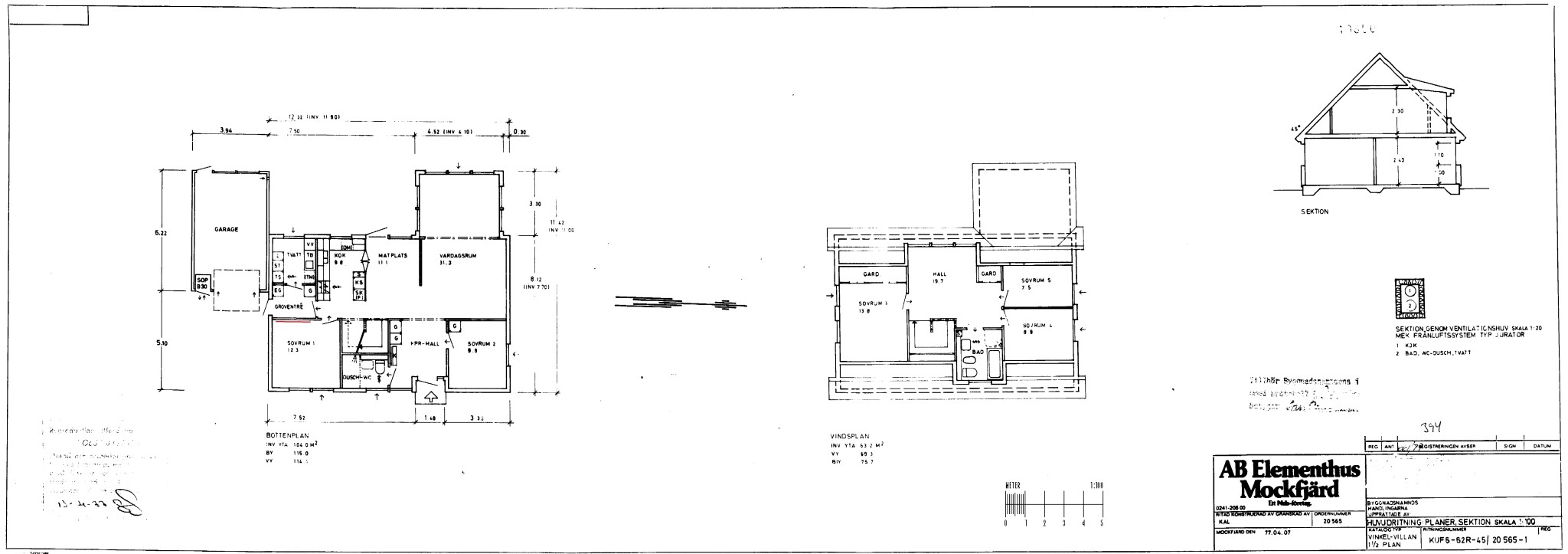
I've skimmed through everything and opened up the wall a bit. The frame is 80 even in the load-bearing wall. However, the header is 90, which is what fooled me.
Attached is the drawing.
Can I remove a wall stud (the intermediate floor is cc60 so I'm thinking of taking one that's in between) and replace it with a horizontal 45x220? with extra studs on both sides? Do you use angle irons or what is best?
Since the board is glued, I suspect I’ll have to replace it entirely when I open up the wall. Does glued k-plywood work as a replacement?
Attached is the drawing.
Can I remove a wall stud (the intermediate floor is cc60 so I'm thinking of taking one that's in between) and replace it with a horizontal 45x220? with extra studs on both sides? Do you use angle irons or what is best?
Since the board is glued, I suspect I’ll have to replace it entirely when I open up the wall. Does glued k-plywood work as a replacement?


The problem with panel-built wooden houses is that even the wallpaper contributes to the structural integrity... If only a middle stud needs to be transitioned, no large dimensions are required. A 45x95 mm stud on its edge is sufficient. The difficulty lies in being able to remove the glued board in a neat way. 10 mm pine plywood is probably an excellent replacement material.
Click here to reply