
1,462 views ·
3 replies
1k views
3 replies
Load-bearing wall (lightweight concrete)
Hello!
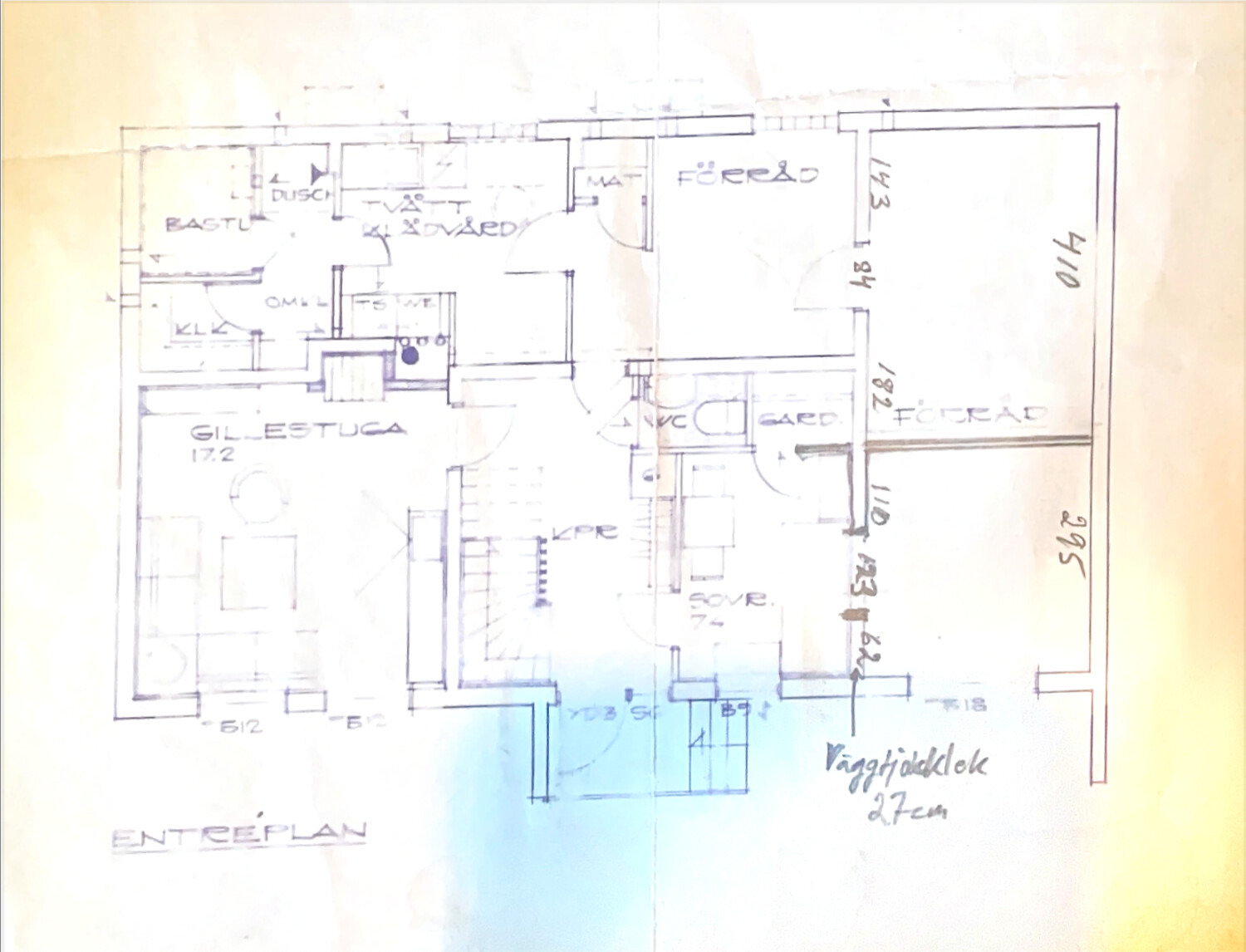
We had plans to demolish some interior walls on the ground floor, which we thought were not load-bearing. But now that we've started, we discovered that they were made of what I believe is lightweight concrete, which makes me start to wonder what I'm doing. The walls in question are marked in red on the attached drawing. I am also attaching a sketch of the floor structure between floors, where I have tried to sketch in the walls in question (since they are not included on that drawing at all). The red-marked walls in question are ~10 cm thick of what I believe is lightweight concrete (or possibly concrete blocks, it's very porous in any case), which can be compared to the exterior wall and wall no. 3 (green in the picture) which are ~20 cm thick in the same material.
Optimally, we would like to demolish the whole of wall 1, half of wall 2, and the whole of wall 3. But removing half of wall 2 is the most important. We are willing to leave wall 3 as it is. I think I should be able to tear down wall 1 (+2) since it runs parallel to the floor structure between the floors, and there is also no wall directly on the floor above. I am interested in hearing if my thinking is correct, or if I've missed something.
Have I interpreted the drawings correctly, and is it just a matter of taking them down, and if so, I'm a bit curious as to why one would choose to build an interior wall with masonry? Is it to stabilize the exterior wall? If so, I might consider leaving wall 1 (but removing the door and half of wall 2) to maintain some stability, even though I think there are already two thicker walls running in that direction.
I hope this made sense; otherwise, feel free to ask questions and I'll try to answer as best as I can
We had plans to demolish some interior walls on the ground floor, which we thought were not load-bearing. But now that we've started, we discovered that they were made of what I believe is lightweight concrete, which makes me start to wonder what I'm doing. The walls in question are marked in red on the attached drawing. I am also attaching a sketch of the floor structure between floors, where I have tried to sketch in the walls in question (since they are not included on that drawing at all). The red-marked walls in question are ~10 cm thick of what I believe is lightweight concrete (or possibly concrete blocks, it's very porous in any case), which can be compared to the exterior wall and wall no. 3 (green in the picture) which are ~20 cm thick in the same material.
Optimally, we would like to demolish the whole of wall 1, half of wall 2, and the whole of wall 3. But removing half of wall 2 is the most important. We are willing to leave wall 3 as it is. I think I should be able to tear down wall 1 (+2) since it runs parallel to the floor structure between the floors, and there is also no wall directly on the floor above. I am interested in hearing if my thinking is correct, or if I've missed something.
Have I interpreted the drawings correctly, and is it just a matter of taking them down, and if so, I'm a bit curious as to why one would choose to build an interior wall with masonry? Is it to stabilize the exterior wall? If so, I might consider leaving wall 1 (but removing the door and half of wall 2) to maintain some stability, even though I think there are already two thicker walls running in that direction.
I hope this made sense; otherwise, feel free to ask questions and I'll try to answer as best as I can



Basement floors, like cellars, are often made of masonry.
Normally, walls 1 and 2 are not load-bearing. Wall 3 may be load-bearing, perhaps necessary to prevent the staircase from collapsing.
Typically, there is a more or less continuous wall roughly under the roof ridge that is load-bearing in houses from that time period. In this house, the wall along the large storage room is also load-bearing since it could also be used as a garage. In this case, the walls shown in the floor plan are likely load-bearing.
It is common for walls to be load-bearing even if there is no wall above. It is the floor structure that needs to be supported, not the walls.
Normally, walls 1 and 2 are not load-bearing. Wall 3 may be load-bearing, perhaps necessary to prevent the staircase from collapsing.
Typically, there is a more or less continuous wall roughly under the roof ridge that is load-bearing in houses from that time period. In this house, the wall along the large storage room is also load-bearing since it could also be used as a garage. In this case, the walls shown in the floor plan are likely load-bearing.
It is common for walls to be load-bearing even if there is no wall above. It is the floor structure that needs to be supported, not the walls.
Thanks for the reply! Yes, I think you're right. The stairs are anchored in wall 3, you are completely right about that! I see I made a mistake in the original post. That wall is not to be demolished; rather, I wanted to show that it was in thicker concrete and appears differently on the drawing. The unnumbered red one was the one I was talking about potentially demolishing.BirgitS said:
Basement floors, like cellars, are often made of masonry.
Wall 1 and 2 are usually not load-bearing. Wall 3 may be load-bearing, perhaps necessary to prevent the stairs from collapsing.
Normally, there is more or less a continuous wall roughly under the roof ridge that is load-bearing in houses from that period. In this house, also the wall along the large storage since it could also be used as a garage. In this case, it's probably the walls shown in the floor plan that are load-bearing.
It's common to have walls that are load-bearing even if there is no wall above. It is the floor layer that needs to be supported, not walls.
The ceiling on both sides of 1+2 is wood, "inserted" above the wall, but nailed to the floor joists that run across. That should indicate that nothing bearing is attached to the wall at all, I think.
Click here to reply