
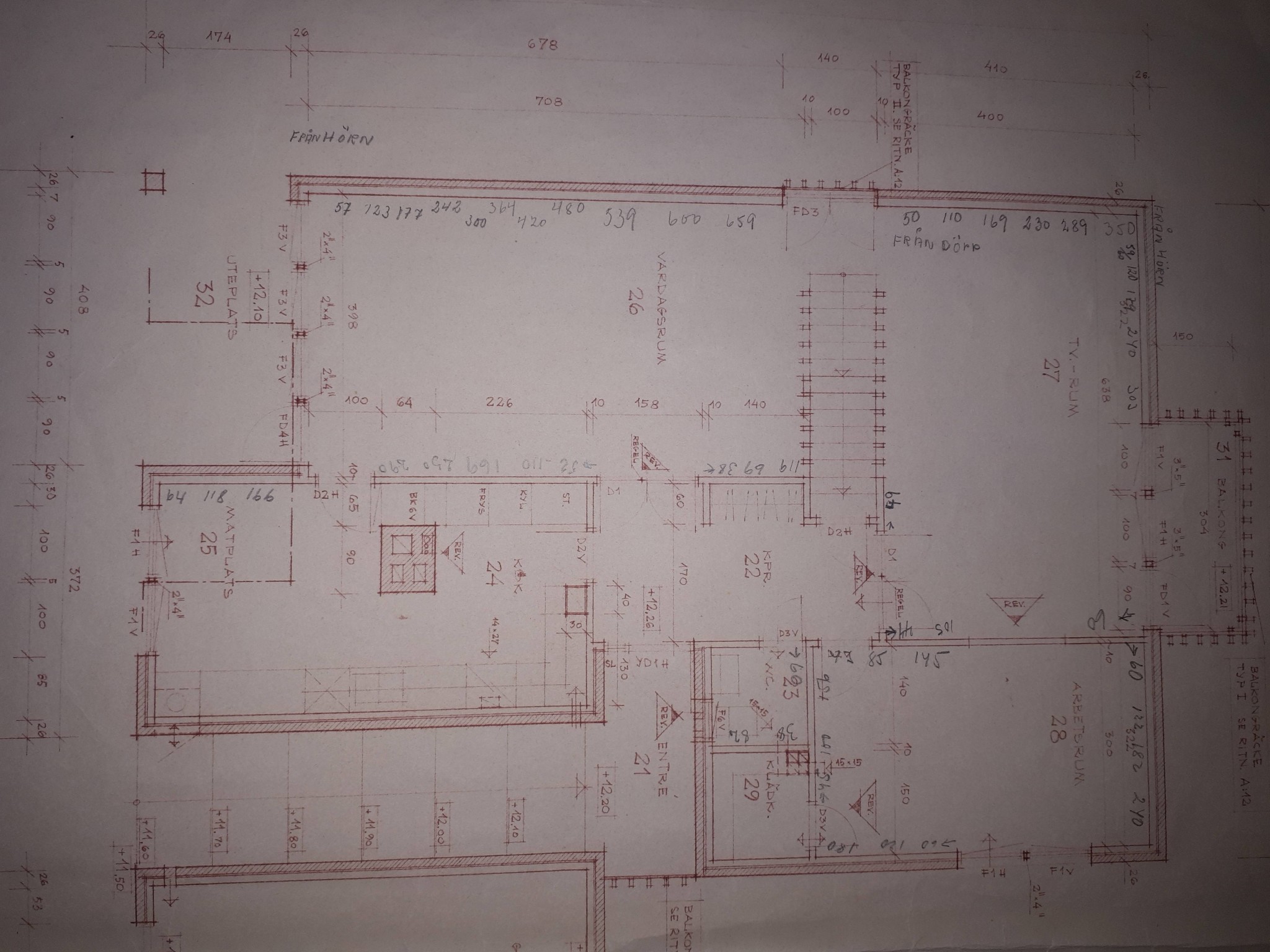
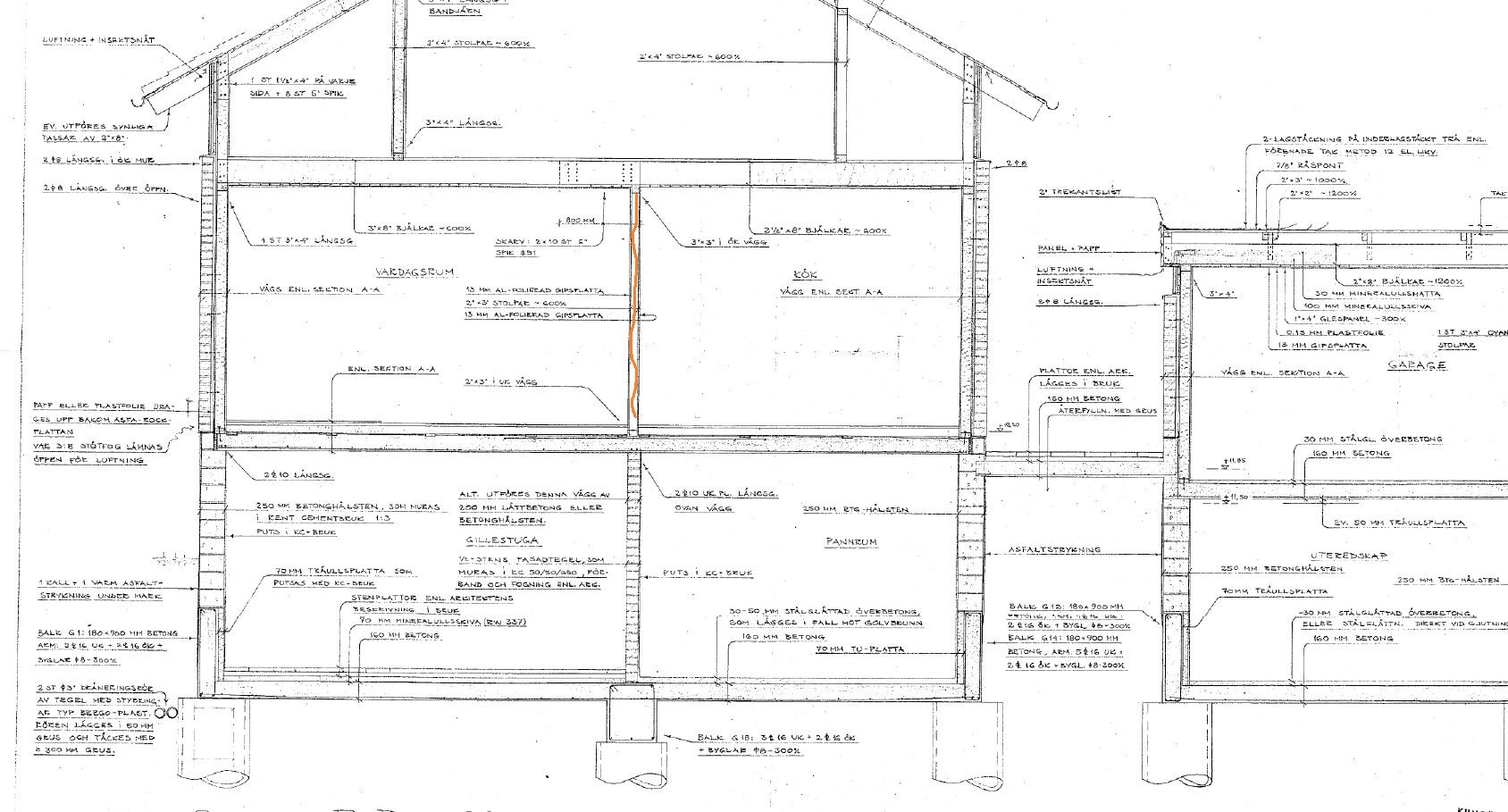
We want to demolish a wall that might be load-bearing and would need some advice. The wall stands perpendicular to the trusses and is about 3-3.5m with door openings on either side. The studs in the wall are 2"x3" c/c 60 with 13mm gypsum, so it feels a bit flimsy to be load-bearing?
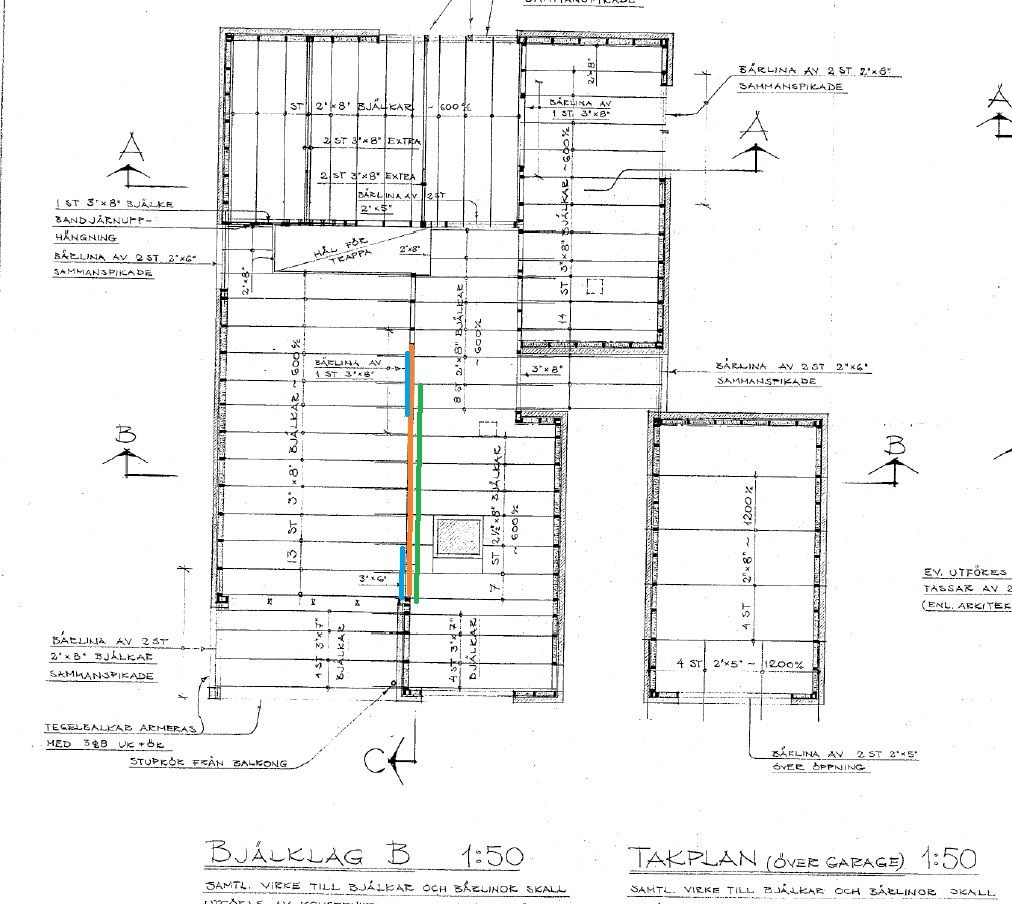
On the colored drawing, I've drawn red for the opening we desire, about 5.5m. Blue represents the existing door openings, one 80cm and one 140cm. We could also consider a smaller opening, about 4.9m, by partially filling in the 140cm door opening.
Is the wall load-bearing or not? It feels more like "supportive." The next step is to contact an engineer, but I would like some input before going there.
On the colored drawing, I've drawn red for the opening we desire, about 5.5m. Blue represents the existing door openings, one 80cm and one 140cm. We could also consider a smaller opening, about 4.9m, by partially filling in the 140cm door opening.
Is the wall load-bearing or not? It feels more like "supportive." The next step is to contact an engineer, but I would like some input before going there.


If I have to guess, then yes, it's load-bearing. That type of truss (framework-) should always have support roughly in the middle, either in the form of a central wall or beam.
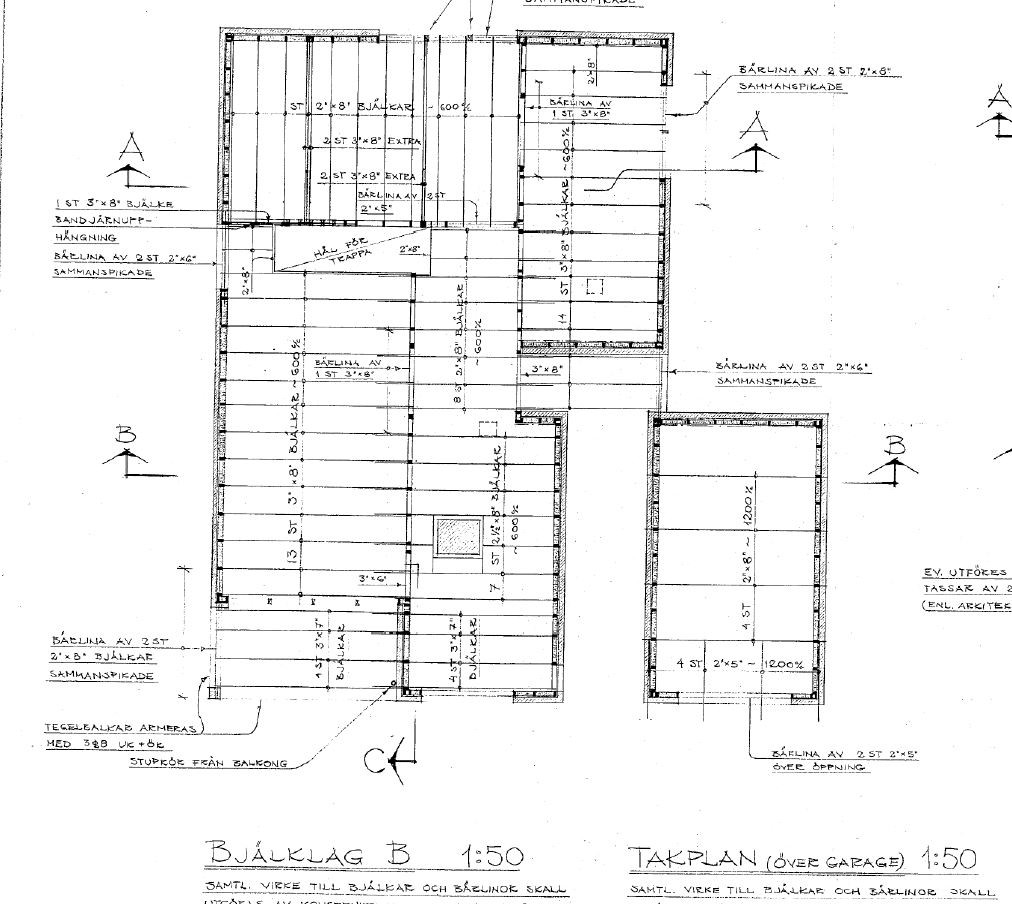
I find it hard to read the drawings, but there is something about 8" joists.
And the central wall in our house also has 3" standing studs.
I find it hard to read the drawings, but there is something about 8" joists.
And the central wall in our house also has 3" standing studs.
KnockonWood guesses correctly. The wall is definitely load-bearing! The floor joists above consist of 21/2"x8" joists, which correspond to 45x228 in terms of resistance to deflection. The load on the joists consists of, in addition to its own weight, a useful load of 2 kN/sqm between the truss posts (if the use is residential), 0.5 kN/sqm on the catwalks (if used as storage), and two point loads from the roof via the posts. The total span is just under 7.8 meters. The span limit is between 4 and 5 meters.
2"x3" posts may seem weak but can handle quite large vertical loads if braced laterally with noggings.
If you want a beam that can handle a 5.5-meter span, as a replacement for the wall and the reinforcements that must be above the door openings, it will need to be very strong. The best option is if you can find a place for a column somewhere in the middle.
2"x3" posts may seem weak but can handle quite large vertical loads if braced laterally with noggings.
If you want a beam that can handle a 5.5-meter span, as a replacement for the wall and the reinforcements that must be above the door openings, it will need to be very strong. The best option is if you can find a place for a column somewhere in the middle.
Ok, thanks! I did some calculations with a dealer of glulam beams and it turned out very heavy. I guess in such cases it will have to be a steel beam, or we try to reduce the opening to 4.9 meters. Or then find a place for a column.
Steel beams are rarely the solution to the problem when there are floor structures above and one must consider deflection. Steel is tough but wobbly, simply put. The best option by far is to find space for a column.
 then it'll be a matter of talking to my partner, but she's probably more fond of columns than I am.
In our house, built in 2010, we have a 200 mm HEA steel beam over the opening between the dining area and living room.J justusandersson said:
It's exactly 5 meters where there is no load-bearing wall.
And there, the lower frames of the trusses are cut and rest on the lower flange of the beam.
The beam is completely embedded in the 300 mm thick joist layer, and it is supported by two 95x95 mm wooden posts,
one at each end.
The upper floor is very stable, but it is mostly used as storage.
I never wrote that steel is unsuitable in building contexts. There are many situations where it is the only solution. What I wanted to emphasize was that often it does not lead to a significant saving in height, when you have accounted for deflection and vibration and added space for fire insulation, and it can also be difficult to fix in a simple way. When you are, like TS, at the beginning of a process, I think one should start from a different angle.
Click here to reply