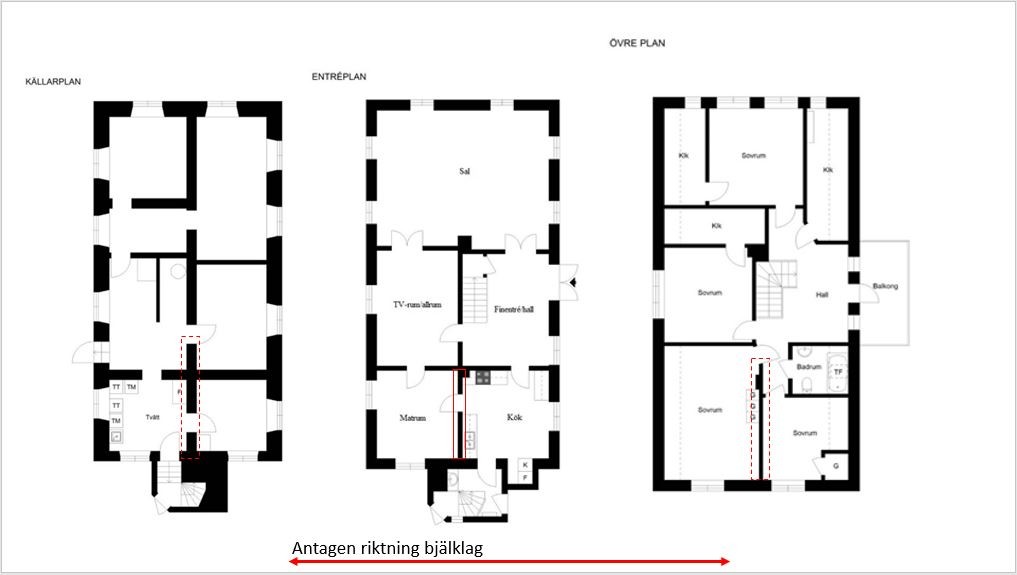
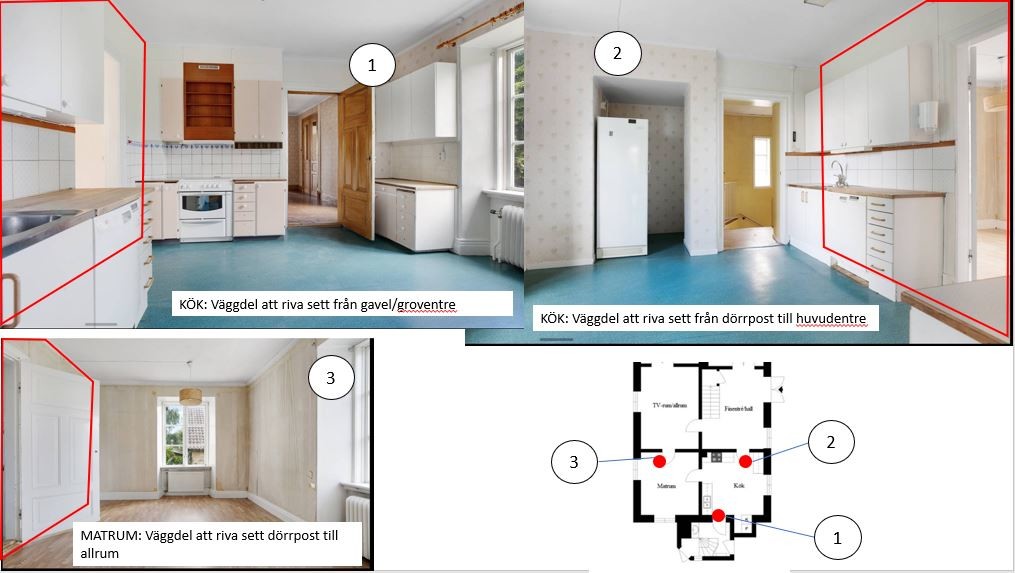
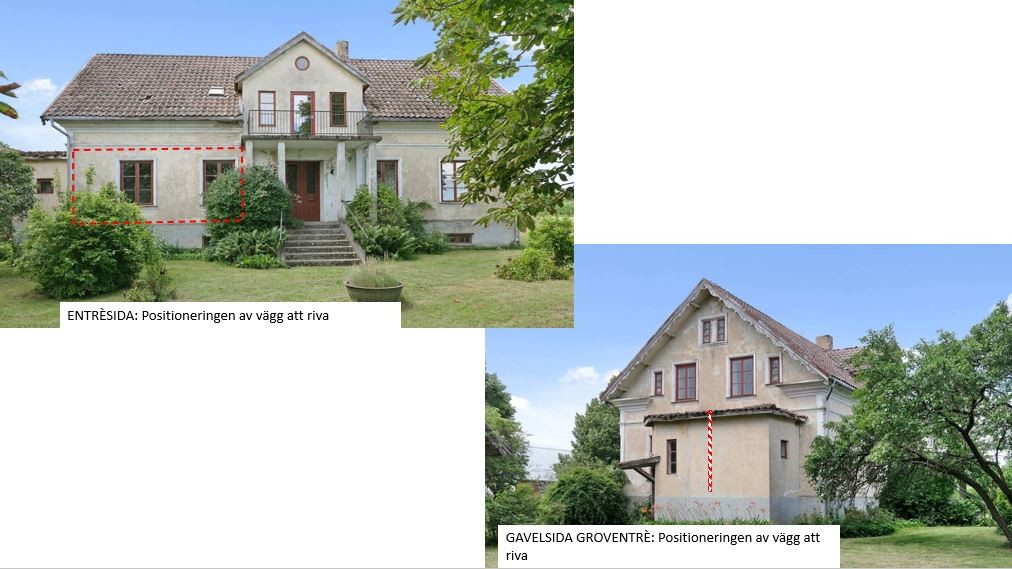
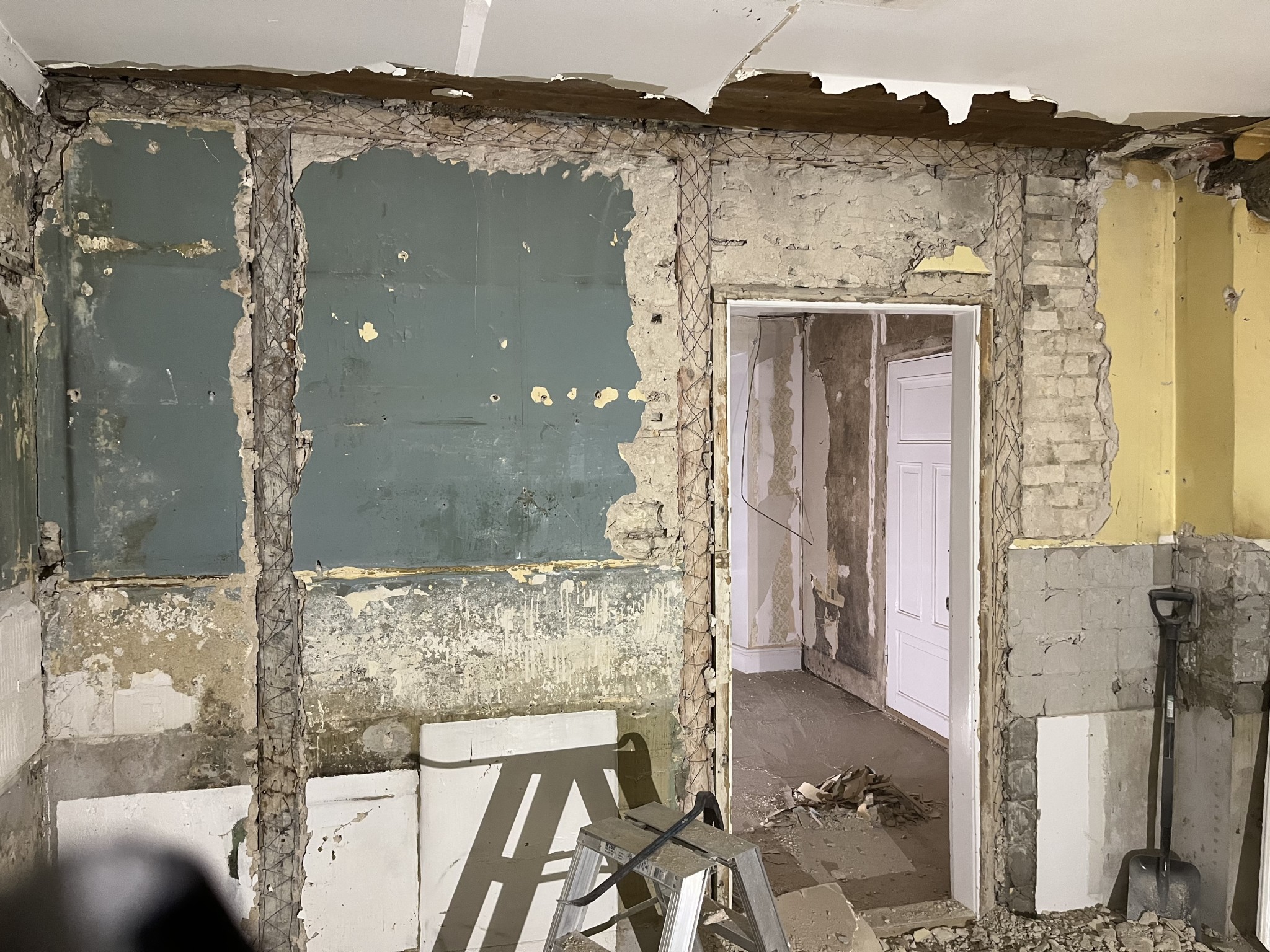
I am helping a friend try to determine whether a wall is load-bearing or not and how it might be relieved if necessary. "Unfortunately" in this regard, it is not a "standard wooden house," so for my part, it is not entirely trivial how it is constructed. I have read a lot of the good things that JustusAndersson writes here on the forum, and as I understand it, stone houses are/can be difficult to calculate the loads on, especially if they are old.
"Gotlandshus" in limestone from "around the turn of the century 1800-1900"
The basement walls are about 90 cm deep
The house consists of a basement, ground floor, and upper floor.
In the "other gable side" of the house, there is a room where the heart wall is missing. Based on images, I assume this is original, so some type of relief should be there.
My interpretation is that the heart wall is load-bearing.
Below are some pictures explaining what it looks like. I understand that more information is probably needed, so I hope with this post to "start" to be able to get feedback on what more information is needed and/or other recommendations for further handling.
Hi Viktor! To be able to calculate it, one needs to know the width of the house and the length of the wall. Additionally, you need to know how the roof structure is made and what material the wall is made of. If the wall is reinforced with a glued-laminated beam, it's a challenge to calculate what the basement wall can withstand. Probably some form of pressure equalization will be necessary. Limestone has a higher modulus of elasticity than brick, but then you have to assess the quality of the mortar. Not many people master such problems today. Personally, I'm starting to get a little tired of everyone who has to open up between the kitchen and surrounding rooms even though the house is over 100 years old. It's a typical fashion trend that later generations will restore. But it keeps many in the construction business occupied...
Hi Viktor! To be able to calculate that, one needs to know the house's width measurement and the length of the wall. Additionally, one needs to know how the roof construction is made as well as what material the wall is made of. If the wall is replaced with a glulam beam, there is a difficulty in calculating what the basement wall can withstand. Probably, some form of pressure equalization would have to be done. Limestone has a higher modulus of elasticity than brick, but then it is important to assess the quality of the mortar. Not many people master these problems today. Personally, I'm starting to get a bit tired of everyone having to open up between the kitchen and the surrounding rooms despite the house being over 100 years old. It's a typical fashion trend that future generations will restore. But it keeps many in the construction business busy...
Thanks, Justus.
I'll start with your last paragraph. I agree in most cases. In this specific case, it’s about a farming household from Gotland where in other family farms there are incredibly large kitchens. Which is practical as there is a large turnover of people on the farm. I think this largely influences the desire for the floor plan. An alternative could be to move the kitchen to the "sal" at the other end of the house since this room already has the dimensions they desire.
But until then, I'll try to help them along the way, maybe it will help them make a decision.
So, I apologize for forgetting this trivial information. The house is about 8 m wide (interior measurement) and the wall they want to remove is about 4 m long.
Currently, it is unknown
- what the wall is made of
- how the trusses are constructed
I will get back to you on that.
Let's see, hoping to get a somewhat clearer picture. Not all information is currently available, it's an old house after all, so you don't want to destroy more than necessary.
Feel free to come back with comments or questions, need for clarification, etc.
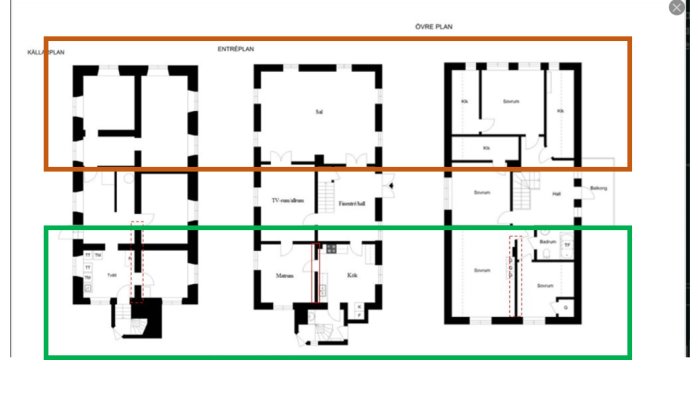
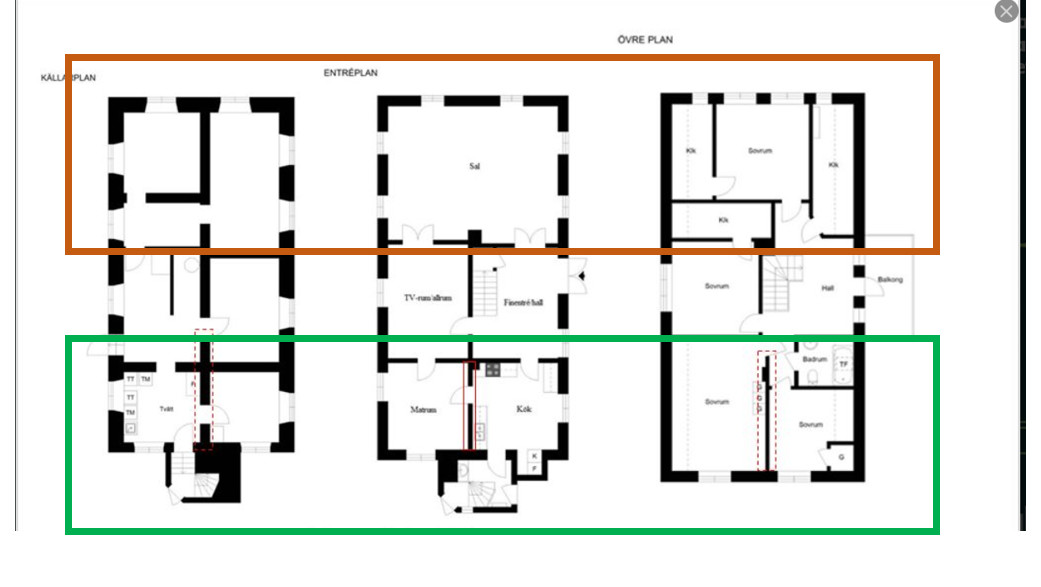
The house looks different depending on whether it's the "sal sidan" or "kök sidan." In the floor plan below, I have marked Sal Sidan in brown and Köksidan in green.
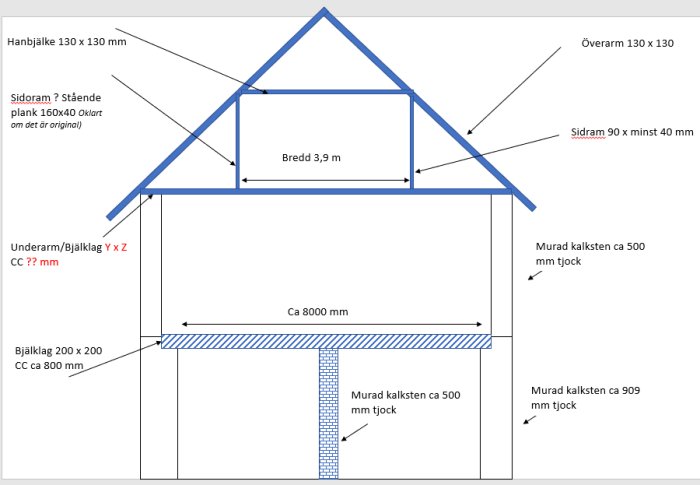
We'll start with Sal Sidan, here a load-bearing wall is missing. I believe this is original, and my suspicion is that a relief beam sits in the floor structure and rests on the chimney and the outer wall/gable. But in section, it looks something like this (I have not drawn in my assumed relief).
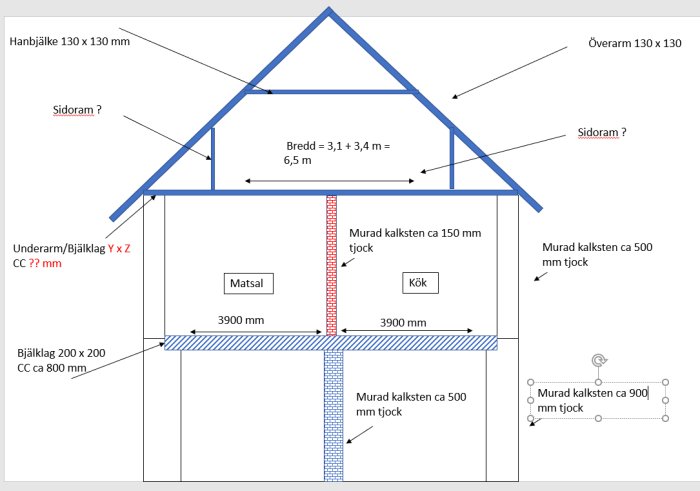
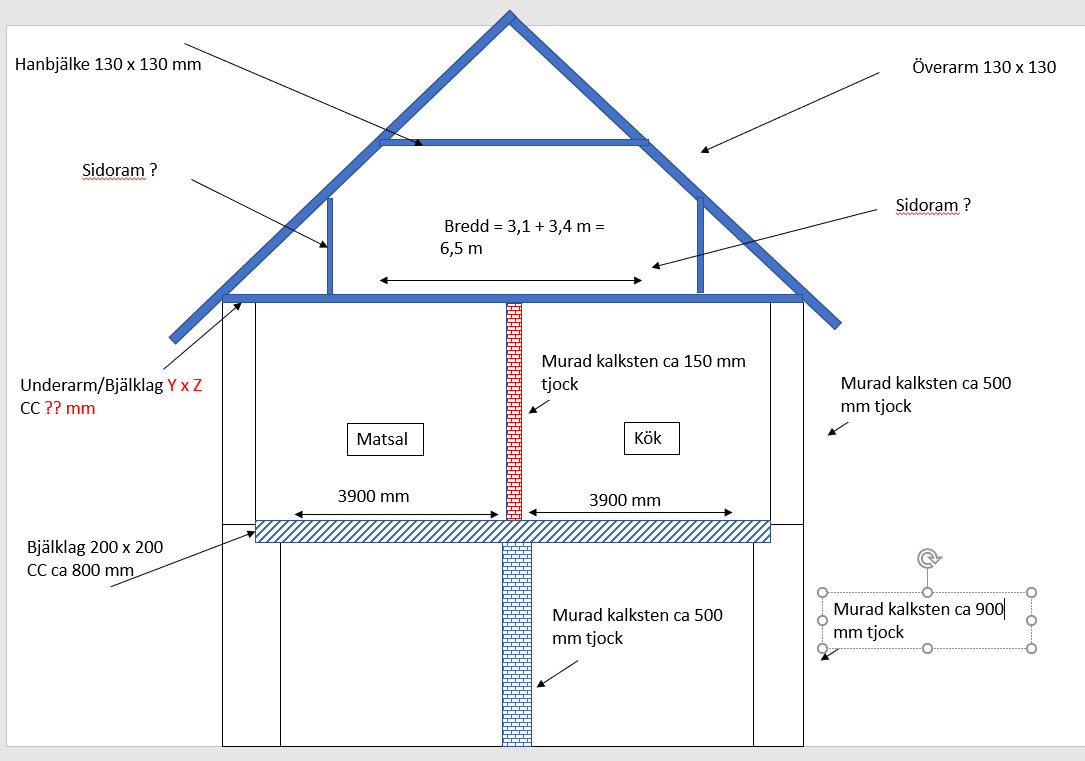
And on the other side of the house, where the current wall stands, it looks like this...
Basement:
We have an outer wall in the basement that is 900 mm thick built of limestone, and the load-bearing wall in the basement is about 500 mm wide and also made of limestone.
Ground floor:
Above this, there is a beam structure with approximately 200x200 beams with a center-to-center spacing of about 800 mm. The outer walls here are about 500 mm deep and built of limestone. The current wall that we want to remove is about 170 mm wide with plaster, but without plaster, it's about 130 mm wide. It rests on a beam that is about 130 mm wide and 200 mm high, which in turn rests on the beam structure below, which then stands on the basement's load-bearing wall.
Upper floor/attic:
Above this, there is an upper floor that lies in the roof truss itself. So there are knee walls along the long sides. Above the sal, you can access the knee wall on the other side; on the kitchen side, they are hidden. Above the sal where you can access the knee wall, one might assume it's a side frame, a bit hard to see if they bear any load without breaking up too much. But what can be stated is that if they do bear load, they are positioned at different distances from the eaves depending on whether it is above the sal or above the kitchen.
My amateur thoughts have come this far.
The wall is load-bearing, but the wall's relatively thin dimension might indicate that it does not bear much load. The wall's ability to bear load from side posts should be quite high since it is 500mm thick. Add to that, it bears the weight from the limestone wall above, which would disappear. The outer walls are really thick, perhaps it's to bear large loads or for thermal properties? Since the floor structure is 20mm wide, it's theoretically possible to place 20x20 or similar dimensions directly on the beam and subsequently directly on the load-bearing wall in the basement.
The thoughts I have now are: If we assume that the side posts' loads are handled, what dimension are we talking about for the relief beam?
Are there lateral forces that need to be managed?
How do you verify the load-bearing capacity in the load-bearing wall under the side posts?
Approximately, I think it involves glulam in the size of 90x450 mm. In terms of capacity, the equivalent is 190x360. I believe the stability of the construction is not something to worry about. There are plenty of tables in older reference works for calculating the strength. The condition of the masonry must be assessed on site. I believe there are knowledgeable people on Gotland. I think the beams in the intermediate floor of the hall section run in the other direction, so the span is smaller. I don't believe in any hidden beams.
Roughly I believe it involves glulam in the size of 90x450 mm. In terms of capacity, equivalent is 190x360. I don't think there is any need to worry about the construction's stability. There are plenty of tables in older reference works to calculate the strength. The condition of the masonry must be assessed on-site. I believe there are knowledgeable people in Gotland. I think that the beams in the mid-floor of the hall section run in the other direction, so the span is smaller. I don't believe in any hidden beams.
sounds wise Justus!
Is it possible to say what the dimensions of the glulam beams correspond to in a steel beam? And how would it affect the dimensions if a vertical relief is placed in the middle to reduce the dimensions? (Going from a 4m relief to 2 pieces with 2m)
90x450 corresponds to HEA 200 in steel. If you halve the span, you can reduce it to 90x225. Additionally, the external column loads decrease. It is always better to keep the beam whole (4 m) even with a central support.
90x450 corresponds to HEA 200 in steel. If you halve the span, you can go down to 90x225. Additionally, the external column loads decrease. It's always better to let the beam be whole (4 m) even with a middle support.
Thanks, I didn't know that, but it sounds reasonable. 90x225, what does that become in HEA? Like HEA140?
HEA 120. You compare the bending stiffness I*E, which is the product of the modulus of elasticity and the moment of inertia.
Thank you Justus, I will take this to those who own the wall. My recommendation to them will be to bring in a local engineer who can look at the exact conditions on-site. But now at least we have some idea about alternative solutions and beam dimensions. Big thanks for that.
After some more searching, it turns out that the wall consists more of old studs and that the limestone is filling. There is a vertical stud at the bottom and one at the top against each joist and vertical standing studs in between. The dimension of all the studs is about 12x12. Distance from the outer wall is 650mm, 1300mm to the door frame, 1020mm to the other side of the door frame, then comes an old chimney.
Does this change the conditions somewhat?
I assume the chimney should be preserved?
Is it a "common" construction method for the time?
Is it safe to remove the limestone in the middle, put in some new studs just in case, to preserve the wooden structure until the engineer arrives?
Correction. It is doubtful if it is a chimney breast (it should be, as the kitchen has been here). But at the same time, the "chimney breast" extends very far in the directions of the walls, further than usual to stay away from combustible material.
1 Good to have a local contractor. Likely leads to less over-engineering.
2 It must be easier to tear down the wall with that appearance. The construction is probably typical for Gotland. In the summer, you can remove the limestone, hardly in the winter without shoring.
3 The chimney's "wings" should probably be considered part of the chimney, especially if they go through multiple floors. They are likely built into the bond with the chimney, so they can be tricky to remove.
Click here to reply
Vi vill skicka notiser för ämnen du bevakar och händelser som berör dig.