
Anyone want to give me some feedback on this question: Drilling in a load-bearing brick wall to create an opening between the living room and kitchen. The opening needs to be 1300 mm wide and 2170 mm high to fit a standard frame. Above the opening, there will be 530 mm left to the ceiling.
Now to the question: The company suggests a glulam beam resting on glulam pillars. Okay, but then you should use shoring during the work, right? And why are pillars needed? 25 cm of brick should be a good base for the beam to rest on, right?
As an alternative, milling in L-profiles can be good, right? But which would look best? Most economical?
Submitted a building notification but the municipality wants a structural analysis for the dimensioning of the beam, regardless of which is used, basically a load calculation. Complicated?
By the way, I live in a multi-family building from 1920.
Anything else to consider?
Now to the question: The company suggests a glulam beam resting on glulam pillars. Okay, but then you should use shoring during the work, right? And why are pillars needed? 25 cm of brick should be a good base for the beam to rest on, right?
As an alternative, milling in L-profiles can be good, right? But which would look best? Most economical?
Submitted a building notification but the municipality wants a structural analysis for the dimensioning of the beam, regardless of which is used, basically a load calculation. Complicated?
By the way, I live in a multi-family building from 1920.
Anything else to consider?
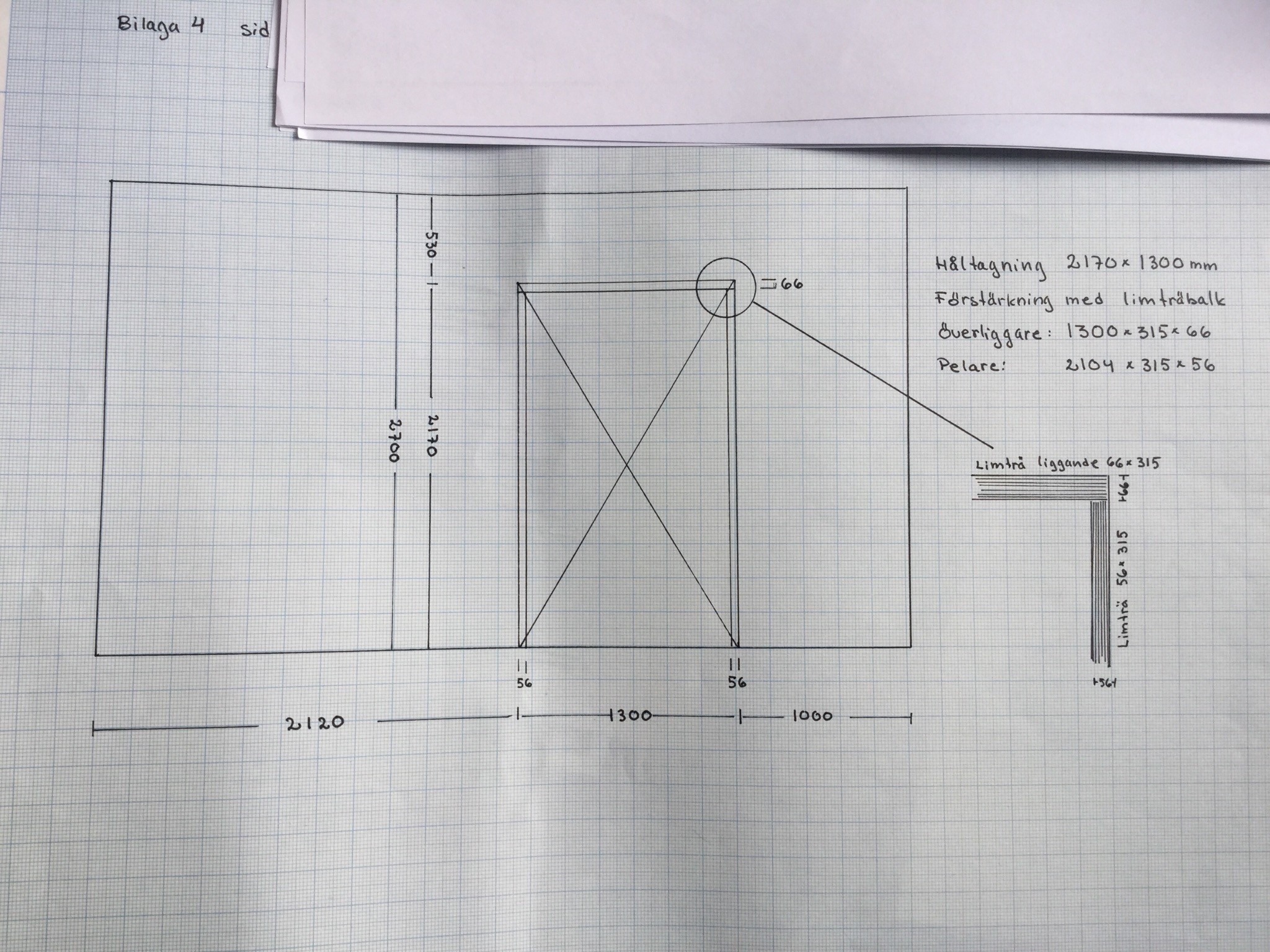

Masonry are shell structures and the brickwork bonds above the opening have a certain load-bearing capacity. The difficulty lies in calculating it correctly as neither the quality of the bricks nor the mortar used is known. It is then easier to consider it as a course adjustment problem, as if the material above the opening does not exist except as weight. To be able to calculate it, one needs to look at both floor plans (the current floor and the one above) and a sectional drawing. Floor structures in multi-family houses from the 1920s can be constructed in several different ways: Reinforced concrete, regular wooden floor structures, or wooden floor structures with steel beam elements. The task requires both engineering competence and good knowledge of older building techniques.
Thank you Justus. You pinpoint my problem. I have access to floor plans for all floors and construction technical descriptions, but section drawings are neither available at the condominium board's manager nor the city's drawing archive. I wonder if the requested information can be gleaned from a construction technical description?
Maybe, with a bit of luck.
Post some material, and you might get more help along the way.
J justusandersson said:
Thanks for considering. Here is a technical description and floor plan. I can't determine if the wall is load-bearing or not. And is it possible to calculate how the beam should be dimensioned? How complicated is it?J justusandersson said:

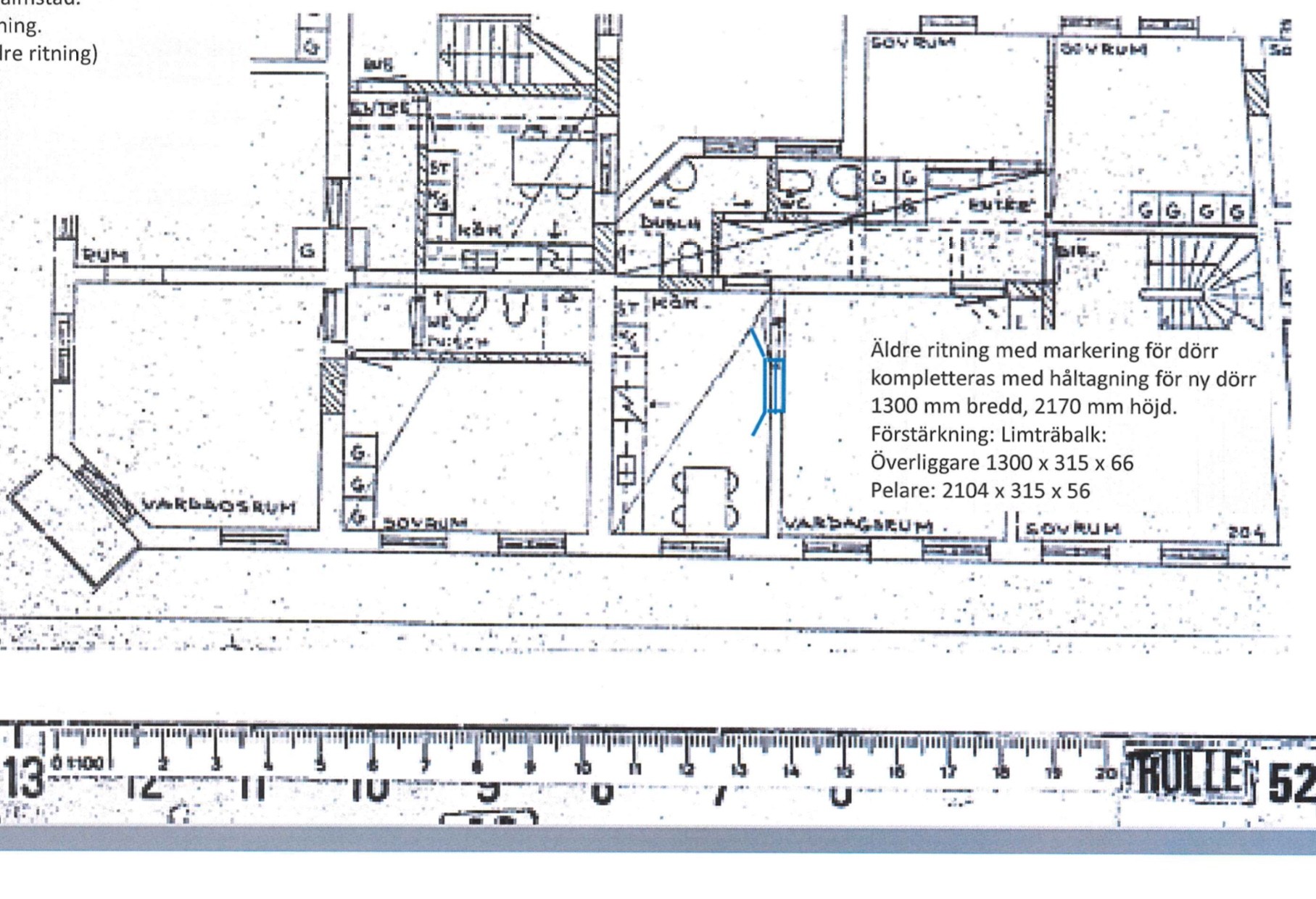
I think it is highly unlikely that the wall is load-bearing. The floor joists probably rest on the outer walls and the core wall. This should be ascertainable using a stud finder. In that case, only the remaining bricks above the opening need to be secured, preferably with 2 steel profiles, type VKR, placed so that they are positioned directly under each brick row. I assume that the text on the drawing refers to a previous renovation.
Thank you for your quick assessment. So now it's up to me to find a contractor who can actually determine if the wall is load-bearing or not. If it's not, I have the impression that no building permit is required. Regarding the blocked door, I get the impression that there has never been one there, and if there was, it seems to be filled in with brick or something similar. No difference in sound in the wall. Do you have any more tips to give me? By the way, do you think it's okay with glulam?
Sometimes it takes a moment for the penny to drop. In your drawing, glue-laminated timber has been used to frame the opening. The lintel is naturally placed on its edge. I think that's a better solution. This way, you also have wood that can be screwed into. Since it's only the brick's own weight that needs to be considered, in your case, 42x270 mm should suffice for both the lintel and side supports. I believe the simplest option is to hire a concrete cutter. That way, you'll get a good cut in the wall. Dusty it will be, regardless.
An alternative way to find out the direction of the floor joists (in the ceiling above) is to look at the direction of the floorboards in the neighbor's apartment one floor up.
Looking for a local company that can check joists, load-bearing capacity, etc. I have one that can do the job for 800 SEK per hour x about 10 hours, but it will take about a month.
Regarding load-bearing, the neighbor upstairs doesn't have bricks but rather 60cc joists with plasterboards. That should also indicate that the wall isn't load-bearing, I suppose?
The direction of the floorboards is difficult to follow, parquet.
Regarding load-bearing, the neighbor upstairs doesn't have bricks but rather 60cc joists with plasterboards. That should also indicate that the wall isn't load-bearing, I suppose?
The direction of the floorboards is difficult to follow, parquet.
I would be extremely surprised if the wall is load-bearing, but old houses are built unsystematically. It's always best to be thorough.
Click here to reply