I am renovating a single-story house from 1958 and am about to replace the sill in part of one wall on one long side due to water damage. But when I removed the raw board from a section of the wall, to my surprise, I find no vertical studs!
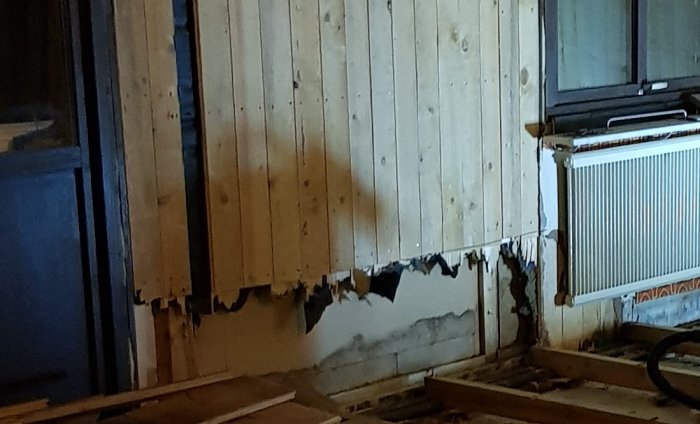
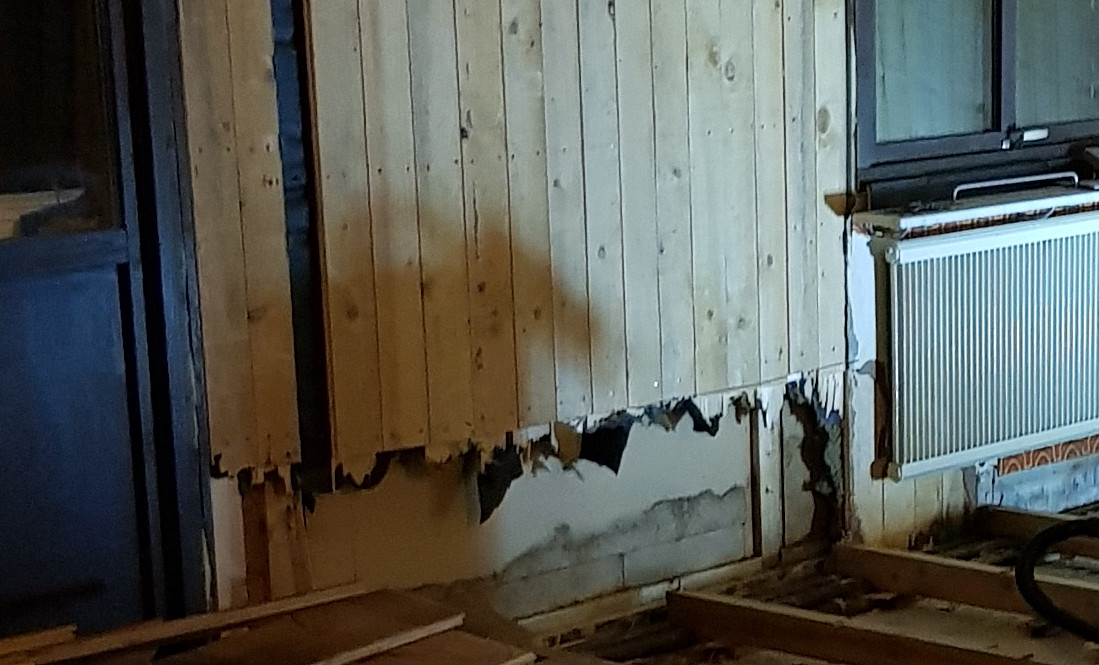
Poor image, but what you see is a standing stud to the left by the patio door, but then it is completely empty of studs, even by the window. Then the next stud is about 5 meters further away.
At the top lies a 2x5 stud (by eye measurement) on its side.
My theory is that the raw board and the exterior panel together have a load-bearing function with the relatively thick top stud? (I should not cut away any more raw boards until this is settled )
The roof, as far as I can see, is straight and nice, and it has stood since '58, so it can't be completely wrongly built.
The questions are thus two:
1. Is my theory correct, i.e., that the raw board/panel has a load-bearing function and must be supported before I can continue cutting it away to replace the sill?
2. The original idea was to screw a stud along the wall and support it with a jack to then replace the sill. But now the plan needs some changes, what is the best way forward now? I guess I have to replace the raw board all the way from top to bottom to avoid any seams, so maybe it's convenient to take about 60cm at a time where I remove the raw board, cut the sill, and carefully pry it off the boards that are nailed from the outside (there's a brick facade outside which I'd rather not tear down). Then place new sill, screw the outer boards from the inside, and then put in insulation and new raw boards on the inside?
I am renovating a single-story house from '58 and am about to replace the sill in part of the wall due to water damage. But when I removed the wall boards on a section of the wall, to my surprise, I found no vertical studs!?
[image]
Poor picture, but what you see is a vertical stud to the left by the patio door, but then there are no studs at all, even by the window. The next stud comes about 5 meters away.
At the top, there is a 2x5 stud (eyeball) on edge.
My theory is that the wall boards and the exterior panel have a load-bearing function together with the relatively thick top stud? (I will not cut away any more wall boards until this is investigated )
The roof is, as far as I can see, straight and nice, and it has stood since '58, so it can't be completely misbuilt.
So the questions are two:
1. Does my theory hold, i.e., do the wall boards/panel have a load-bearing function and need to be supported before I can continue cutting them away to replace the sill?
2. The original idea was to screw on a stud along the wall and support it with a jack to then replace the sill. But now there are some plan changes, what is the best way to proceed now? I guess I must replace the wall boards all the way from top to bottom to avoid any joints, so maybe it's convenient to take about 60cm at a time where I remove the wall boards, cut the sill, and carefully break it away from the boards that are nailed from the outside (there is a brick facade outside which I would like to avoid tearing down). Then put in a new sill, screw the exterior boards from the inside, and then add insulation and put new wall boards on the inside?
Thanks for the input
In another thread on the forum, the phenomenon of door and window frames being load-bearing has been discussed. Seems so in your case. Possibly in combination with wall boards and facade boards.
In another thread on the forum, the phenomenon of door and window frames being load-bearing has been discussed. Seems to be the case in your situation. Possibly in combination with the tongue and groove boards and facade boards.
But shouldn't there at least be studs above/below the window, then? And it's still almost 2 meters between the door and the window, feels like a long distance if they're supposed to support the whole structure?
Both the window and the patio door were replaced in the late '80s without any other modifications to the wall. Is it simply because they are load-bearing?
What prevents you from building the new wall with studs, OSB, and drywall instead of raw plank...?
That's certainly an option, but is there an advantage compared to putting back the raw plank and then new drywall on top of it?
It wouldn't hurt to add some vertical studs while you're at it, regardless of whether it's raw plank or OSB, though there's not much room for particularly strong materials since I have about 70mm to work with between the raw plank and the exterior boards (then there's additional insulation outside of that when the brick facade was added at some point in time). It would be possible to build the entire wall inward to fit at least 95mm studs and a bit more insulation, which in itself is good...
It's a long side, I missed that but updated the thread start now.
If it had been a short side, I would have thought it less strange since then the trusses support, but in this case, the trusses rest directly on the wall you see in the picture.
But shouldn't there at least be studs above/below the window then? And it's still almost 2 meters between the door and the window, feels long if they are supposed to support the entire structure.
Both the windows and the patio door were otherwise replaced in the late 80s, without intervention on the rest of the wall. Is it simply if they are load-bearing?
Ccarlbeck said:
But shouldn't there at least be studs above/below the window then? And it's still almost 2 meters between the door and the window, feels long if they are supposed to support the entire structure.
Both the windows and the patio door were otherwise replaced in the late 80s, without intervention on the rest of the wall. Is it simply if they are load-bearing?
If the window frame is supposed to be load-bearing, there must be a short stud under and above each, clearly. But I can't see that in your picture.
Replacing the window and door may not necessarily have any significance. The house probably held together during the change.
I have no idea, just want to point out that exactly this type of wall, with load-bearing frames, has come up before. It may or may not be the case with yours.
But the construction looks like that since there are no other vertical studs.
It is of course also a possibility, but is it an advantage compared to pulling back the råspont and then new plasterboard on it?
It doesn't hurt to put in some vertical studs while you're at it, regardless of råspont or OSB, but there isn't space for particularly strong fixtures since the area I have to work with is about 70mm between the råspont and the outer boards (then it's additionally insulated on the outside in connection with when they put up the brick facade some time ago). It would be possible to build the entire wall inward to get at least a 95mm stud and a bit more insulation, which is good in itself...
What type of board is on the current råspont?
Tretex, chipboard, or maybe even masonite...?
And how thick is the board and the råspont, respectively?
It should be possible to achieve the same thickness as the current wall with either 70 or 95mm studs, and then OSB + plasterboard or just plasterboard.
What type of board is currently on the tongue and groove?
Tretex, chipboard, or maybe even masonite...?
And how thick is the board and the tongue and groove respectively?
It should be possible to achieve the same thickness as the current wall with either 70 or 95mm studs, and then OSB + gypsum or just gypsum.
From what I can see from what I've opened up in the wall, it is, looking from the inside: Masonite | Tongue and groove | 45mm horizontal studs that the tongue and groove is nailed to (and mineral wool) | Tretex | outer paneling | insulation | brick
The masonite is only a few mm thick, the tongue and groove is 22mm.
Isn't it the brick that supports the roof trusses then?
It's mexitegel which is only about 5cm thick, so I've interpreted it as merely a surface layer? However, it is entirely possible that it has become part of the load-bearing structure over the years as the wall settles
If only the hammarbandet is constructed for the stud spacing, then there are no issues. Do you not have construction drawings? Very doubtful that the brickwork is load-bearing.
It looks like there's a stud next to the patio door and one just to the left of the window section?
As long as the wall plate is designed for the spacing of the studs, there should be no issues. Do you have any construction drawings? I am very doubtful the brickwork is load-bearing.
It looks like there's a stud next to the patio door and one just to the left of the window section?
Next to the patio door, there's a roughly 95x95 stud, but then I haven't found any more studs until about 5 meters away. What you see by the window is unfortunately just a thinner board for joining the tretex boards. Does a 2x5 stud on its side, together with rough-hewn boards and exterior paneling, function as a load-bearing exterior wall? If so, I believe that's the case, and I should be careful not to cut away more of the rough-hewn boards.
Click here to reply
Vi vill skicka notiser för ämnen du bevakar och händelser som berör dig.

 )
)

mexitegel said: