
6,691 views ·
31 replies
7k views
31 replies
Lifting force concrete foundation 700mm
It becomes very unfavorable for that reason, all the simplifications, etc. It's no wonder it turns out like this if you're calculating 1.5 kN/m2 over the entire 30 sqm vertically upwards.H HEA260 said:
If the internal wind pressure is chosen to be the most unfavorable (wind suction -0.3) and we choose the lowest zone (zone I), we get with q(z)=0.49kN/m2 that wind suction = 0.49*0.5= 0.245 kN/m2.S scorp1on said:
Load combination 6.10b = 0.245 kN/m2 * 30m2 = 11 kN or 1100kg
Remove the weight of the carport, say 600 kg
So there is 500kg left, distributed over 8 pillars = 62 kg / piece
In other words, some type of wind brace or plate under the concrete is needed to handle the current load case, if I haven't calculated incorrectly.
Fun that you're trying on your own, but there are some methodological errors. You shouldn't calculate a lift force on the roof, it's the pressure + suction on the walls you should calculate. Then you use force equations on the wind braces to get horizontal and vertical components.
When the self-weight is favorable, you must reduce it in 6.10b.
When the self-weight is favorable, you must reduce it in 6.10b.
So even if walls are missing, you assume they exist and then apply it as a lifting force? (Since the air now enters and affects the roof upwards?)W witten said:It's great that you're trying on your own, but there are some methodological errors. You shouldn't calculate a lifting force on the roof; it's the pressure + suction on the walls you should calculate. Then use force equations on the wind braces to determine the horizontal and vertical components.
When the self-weight is favorable, you must reduce it in 6.10b.
I love that the self-weight is added in 6.10b, thank you for that!
Why wouldn't you calculate pressure/suction on the roof?W witten said:It's great that you're trying on your own, but there's a bit of a methodological error. You shouldn't calculate a lift force on the roof; it's pressure + suction on the walls you should calculate. Then use force equations on the wind bracings to extract horizontal and vertical components.
When the self-weight is favorable, you must reduce it in 6.10b.
If you're not going to have any walls, you hardly need to do a wind load calculation. There's no wind catch to speak of.H HEA260 said:
Thank you!S scorp1on said:
Is it possible to somehow convert the lift force using tie rods against a horizontal beam so that part of the vertical load is absorbed by a horizontal beam? In other words, some type of truss construction installed in the wall. Or am I completely off track?
S scorp1on said:
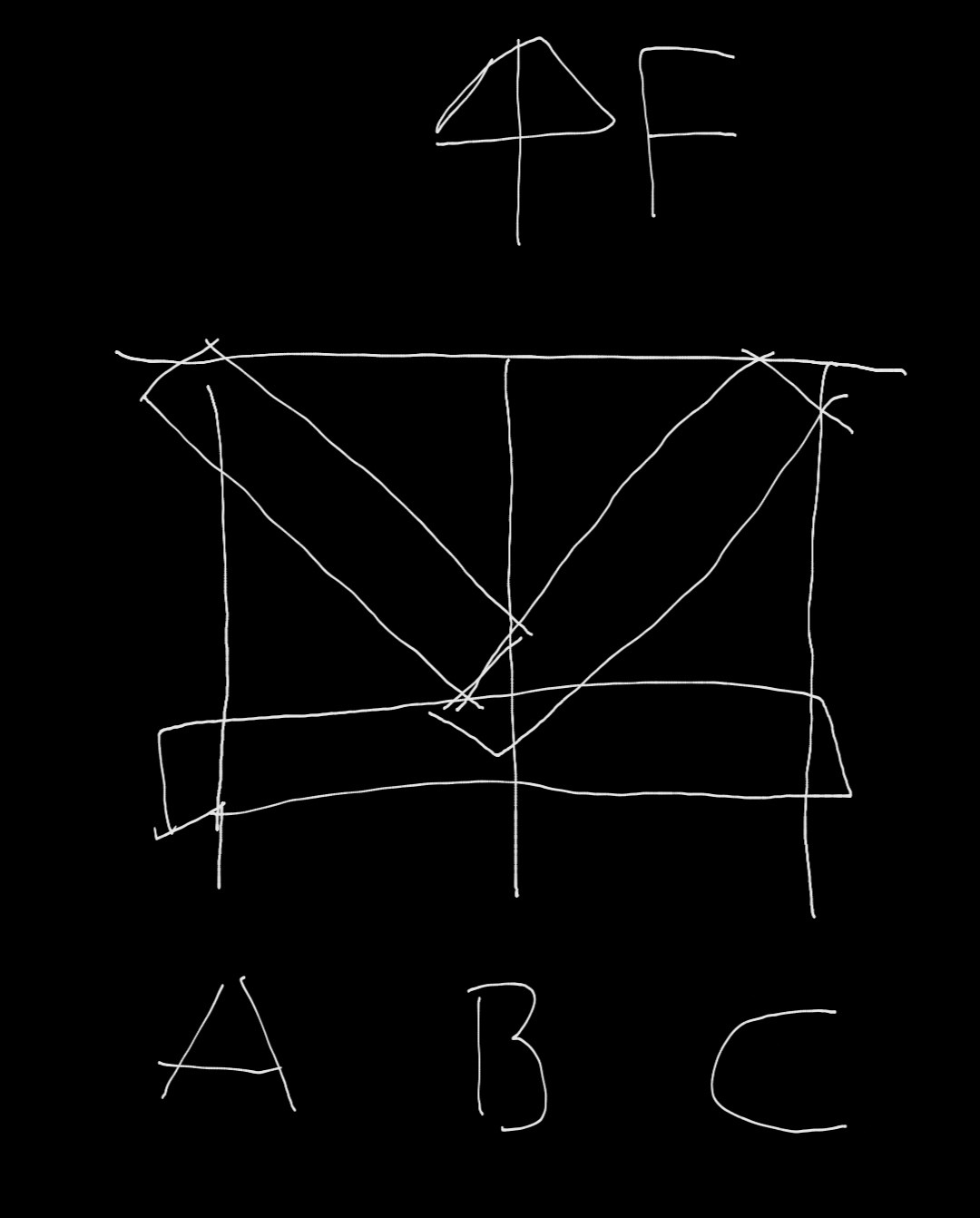
F is the lift force from the wind. The horizontal beam is fixed with moment-stiff attachment to the column at points A and C. Also fixed to approximately 45-degree beams at point B.
Can the vertical force be converted to a moment/tensile force in the horizontal beam in this way?
Apologies for the poor sketch; I hope the idea still comes across.
F attacks from the side as I wrote in #18, read that post carefully again. There is also a force like the one you show but it is relatively uninteresting for the plinths (unless the self-weight is extremely light on everything). Additionally, as I also wrote, it seems to also act downward because the wind also blows under the roof. Sometimes, for large roofs, you may need to add a horizontal force for friction against the roof surface.
In this case, you need to calculate the wind load from the posts and beams. It's probably according to the book, but the wind load is likely quite small compared to if the walls are solid.
In this case, you need to calculate the wind load from the posts and beams. It's probably according to the book, but the wind load is likely quite small compared to if the walls are solid.
I read your post carefully, but Eurocode 1-4 chapter 7-4 (I think, for canopies). Gives a very large lifting force, i.e., vertically. (Cp around -0.7 if I remember correctly, I only have my phone with me).W witten said:F attacks from the side as I wrote in #18, read that post carefully again. There is also a force like the one you show but it's relatively unimportant for the footings (unless it's extremely light self-weight on everything). Also, as I wrote, it seems to act downward because it also blows under the roof. Sometimes for large roofs, you might need to add a horizontal force for friction against the roof surface.
In this case, you need to calculate the wind load from posts and beams. It is probably correct by the book but the wind load is likely quite small compared to if the walls are solid.
I really want to understand this completely by the book to learn. Really grateful that you/you all are willing to help.