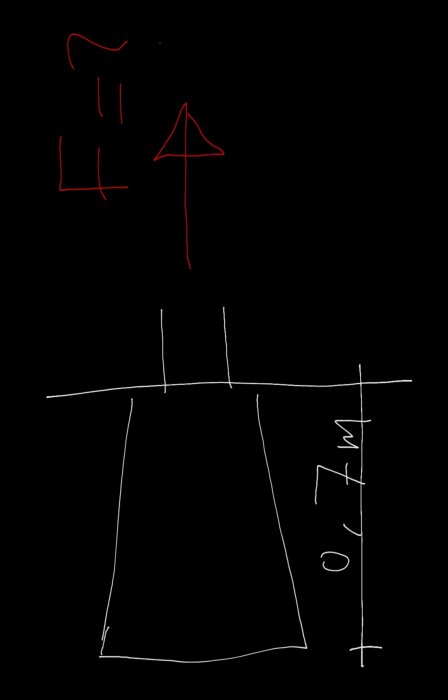
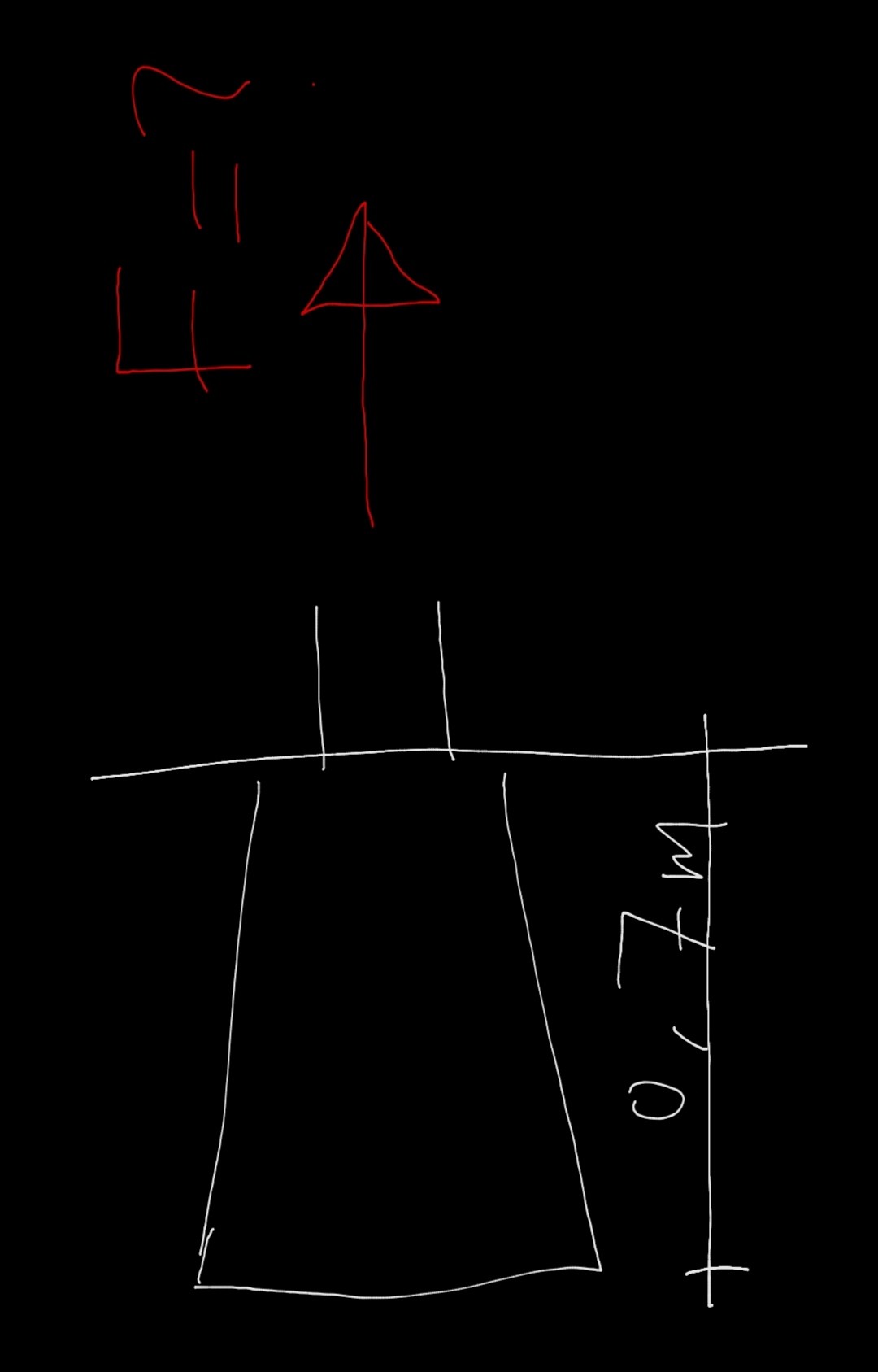
What can we allow F to become in this case, i.e., what lifting force can such a pillar withstand?
What I primarily wonder is whether we get any additional force, besides the self-weight of the concrete, from such as friction between the soil and the pillar, which counteracts the pulling up of the pillar from the ground.
How much lifting force can a typical concrete pillar 700mm below ground handle?
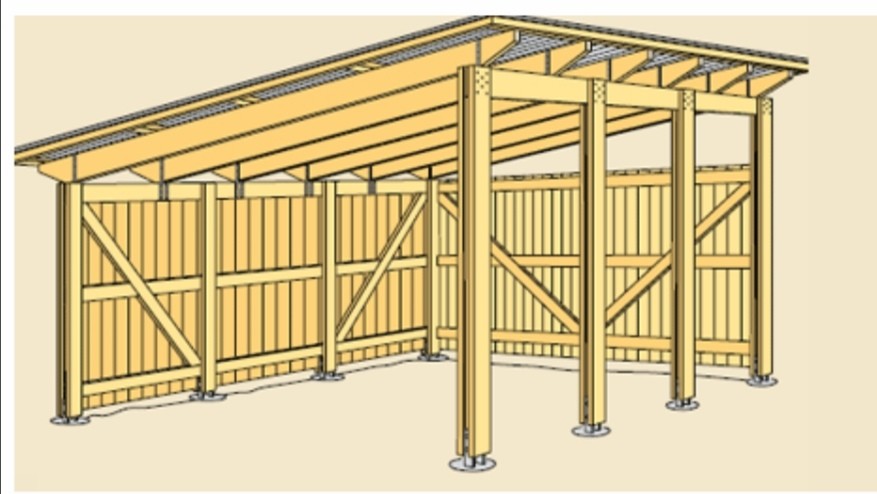
Pillars of the following type:
[link]
We have a load case according to:
[image]
What can we allow F to be in this case, i.e., what lifting force can such a pillar withstand?
What I mainly wonder is if there is any additional force, besides the self-weight of the concrete, from e.g., friction between the soil and the pillar, that counteracts the lifting of the pillar from the ground.
For safety, I would not count on any interaction effect. This is usually done with certain special piles and even then, it is in broad strokes. Then it depends, as polarsson mentions, on the type of soil involved. Check two cases:
1) Sufficient anchoring length for post shoes or whatever you need in the pillar.
2) That you actually do not pull up the entire pillar. There, I would only count on the weight of the pillar as a counterforce.
If you want to increase the counteracting lifting force, you can cast a slab under the concrete pillar in this way you get a counteracting weight of the earth.
For safety's sake, I wouldn't count on any interaction effect. This is usually done with certain specific piles and even then it's roughly. Then it depends, as polarsson mentions, on what type of soil it is. Check two cases:
1) Sufficient anchorage length for post shoes or whatever you're using in the footing.
2) That you're not actually pulling up the entire footing. There I would only count on the weight of the footing as counteracting.
If you want to increase the counteracting force, you can cast a slab under the concrete footing, in that way you get a counteracting weight from the soil.
Thanks, it sounds reasonable to calculate as you suggest.
I have to recalculate the wind load on the carport as I must have made a mistake somewhere. This is because I got it to q_d = 1.5 kN/m2, which over 30m2 corresponds to 45kN. Distributed over 8 footings (cc 1.6) it is 5.6 kN/footing. Meaning each footing should weigh 5.6*100= 560kg.. When a regular footing weighs 50 kg.
This means that in my calculation I would have needed 80 footings on 30m2, so somewhere I miscalculated the wind load.
Thanks, it sounds reasonable to calculate as you suggest.
I need to recalculate the wind load against the carport as I must have made a mistake somewhere. This is because I got it to q_d = 1.5 kN/m2 which over 30m2 corresponds to 45kN. Distributed over 8 foundations (cc 1.6) that is 5.6 kN/foundation. That means each foundation should weigh 5.6*100= 560kg.. When a regular foundation weighs 50 kg.
This corresponds to me needing 80 foundations on 30m2 in my calculation, so somewhere I've calculated the wind load wrong
Have you considered the static system correctly?
It's the case that the frame transfers the wind load down to the bolts in the foundations. You need to calculate what the line load on a beam will be, and then determine the fixed-end moment. Convert this into a force pair, and then you'll have tension in one bolt and compression in the other. That's when you'll have your lift force.
Have you considered the statistical system correctly?
It is likely that the framework brings the wind load down to the bolts in the pilings. You have to calculate what the line load on a beam is to then get the moment of support. Convert this into a couple of forces and then you get tension in one bolt and compression in the other. Then you have your lifting force.
Sscorp1on said:
Have you considered the statistical system correctly?
It is likely that the framework brings the wind load down to the bolts in the pilings. You have to calculate what the line load on a beam is to then get the moment of support. Convert this into a couple of forces and then you get tension in one bolt and compression in the other. Then you have your lifting force.
Sscorp1on said:
Have you considered the statistical system correctly?
It is likely that the framework brings the wind load down to the bolts in the pilings. You have to calculate what the line load on a beam is to then get the moment of support. Convert this into a couple of forces and then you get tension in one bolt and compression in the other. Then you have your lifting force.
No, I haven't calculated like that at all. Instead, I calculated that there is a total wind uplift of 45 kN over the roof, which is held down by 8 pilings. I don't understand how to calculate according to your example.
It is difficult to account for the lift force in carports. If you rely only on the self-weight of the concrete, it often requires an annoyingly large amount of concrete. If you build with wind bracing, all lift force will be directed to the pillars with a brace. If you build with solid walls for stabilization, the force is distributed more evenly to the pillars.
A pillar with a plate underneath is a good solution, as it utilizes the self-weight of the earth.
So you imagine that it is 30 m2 surface area that is lifted vertically up by a force equivalent to 1.5 kN/m2?
The horizontal wind load causes a moment in the fixation between the post and vertical beam.
It is uncommon to calculate posts and footings as fixed. Even if you calculate them (partially) as fixed, you have a global moment on the building to consider.
Carports are often built with wind braces made of boards or wires.
It is difficult to account for the lift force in carports. If only the concrete's own weight is to hold against it, it often requires agonizing amounts of concrete. If you build with wind braces, all lift force goes to the pillars that have a brace. If you build with solid walls as stabilization, it is more evenly distributed to the pillars.
A pillar with a plate underneath is a good solution, as it uses the earth's own weight.
Would a wind brace on the back wall be enough then? Something like this:
But only a wall and wind brace on the backside, would that work?
Also, keep in mind that calculating wind loads is not simple. It depends on a number of factors such as terrain type, reference speed, and shape factor. The system under consideration is also divided into a number of zones.
Also, remember that the carport itself has some weight, which counteracts the lift force.
Keep in mind that calculating wind loads is not simple. It depends on a number of factors such as terrain type, reference speed, and shape factor. The system in question is also divided into a number of zones.
Also, remember that the carport itself weighs quite a bit, which counteracts the lift force.
It is the shape factor I am unsure about in this case. And then I have assumed the same zone to calculate the entire roof. Feels like there should be some computer program for this.
Vi vill skicka notiser för ämnen du bevakar och händelser som berör dig.

Ahmada said:
Hi,