
Hi,
I've experienced a leak in the house. Water is probably coming in through the eave and has run into the wall. It has flowed down the entire wall and is coming out into the crawl space. I've opened up the wall on the upper floor and can confirm that it has been ongoing for a while since there is moisture and mold damage. I estimate that 3 rooms need to be demolished, including 2 tiled bathrooms. Feels like a moderately fun Christmas gift.
I would really just appreciate input on this, if anyone has been in similar situations and how it's been handled by insurance companies, etc.
The house is relatively new, from 2012. It's a 1.5-story built on a crawl space. The house was constructed in sections in a house factory, which was assembled on site by a construction company that also finished the exterior.
I can see that the water leak starts at the eave. I've drilled holes in the ceiling gypsum and the ceiling is dry. It's been very windy here recently and rained a lot. So one theory is that the gutters are improperly installed. They slope towards the middle. Water has collected in the gutter and blown in under the eave through the roof ventilation.
I've contacted the insurance company, which said we should bring in an inspector to determine the origin of the damage. But when I talk to the insurance person, he says it probably involves a construction defect and that it's the builder's liability insurance that should cover it. The construction company has gone bankrupt several years ago...
Well hmm. Thoughts, advice?
I've experienced a leak in the house. Water is probably coming in through the eave and has run into the wall. It has flowed down the entire wall and is coming out into the crawl space. I've opened up the wall on the upper floor and can confirm that it has been ongoing for a while since there is moisture and mold damage. I estimate that 3 rooms need to be demolished, including 2 tiled bathrooms. Feels like a moderately fun Christmas gift.
I would really just appreciate input on this, if anyone has been in similar situations and how it's been handled by insurance companies, etc.
The house is relatively new, from 2012. It's a 1.5-story built on a crawl space. The house was constructed in sections in a house factory, which was assembled on site by a construction company that also finished the exterior.
I can see that the water leak starts at the eave. I've drilled holes in the ceiling gypsum and the ceiling is dry. It's been very windy here recently and rained a lot. So one theory is that the gutters are improperly installed. They slope towards the middle. Water has collected in the gutter and blown in under the eave through the roof ventilation.
I've contacted the insurance company, which said we should bring in an inspector to determine the origin of the damage. But when I talk to the insurance person, he says it probably involves a construction defect and that it's the builder's liability insurance that should cover it. The construction company has gone bankrupt several years ago...
Well hmm. Thoughts, advice?
What does it look like on site, how far does the eave extend, and how are the gutters attached, is there eaves flashing that ensures water doesn't go between the gutter and the edge, water can, if it's not very steep, flow around an edge quite far in, it's called surface tension
If it's a standard house with design drawings, it might be a construction flaw
Some photos of how it looks say more than a hundred words
If it's a standard house with design drawings, it might be a construction flaw
Some photos of how it looks say more than a hundred words
These damn insurance companies.....EliGum said:
Hello,
I've had a leak in the house. Water is probably coming in through the eaves and has run into the wall. It's been running down the whole wall and coming out into the crawl space. I've opened up the wall upstairs and can confirm it's been going on for a while since it's damp and moldy. Estimate that 3 rooms need to be torn down, including 2 tiled bathrooms. Feels like a moderately fun Christmas gift.
I would just appreciate some input on this, if anyone has been in similar situations and how it has been handled by insurance companies, etc.
The house is relatively new, built in 2012. One and a half stories built on a crawl space. The house was built in sections at a house factory and assembled on site by a construction company that also completed the exterior of the house.
I can see that the water leak starts at the eaves. I've drilled holes in the ceiling gypsum and the ceiling is dry.
It's been very windy here lately and rained a lot. So one theory is that the gutters are misaligned. They slope toward the middle. Water has accumulated in the gutter and blown in under the eaves through the roof ventilation.
I've contacted the insurance company, which says we should have an inspector come to determine the origin of the damage. But when I talk to the insurance guy, he says it probably involves a construction defect and that it's then the builder's liability insurance that should cover it.
The construction company has been out of business for several years...
Yeah hmm. Thoughts, advice?
Surely your insurance must step in and take over....
Completely pointless to have an insurance company if they don't help in this situation.
No, it's not a standard house, designed by an architect. It has a very short eave that might stick out a few centimeters over the exterior wall. I remember my dad was pretty skeptical, but it's a design issue... man, I should have listened to the old man. The eave flashing exists. When I went up with a ladder and looked, I could see that water had collected in the gutter where it leaked into the wall. Poor slope on the gutter. Here's a picture, but from the other side of the house...
Yeah, sometimes you do wonder about insurance companies. I don't dare calculate how many thousands we pour into them every month. Then when you need help...
Yeah, sometimes you do wonder about insurance companies. I don't dare calculate how many thousands we pour into them every month. Then when you need help...
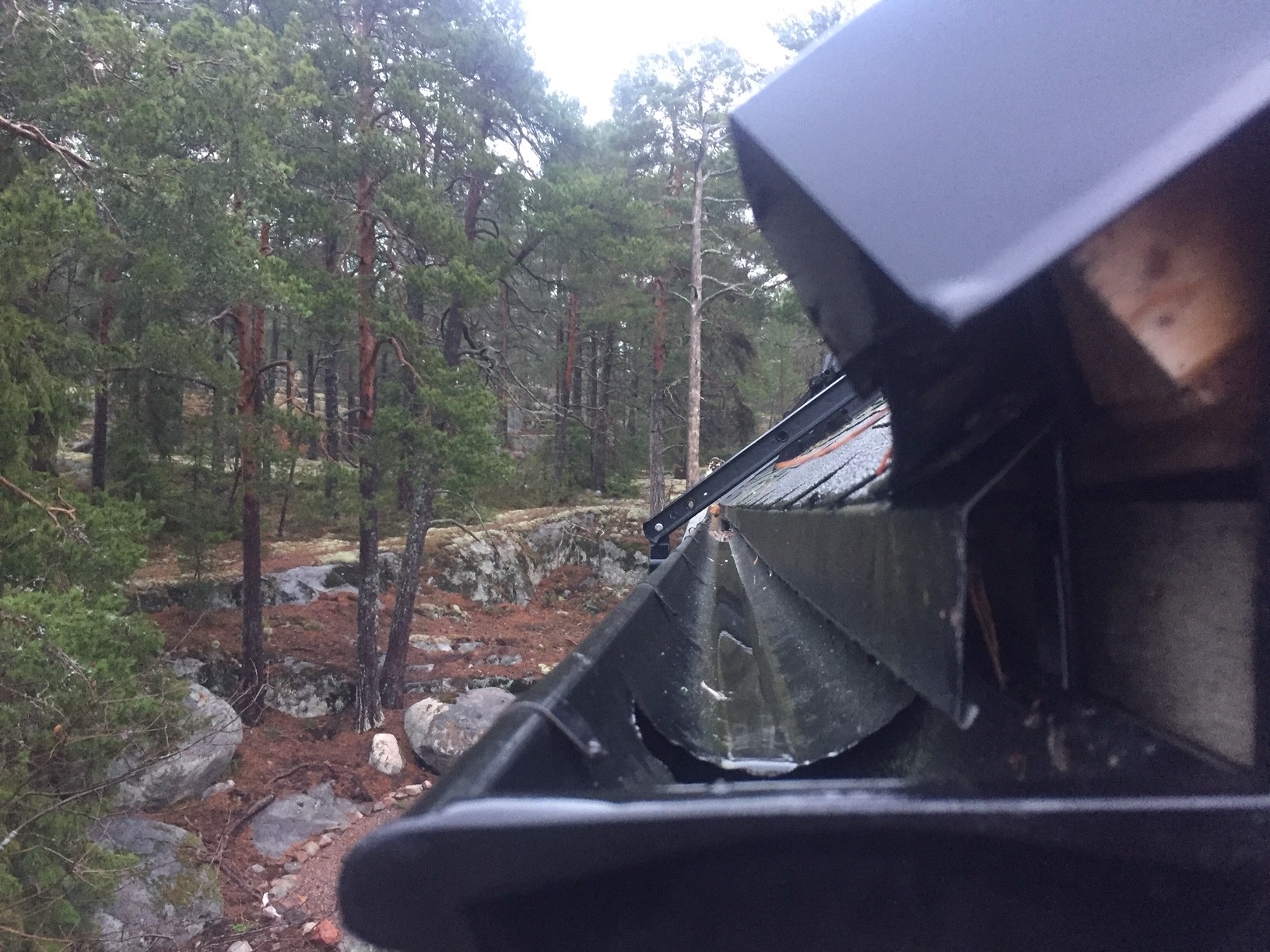
Reminds me of a house that was built in "husdrömmar". Where the eave was very short and Mr. Wingårdh was very skeptical about it. But concerning that this should fall under the builder's insurance. Really insanely annoying. But the problem might be solvable from the outside without breaking too much inside? If you think about how bathrooms, etc. are built.No, it's not a type house, designed by an architect. It has a very short eave that maybe extends a few centimeters beyond the outer wall. I remember my dad was quite skeptical, but it's a design issue... damn, I should have listened to the old man. There is eave flashing. When I went up with a ladder and looked, I could see that water had collected in the gutter where it leaked into the wall. Poor slope on the gutter. Here's a picture, but from the other side of the house...
Yeah, you sometimes wonder about insurance companies. I'm afraid to count how many thousands we pour into them every month. Then when you need help...
Yes, does anyone have experience with liability insurance? For a company that, as far as I know, no longer exists?
I've also been thinking about whether it's easier to approach from the outside. Horizontal paneling does make things more complicated. And then there are battens and fascia boards.
But I'll start by finding the right inspector.
I've also been thinking about whether it's easier to approach from the outside. Horizontal paneling does make things more complicated. And then there are battens and fascia boards.
But I'll start by finding the right inspector.
I think the eaves flashing goes a bit too steeply down, they usually have a slightly narrower angle upward towards the gutter. Try spraying heavily on the roof and see what happens in the gutter, the water can swirl around and under the flashing towards the wall.
Click here to reply