Okay, is there no better option among the alternatives so I can avoid beveling the edges of the studs? What center distance should I aim for with the studs?
"Overdimension properly".. Is a 45x195 load-bearing beam sufficient if I build real walls as load-bearing beams and one load-bearing beam in the center of the shed with posts 1.5m apart?
Also floor joists 45x195.
I actually had planned to recess the floor joists between the load-bearing beams with joist hangers, but then your method of installing the floor joists won't work...? I'm a little worried that the ceiling height in the shed under the middle load-bearing beam will be low...
The plate is only 20mm high. So you can fold down the joists between the beams if you let them stick up 20mm above the beams by adjusting the joists with a slight tilt in the joist hangers.
I can't calculate in my head, but you are, as mentioned, building both a roof and a patio at the same time. It would be unfortunate if the roof started to sag when large amounts of wet snow lay on the patio.
I didn't see a better dimension among the plates you had. So you would need to mill off about 5 x 5 mm on each side of the joists.
I also considered the alternative of building with 315 mm glulam, these are available in 6m beams. Then you should be able to skip the central beam. These are twice as thick as normal joists so you should be able to use a smaller CC distance. I haven't calculated this at all, but if you could use, for example, CC100 on these and place trapezoidal 18 facade plates on it, you could avoid the central beam and posts.
This is just a simple storage shed, so glulam unfortunately is probably not an option. I will have to live with posts in the middle but might go up to 45x220 for both the central support beam and roof joists.
Then build a standard stud frame for walls, like 45x95 cc60, which the roof joists rest on.
Regarding recessing the support beams, could one consider recessing them with joist hangers and then notch the roof joists for 45x70 "battens" and screw the roofing sheets into the valleys on these? Or does the notching weaken the joists too much?
The next question regarding the walls is if you have metal sheeting as wall cladding, can it be screwed directly into the frame or should I have something in between?
If I have boards without batten strip, can these be nailed directly into the frame or should I have something in between?
Set battens as noggings between the roof rafters instead. That way, the sheet metal can lie more or less loosely on the battens. The main thing is that it is fastened to the roof beams. Additionally, you avoid holes in the valleys of the sheet metal and notches that weaken it. Normally, you want good support under the roof sheet, but here the roof sheet won't take any load since everything heavy lands on the decking; there will only be water on the sheet.
The thickness of the support line depends on how closely you set the posts.
It might be smart to place the fence on the edge with post brackets on the decking instead of bringing the posts through the roof. It can be difficult to have the sheet metal pass the posts in a neat way.
You should be able to screw the wall cladding directly into the frame, but you might need to install noggings and diagonal braces between the vertical studs, both to have something to screw the cladding into and for stability against the wind. I assume this will be a completely uninsulated storage shed?
Okay, then I can avoid chamfering the roof rafters, but I'll need to install noggings instead? How would the attachment of sheet metal and rafters actually happen?
Can I let the roof rafters rest on joist hangers on the support line but rest on the beam along the old wall and also on the new exterior wall?
Would you be willing to help with 2 suggestions on how thick a support line would be needed at different post distances?
I've understood that pulling the posts through the roof is a bad option, even if it would be very stable.
How do you mean to screw the posts into the decking? I was thinking about whether one could mount the fence posts outside the "skirt" on the decking, perhaps 70x70 to give a sleeker impression of the fence and 45x45 slats.
You can screw the sheet directly into the frame (studs/crossbars/blocking), but you should place something between the sheet and the wood to reduce squeaking and clicks when the sheet moves with heat/cold/sun/shade. I believe underlay paper works for this.
If you make a substantial and stable support wall/pole wall in the middle, it should work to attach the roof joists with joist hangers. This way, you get better ceiling height under the support/pole wall, and you don't need to buy extra long roof joists.
If you use, for example, double 45x220 (=>90x220) as a girder in the support/pole wall in the middle, you should be able to have relatively sparse spacing between the support poles, possibly up to around 2.5m. Double 45x95 works as support poles. (I would nail and glue the studs/girder together.) NOTE Some form of at least rough structural calculation is recommended.
You can also consider short supports and/or braces at the top of the poles, if the height isn't excessively low, to reduce the free span between the poles. (Old building technique.)
Don't forget masonite as an underlayment, otherwise, there will likely be a lot of condensation drips. If you put sheet metal on the walls, it is advisable to leave gaps in the underlay paper on the bottom plate, top plate, blocking, and braces so that any condensation water can flow freely instead of standing on all horizontal stud surfaces.
Roofing sheet and wood paneling have approximately the same cost per square meter (Byggmax prices), paint and maintenance are additional for the wood. But doesn't it look nicer?
If you build a wooden deck, I assume you plan to be there.
Moreover, you can easily attach hooks, shelves, lights, electricity, etc., in the storage.
Jo actually calculated it might be better with wood paneling. Does it work as previously mentioned to mount wood paneling next to each other without a cover panel?
Yes, it works. That's how I have it on one of my walls in the wood shed and in the barn. It might be that rainwater seeps in on the windward side (west). If it turns out there's too much seepage, it's easy to supplement and put up sealing strips on that side.
But, there seem to be quite a few buildings adjacent to your house; what purpose will the extension serve and where will you enter it? Behind the existing building, that is the shed, there is quite a bit of debris; is that what you are planning to build into? A 54 sqm shed is half a hangar, so couldn't you adapt a more moderate terrace with stairs going down built into it, maybe in different levels? Where is south considering sunny days; can you include a small pool or jacuzzi, how's it going with the little house and the drainage from it? Lots of questions, but it's difficult to have opinions when the overall picture isn't complete.
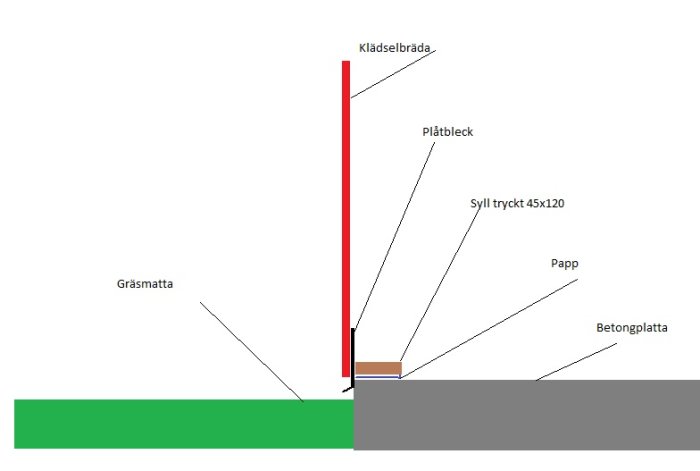
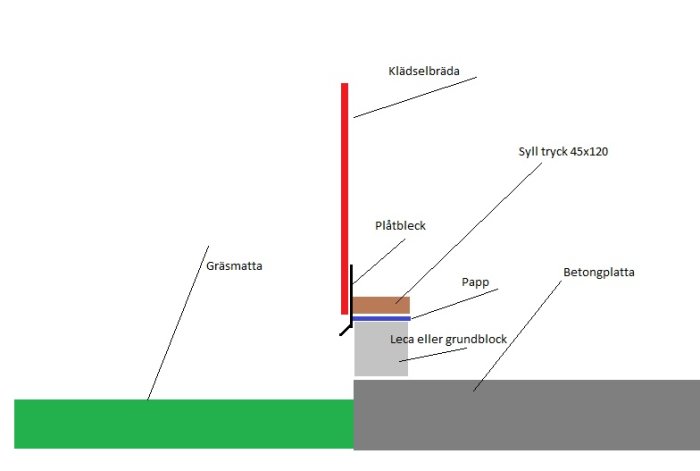
In option 1, I thought of casting in threaded rods with 2 nuts and a square washer directly into the slab to attach the sill. Does option 1 work even if the slab is more or less at ground level?
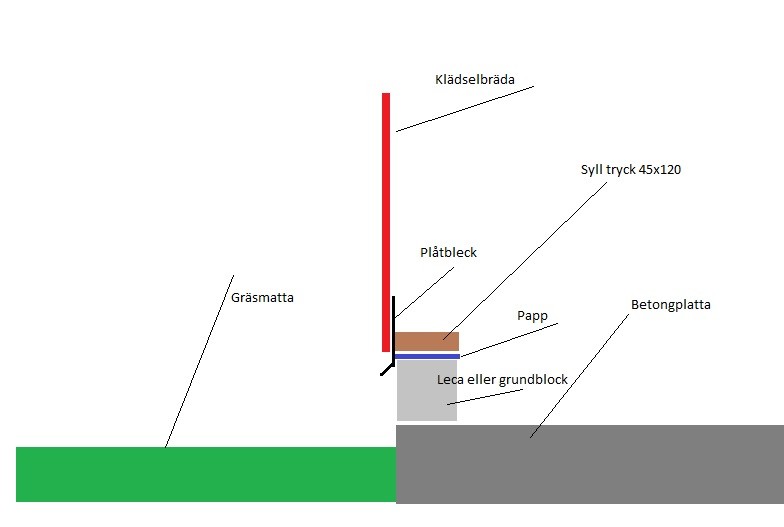
Is option 2 much better, and if so, how do I attach the sill SECURELY to the blocks? Can I do as in option 1 and just have longer threaded rods and drill through the blocks?
Economy is still an important factor in this build, and the storage can be a simple model as long as it holds.
There is a workshop on the lower floor at the large gable. There is a bricked-up window that I'm thinking of converting into a door so you can go from the "hangar" into the workshop. The storage is intended for lawnmowers, outdoor furniture, timber, firewood, etc. I am also thinking of adding a door on the left side of the new wall so you can load and unload, for example, trailers from that side. Since there are finished walls on two sides, I thought it made sense to build big?
I also plan to have a staircase so you can go from the party venue down to the lawn.
The clutter should probably be sorted
The gable is facing south. On the upper floor of the gable, there is a large party venue, and it would be cool to have a balcony extending straight out with a glass door. This gable overlooks the Hallandsås.
You could say I want to kill two birds with one stone: a wooden deck for the party venue and more storage at the same time.
Feel free to give me a suggestion for the layout, etc. I like getting input on my sometimes narrow-minded ideas...
The drainage from the small house can remain, and the metal shed's roof will be placed under the eaves of this building. However, the deck and fence should end outside the gutter.
Vi vill skicka notiser för ämnen du bevakar och händelser som berör dig.