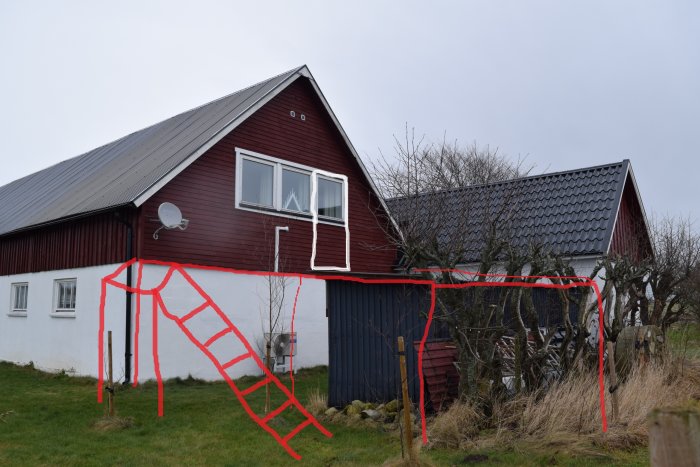
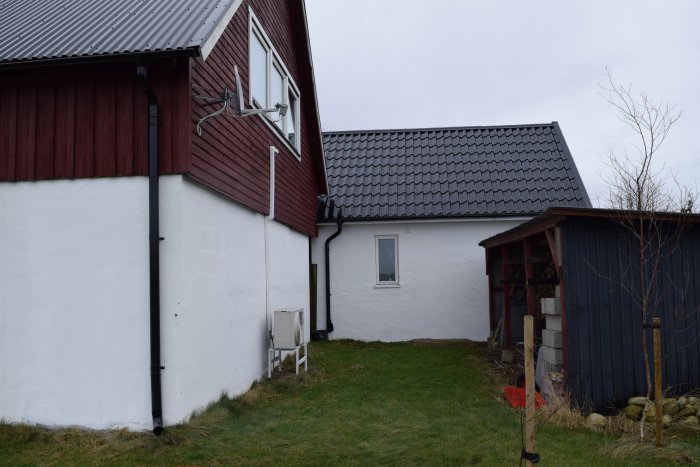
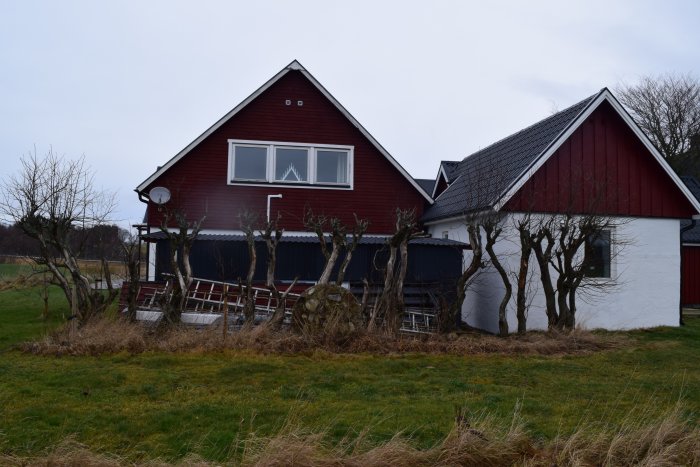
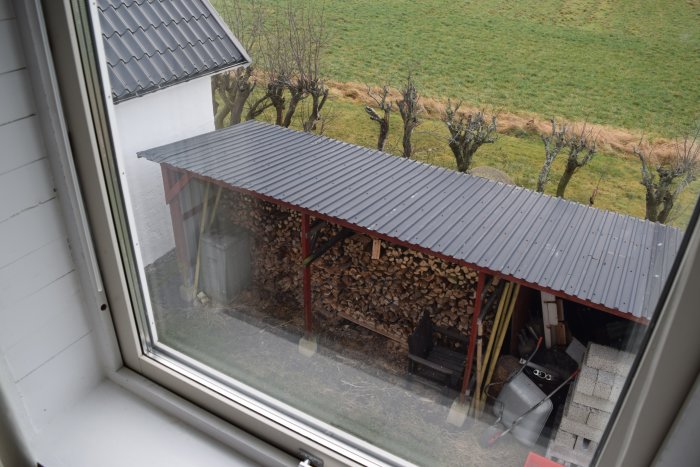
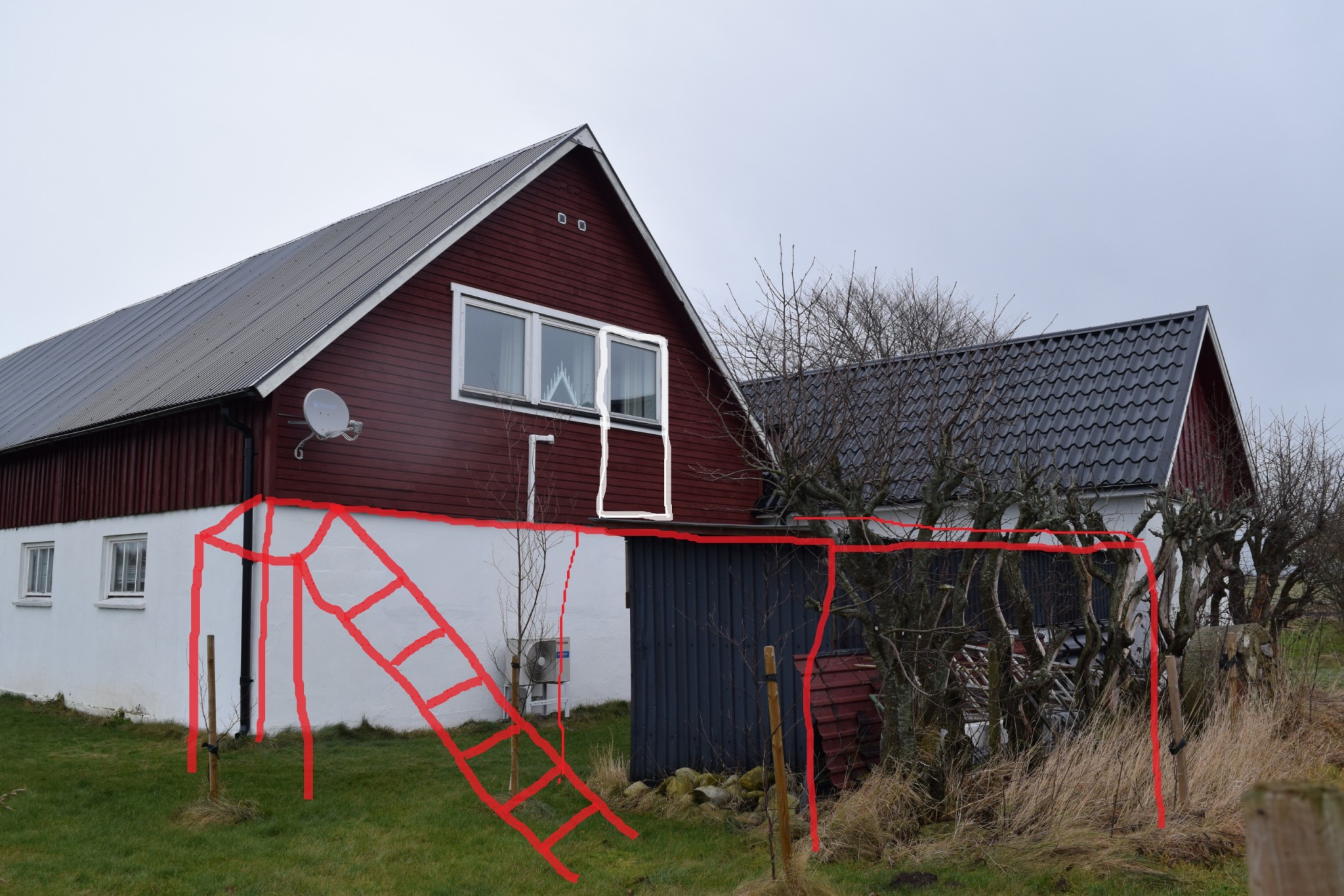
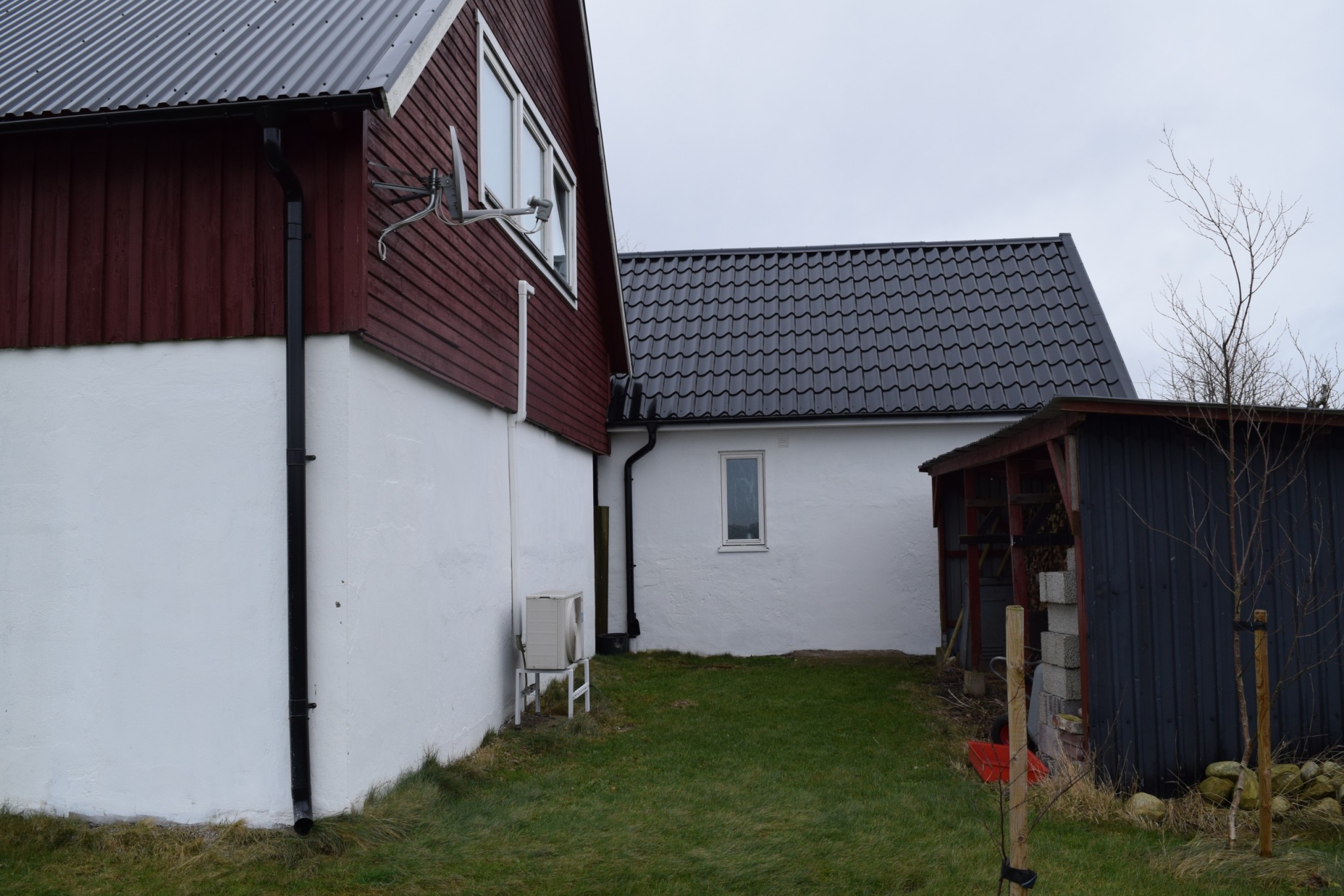
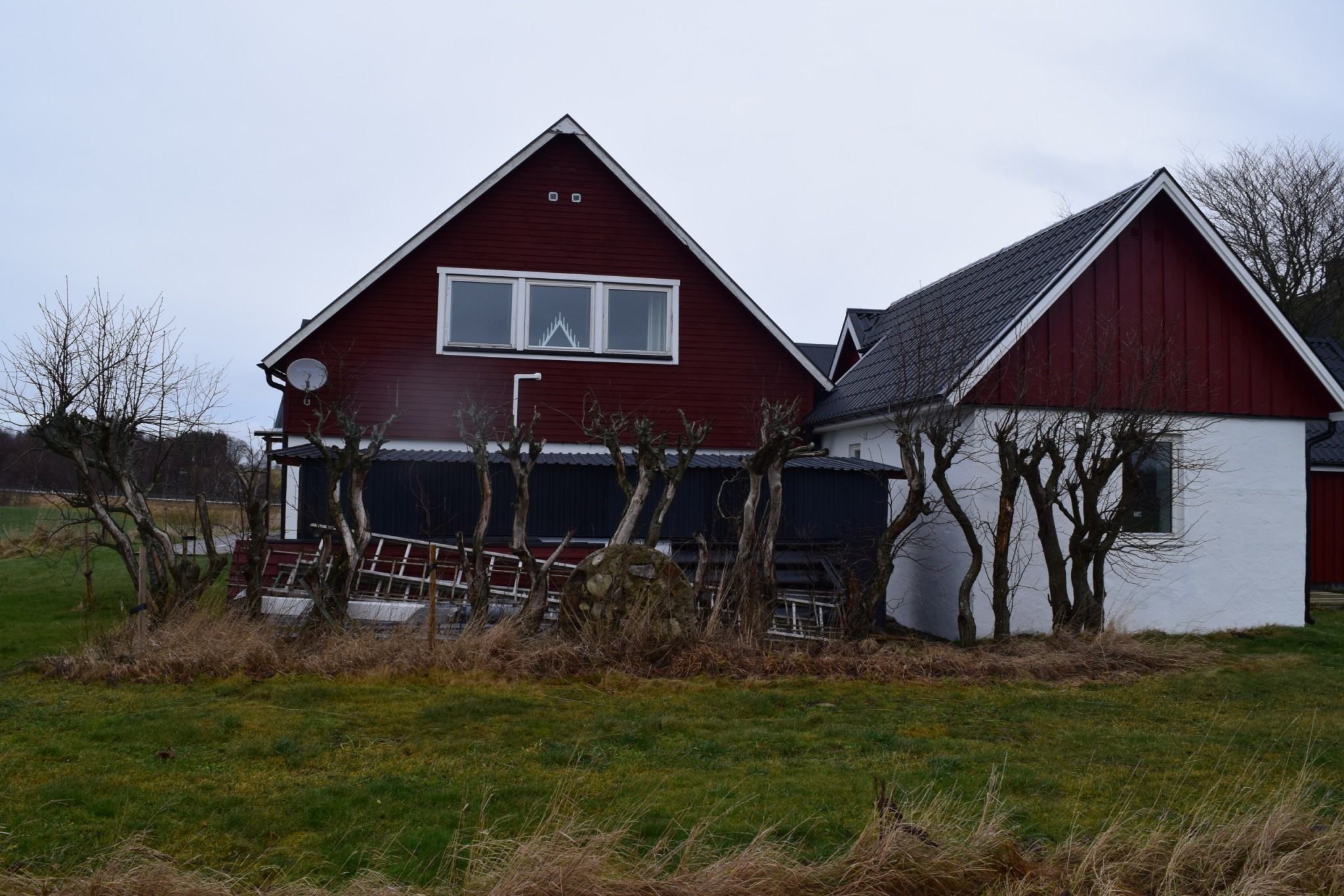
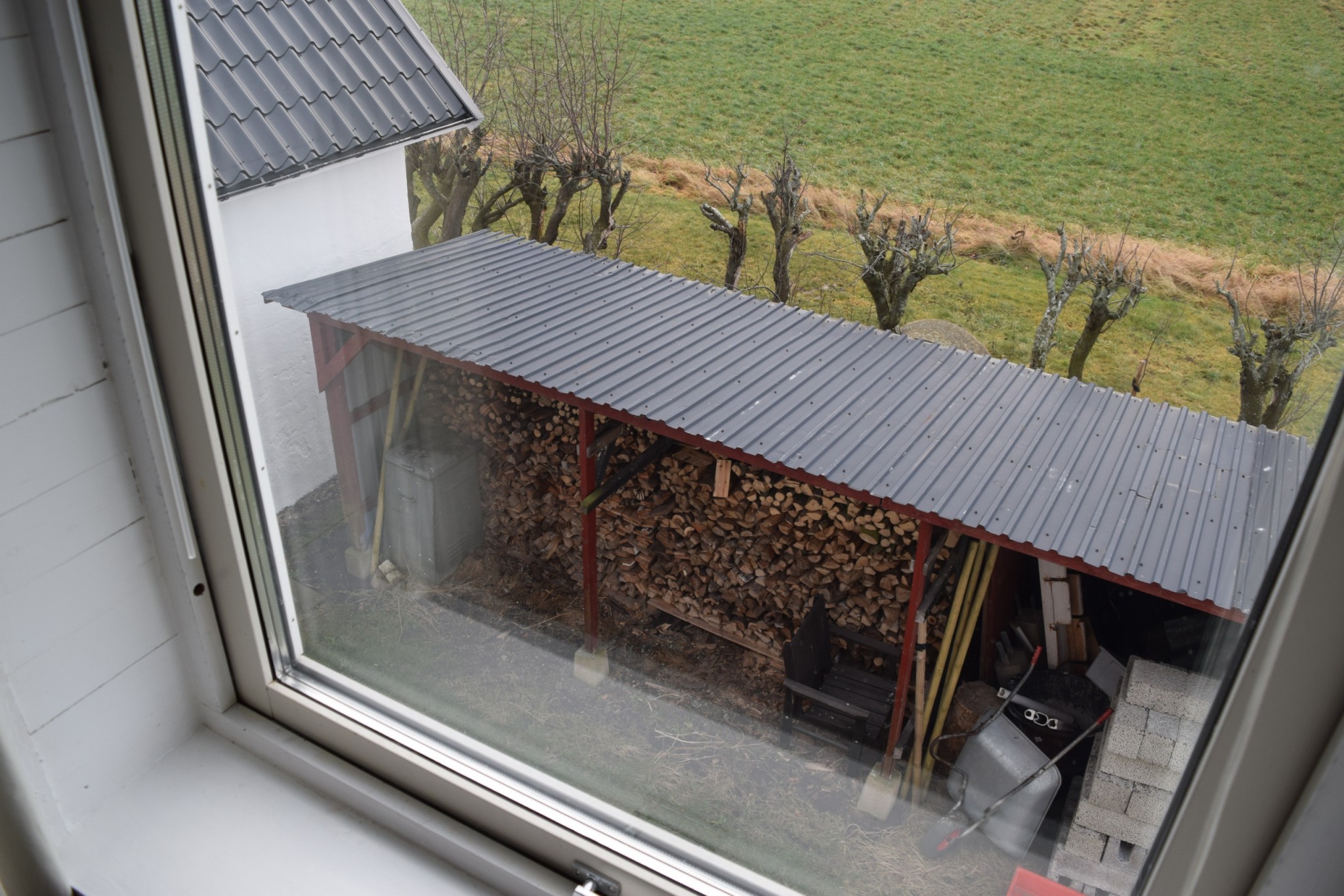
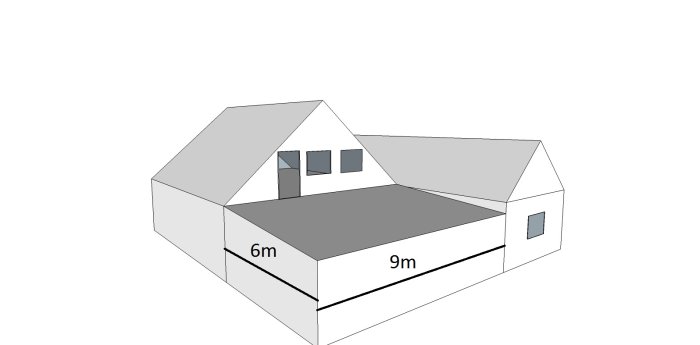
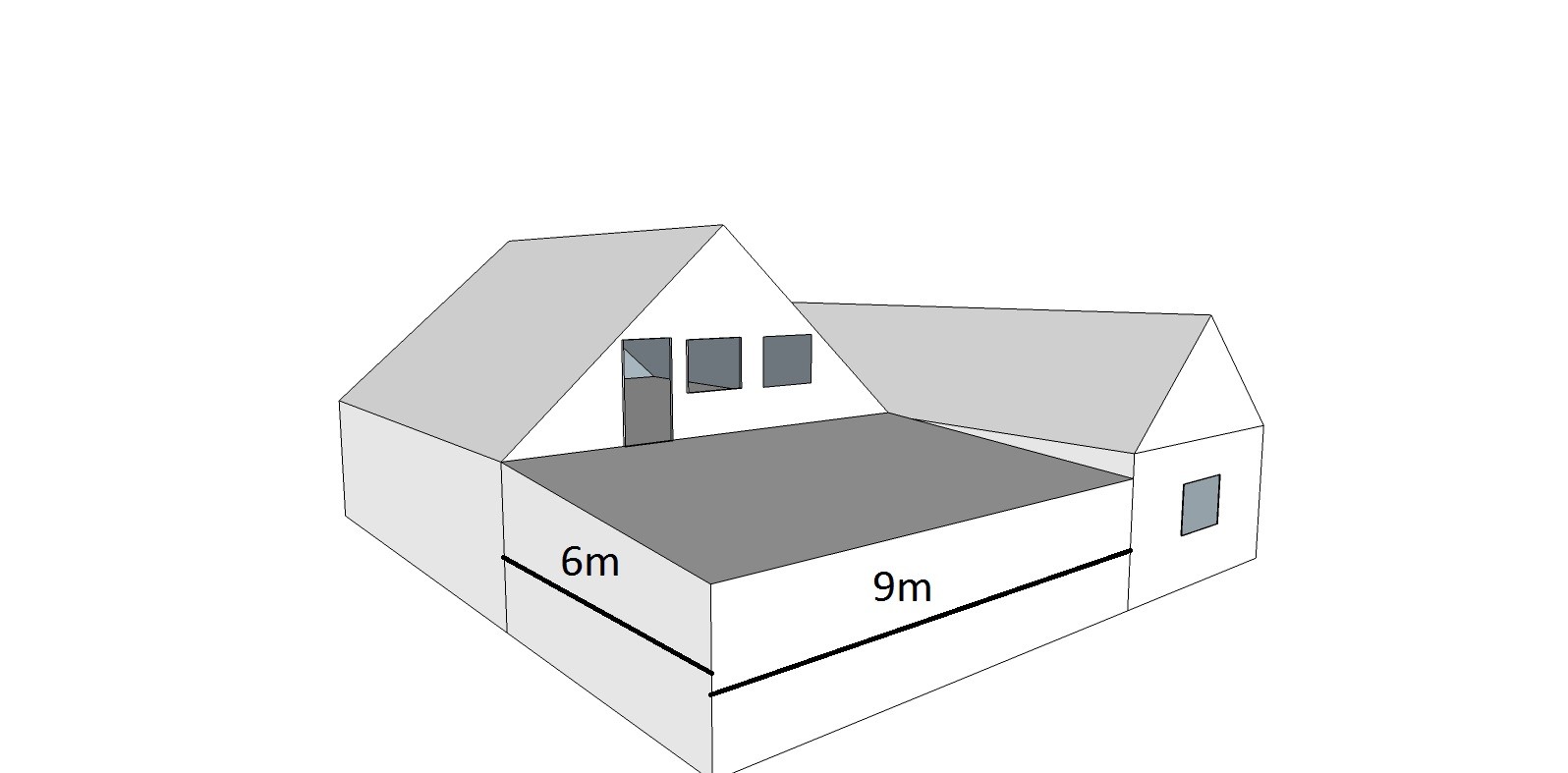
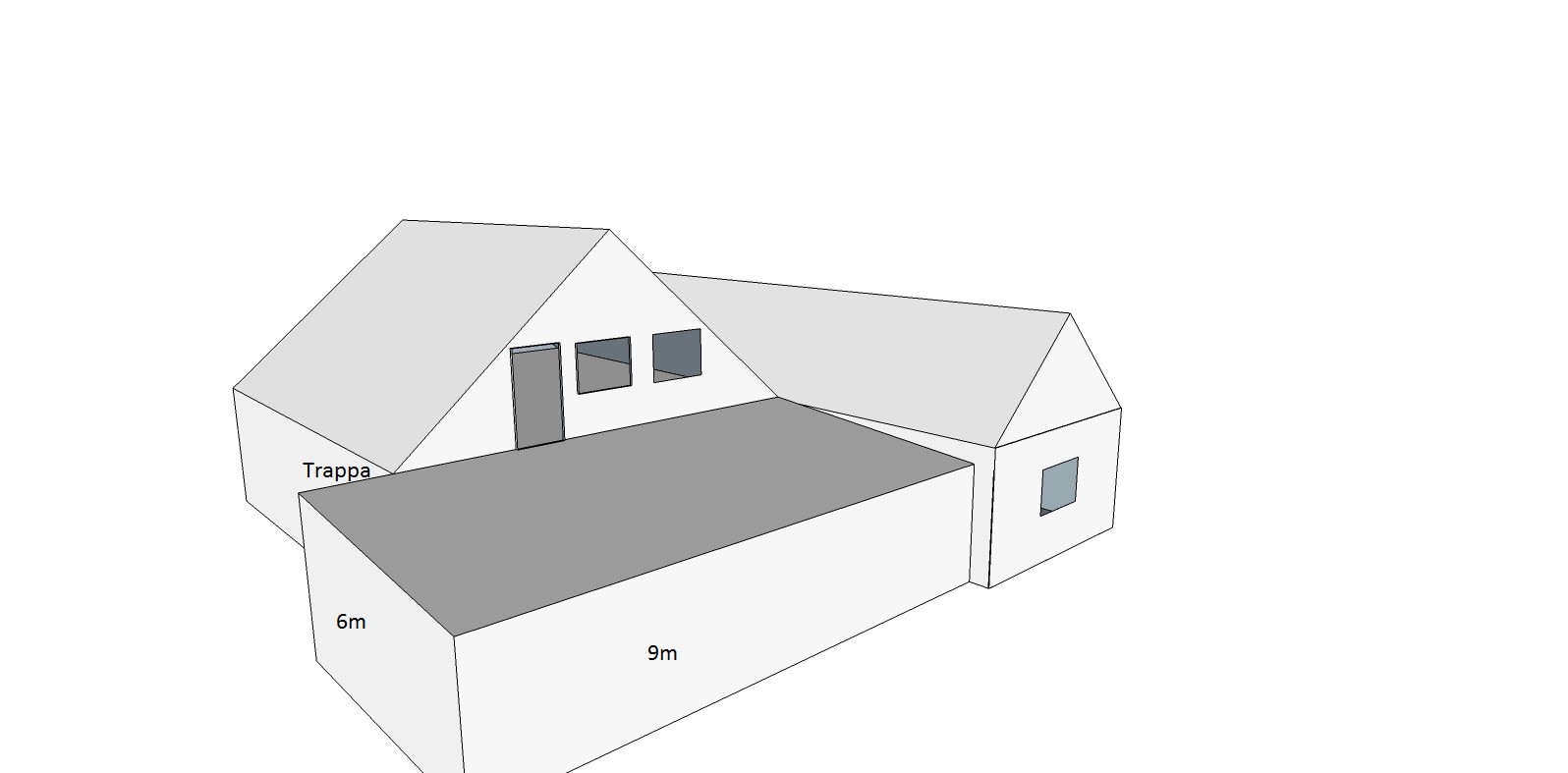
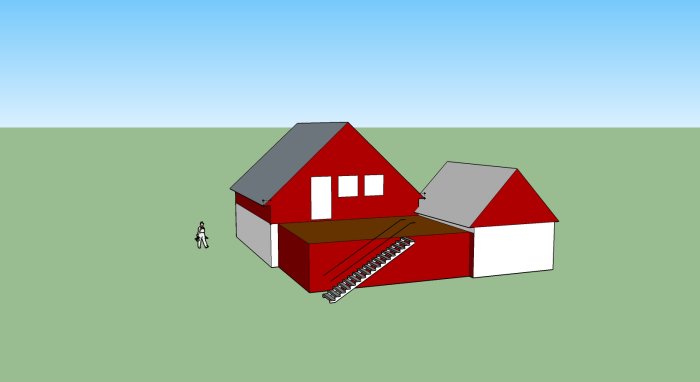
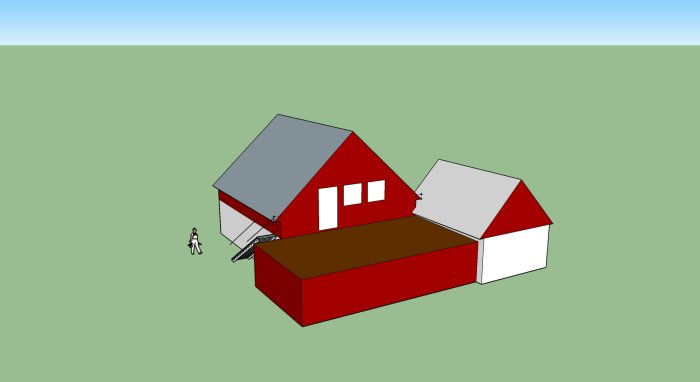
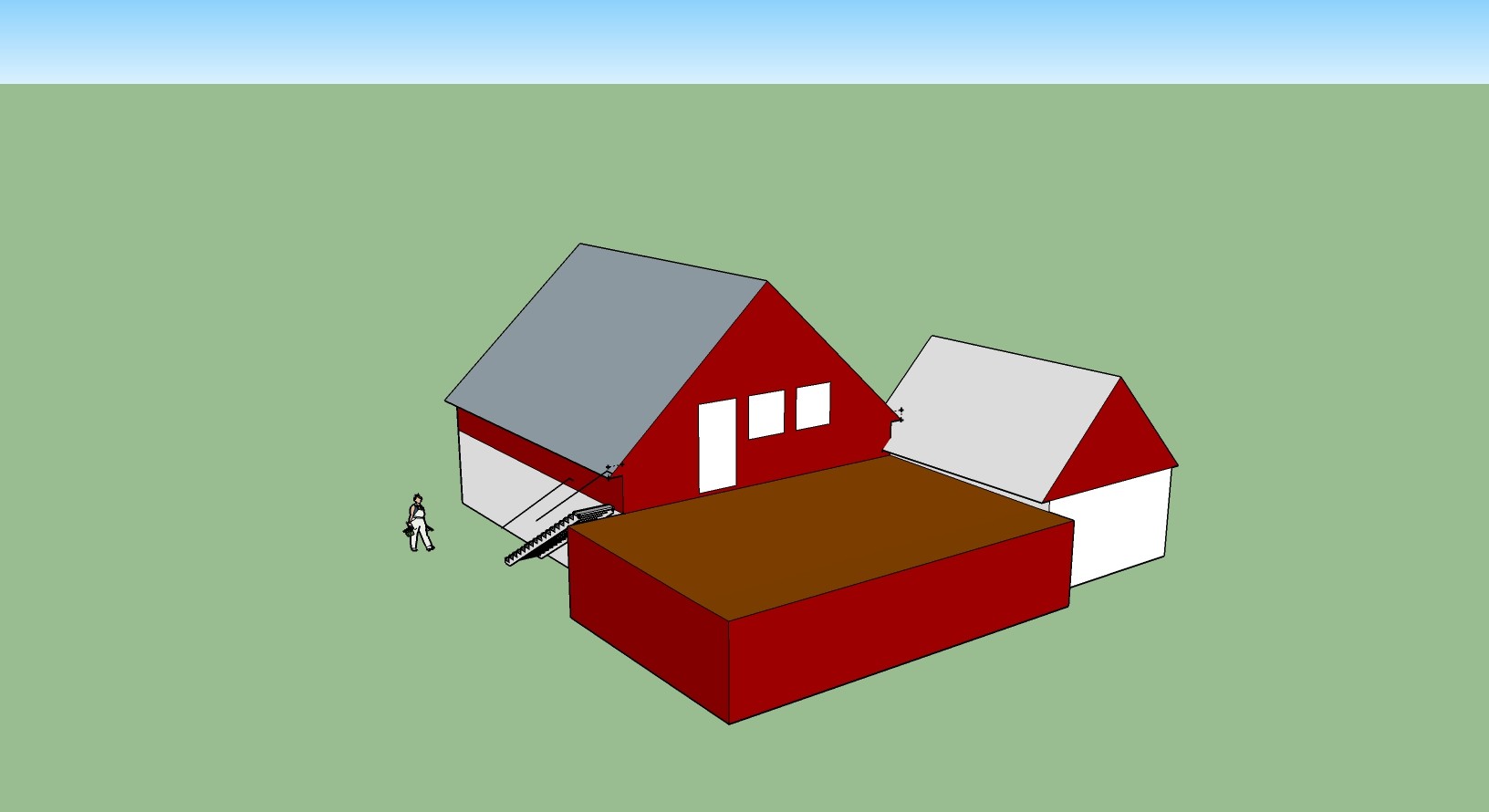
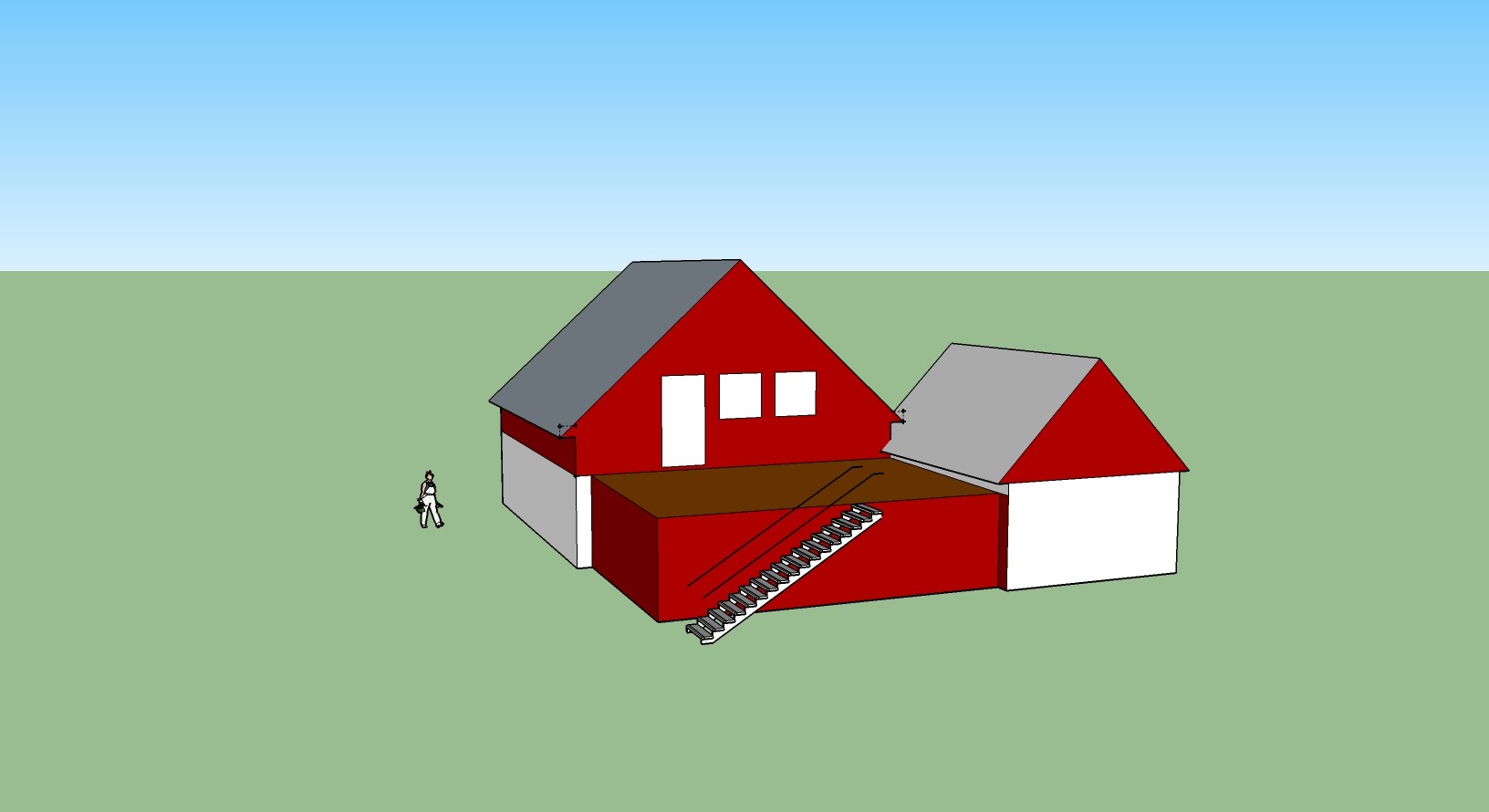
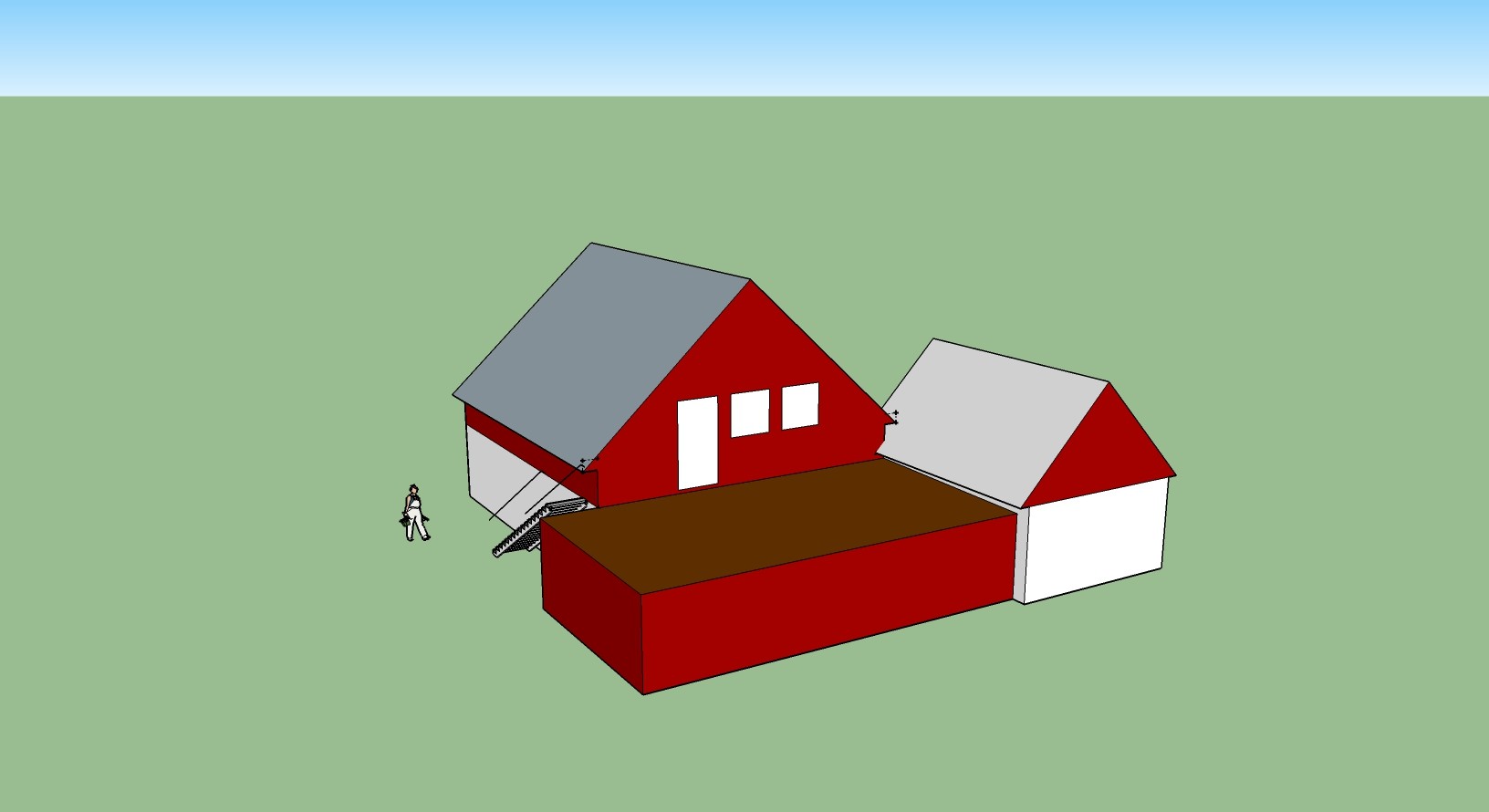
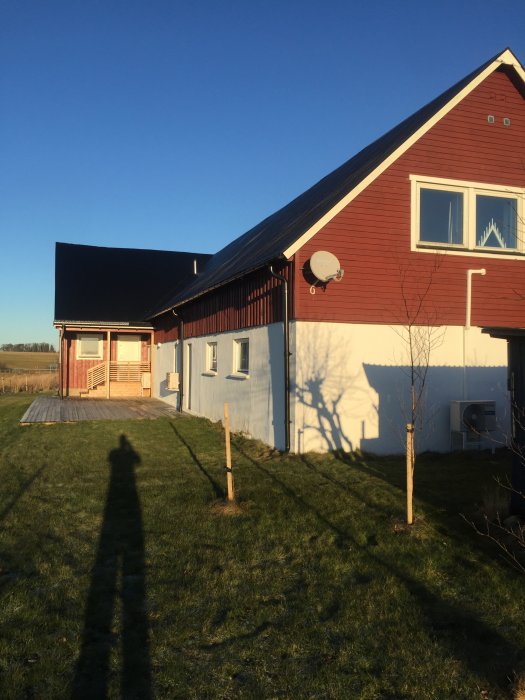
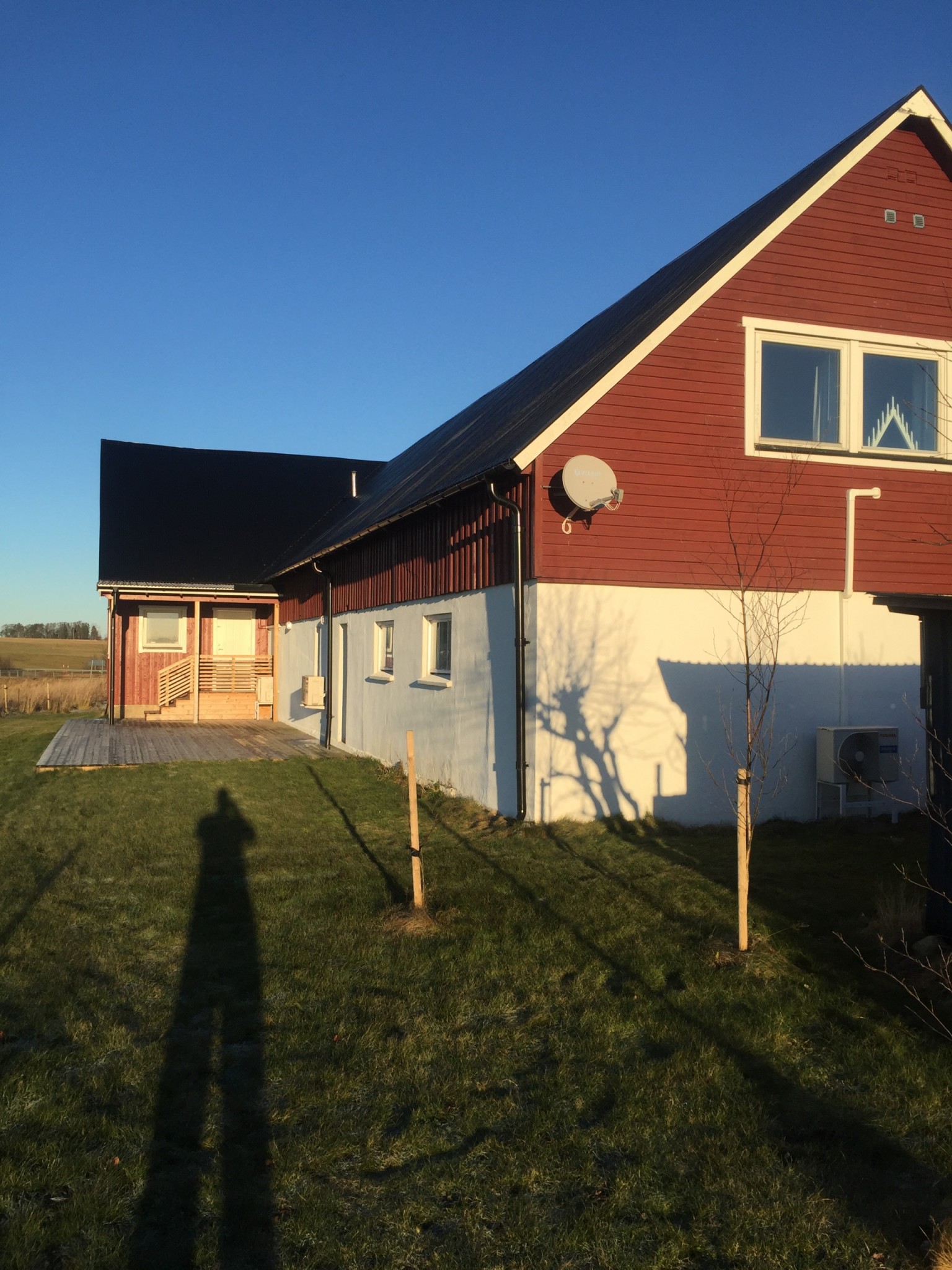
The basic idea is to demolish the existing metal shed and build a new larger one that measures the same dimensions as the gable and adjacent building.
The gable is 9 meters wide and the adjacent building is 6 meters long.
On top of this, build a wooden deck that will be about 2.60m high and install a patio door where there is a window today.
Build a staircase from the deck down to the lawn below, preferably outside the gable on the left side with a platform at the top.
I am thinking of the following construction:
Posts 95x95mm with 3m spacing that go past the load-bearing beam and form the railings for the deck above.
Black simple metal roof.
Walls as the current shed of corrugated metal.
This is a budget project and now to my questions regarding the construction.
1. Foundation:
A) Cast piers and have crushed stone/gravel as the floor in the storage?
B) Cast piers and frame the deck as the floor in the storage?
C) Cast an uninsulated slab in a wooden form with embedded post anchors for all posts directly in the slab?
Can you even do that or should I cast piers first and then also an uninsulated slab.
2. Shed roof, deck floor. How to construct the shed roof and deck floor in the simplest possible way?
Spontaneous thought from below Load-bearing beam 45x195, Joists 45x170 cc 60, Batten 70x45 cc 60, Corrugated metal, Joist 45x170 split at the same pitch as the roof mounted in the valley of the corrugated metal cc 60 positioned directly over the underlying 45x170 joists.
3. Walls:
Frame between posts with 45x70 cc60 and then screw the corrugated metal? Distance between wall sheet and concrete slab 10cm for ventilation for e.g. wood, etc.
So you're planning to enclose the window on the adjacent building?
For primarily aesthetic reasons, the width should be reduced a bit, i.e., <6m, preferably 10-30 cm from the long wall.
For the roof, raw plank and roofing felt should be more suitable.
With a size of about 6x9m, I assume you are counting on a load-bearing wall/support line lengthwise in the woodshed/storage?
If you live in a windy area, I recommend regular vertical siding without locking strips/panel, and base/baseboards. That is, no openings wider than 1 mm to keep airy/ventilated while not allowing snow(drifts) in, and ideally keeping small rodents out.
Gravel works fine on the floor, but feel free to lay old worn-out tarps or ground cover in plastic or construction plastic under the gravel to reduce humidity in the woodshed/storage and also make the ground drier.
Yes, it's a window to a toilet but yeah, that's what I thought :/
Hmm, I'm thinking the width of the gable is 9m and the adjacent building is 6m. What dimensions should I adjust for aesthetic reasons?
Ok, why are råspont and roofing felt more suitable? Do you have any comments on my planned roof/deck construction as I would, as mentioned, like to keep costs down as much as possible.
It's very exposed to wind.
The shed will be used for wood, lumber storage, and winter storage of garden furniture.
My latest consideration regarding the foundation is:
Excavate the soil about 20cm, lay some form of ground fabric, then add a base layer type 8-16 up to ground level, then build a wooden form, then vibration-free concrete about 10cm (the slab will be about 10cm above the current ground level). Install post anchors and threaded rods with flat washers and nuts embedded in the slab, and then lay a pressure-treated sill as a base for the walls between all the posts?
Skip gaps at the bottom of the walls and let the roofing sheet or panel extend beyond the concrete slab.
I think the dimensions seem way too flimsy. A 6-meter span on an almost flat roof with a 170-board sounds way too little even with CC60. This needs better calculations. A regular joist is normally built with CC60 and 300mm joists. I almost think you have to go up to laminated beams here if you don't place posts in the middle of the shed.
Purely spontaneously, I also think it will be incredibly disproportionate and simply terribly ugly.
I think the dimensions seem far too flimsy. A 6-meter span on an almost flat roof with a 170 joist seems far too little even with CC60. This needs to be calculated better. A regular floor structure is usually built with CC60 and 300mm joists. I almost think you need to go up to laminated beams here if you don't put posts in the middle of the storage.
Just instinctively, I also think it will end up being extremely disproportionate and simply terribly ugly.
Sorry for the lack of clarity, I was obviously planning to put posts in the middle of the storage so the span will only be 3m.
I even considered the following option though:
I will make a more to-scale drawing this afternoon. Then, I have a field as a neighbor on this side so function takes precedence over design.
Okay, that would make it easier. I had at least reduced the house to 8m x 5.5m so that the building ends up within the main structure, including the stairs.
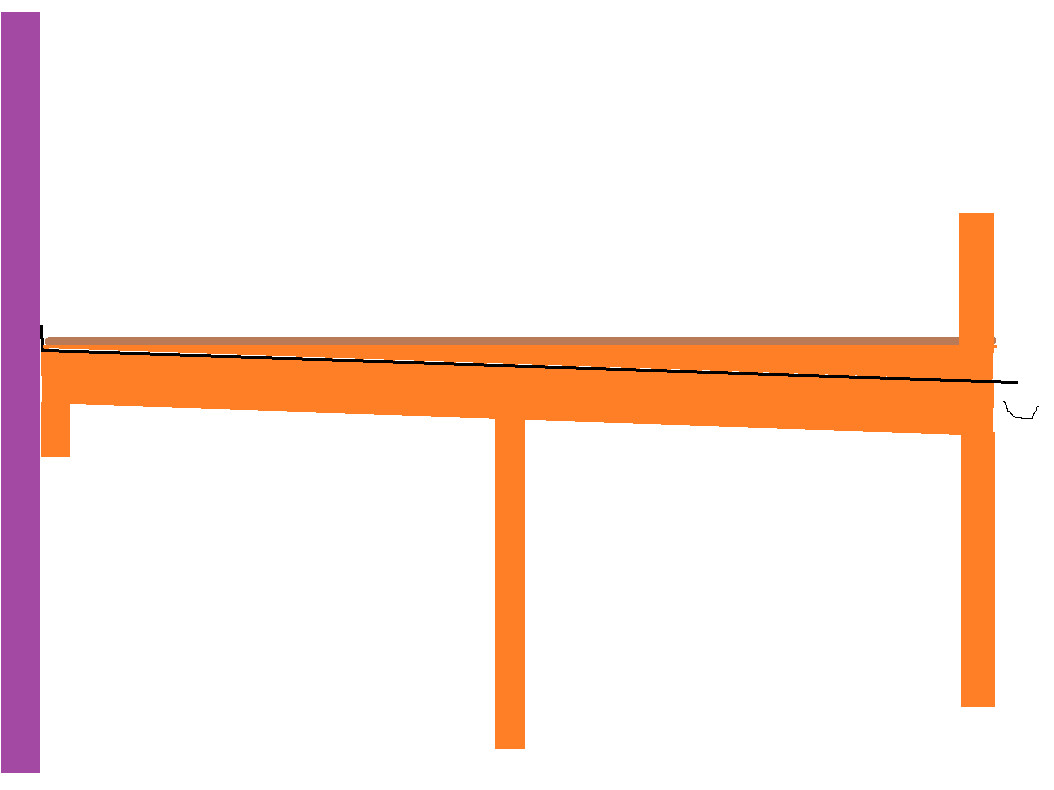
I probably would have laid floor joists with a slight incline and then tried to use wider trapezoidal sheet metal (not TRP20) so that the joists sit under the ridges. Then I would have placed pressure-treated beveled joists on the sheet to compensate for the incline so that the deck becomes level. This should give a gap of between 1-20 cm between the sheet joists and the deck. The only downside would probably be that you need to pre-drill a bit when screwing the decking because you have to go through the sheet in many places.
I think the dimensions seem way too weak. A 6-meter span on an almost flat roof with 170 studs sounds way too little even with CC60. This needs to be calculated better. A common joist is usually built with CC60 and 300mm joists. I almost think you have to go up to glulam beams here if you don't put up posts in the middle in the storage.
Spontaneously, I also think it will be extremely disproportionate and simply awfully ugly.
I agree - Generally, when you calculate on a 45x195 C24 as a support beam under a deck, you get a post distance of 145cm.
As for the joists, it is not far off with a 45x170 that can handle a free length of 267cm.
But yes - It will be too weak. 3 meters between posts and support beams would need to be dimensioned with glulam as the support beam and at least 45x195 as joists, even if it's on the edge in a two-bay construction that would need 45x220 on a 6m span in a two-bay construction.
If you are going to build it according to recommendation, it should thus be support beams: 90x270 of type GL30c and joists 45x220 C24 if the conditions are 3m between each post in X and Y. So there you go!
When building other types of extensions, I have the impression that they are preferably built outside the existing building?
Ok, how close do I need to have between the posts to manage with standard timber 45x220 as beams? My latest suggestion is even to build walls with a sill on a slab and thus place the beams on the walls which are framed cc60 with something like 45x95.
Below are some new suggestions, feel free to reflect on them... Fence not drawn.
Are you willing to explain a bit more how you mean it?
Braces under the purlins and then braces to the decking on top of the purlins? How to screw the sheet or what do you mean?
I have realized it would be good if I could keep the height of braces, roof, decking as low as possible to get a decent ceiling height in the storage but still fit the sheet metal roof under the right Building's gutter.
Do I have to have a 5.7-degree slope, or can I get away with less since I have decking as an extra roof on top?
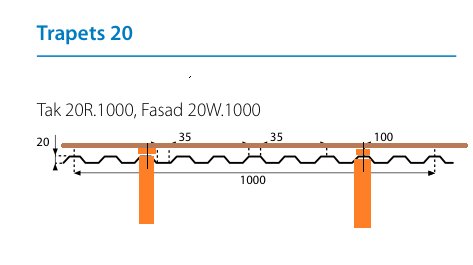
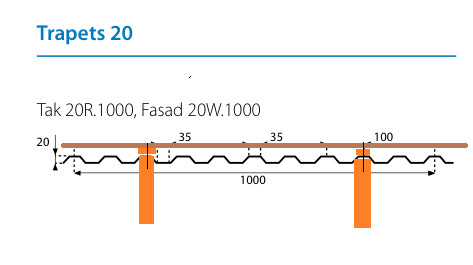
Attaching images of profiles I can get hold of.
pelpet said:
Okay, that makes it easier. I would have at least pulled the house to 8m x 5.5m so that the building ends up inside the house bodies with the staircase as well.
I would probably lay floor beams with a few degrees of slope and then try to lay wider trapezoidal sheet (not TRP20) so that the beams end up under the purlins. Then I would lay treated slanted braces on the sheet to compensate for the slope so that the deck becomes straight. Then you should get between 1-20 cm between the sheet metal beams and the deck. The only disadvantage would probably be that you have to pre-drill a bit when screwing the decking since you'll have to go through the sheet metal in many places.
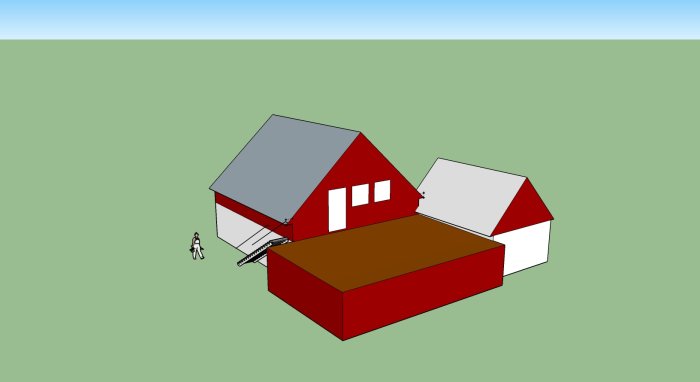
Here is a profile image. The Tp20 sheet will probably work if you bevel the edges of the beams so that they go under the rafters, which are 35mm wide. Then you can have the roof beams under the sheet. On top, place pressure-treated beams that you've mitered so that the deck is straight even if the sheet slopes. Then decking on top of that (brown in the image).
I would settle for maybe a 2-degree slope. I think the requirement for a 5.5-degree slope is due to wanting to prevent water from seeping between the sheets at the joints, but if you lay it with a two-row overlap and a thick silicone bead in between, that problem should be avoided. Choose full lengths for the sheet.
I think you should over-dimension significantly since you will have a load both from the decking and snow on the roof beams. They serve as both a deck and a roof at the same time.