Need some help with calculations and bouncing ideas around construction for my pier. The location is exposed and open in the Baltic Sea. The existing pier is 8x2 meters with a concrete block on rock at the shoreline and a concrete caisson about 10 tons on a gravel bottom approximately 6 meters out in the water. The concrete caisson, if I remember correctly, has three piles down to the rock (?) embedded in it. The pier has been completely destroyed for some time now after a difficult ice winter. The caisson has tilted. Perhaps a pile has broken. It probably needs to be removed.
I am considering changing the construction solution and building up the concrete block at the shoreline quite substantially and attaching two steel beams extending over the water there. The pier needs to extend 8 meters out. The concrete block can certainly be built about an additional meter out into the water, which leaves approximately 7 meters to the beams.
Is it realistic to build such a construction? What dimension of beams is required?
I don't need it to be stable at the very end. It's okay if it sways, but it must hold.
Any other measures that might be appropriate in this context?
Hmm, interesting.
Usually, I would have suggested a floating dock, but I'm quite sure that a hanging dock is the solution for you.
Image-Google hanging dock so you can see the construction and can surely build one yourself.
However, forget about placing a boat next to it. They handle side forces poorly.
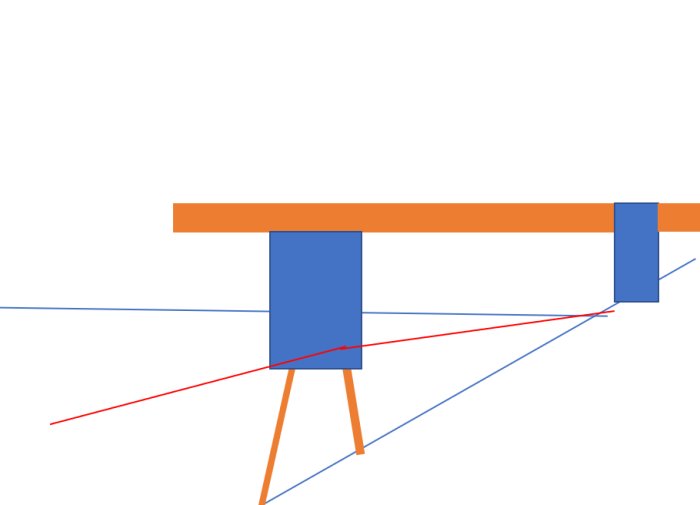
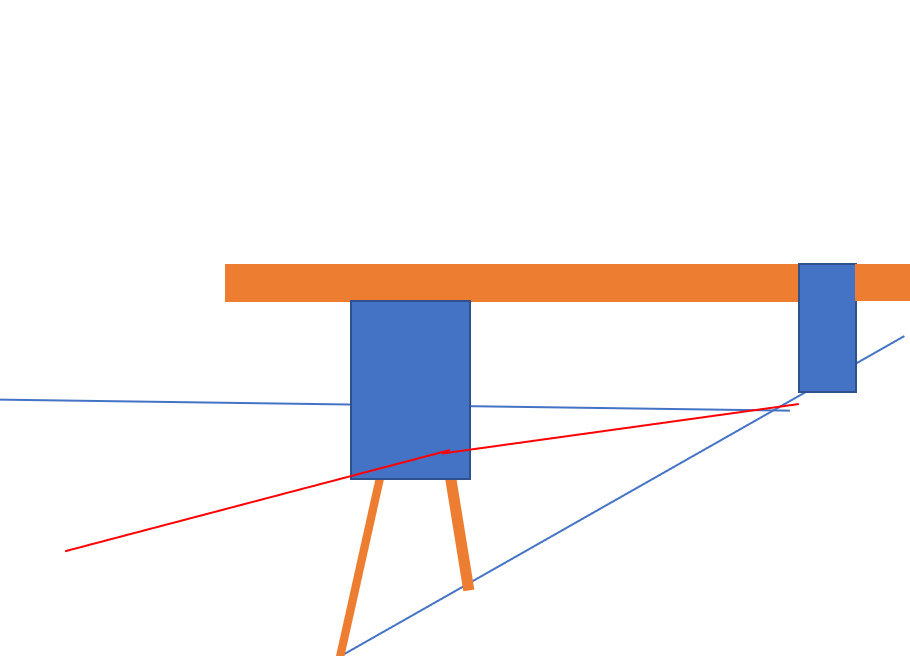
Here's a quick sketch to illustrate the conditions (current situation). Blue rectangles are concrete, brown is the pier deck (glulam, etc.). Blue lines are water and rock. The red line is the gravel bottom, and below that are guesses about how it looks.
Image-Google "hanging bridge" so you see the construction and can surely build one yourself.
Tried the tip and got many hits on scaffolding but found a site that referred to Norway. Then I tried googling "Hengebrygger" instead. Then I got good hits. They feel a bit more like a "gangway" than what I preferably wish for. They seem to use bracing even in the horizontal plane to make it a little more stable as, for example, a mooring point for a boat.
Difficult to provide good answers when the conditions are unclear. However, all reasonable solutions require external support of the type that the concrete caisson provided. Every cm that the bridge's span can be shortened is a plus. I don't know how the Baltic Sea is in the Stockholm area, but here in Blekinge the environment is quite aggressive. You can't use regular pressure-treated wood, it must be NTR-M marked. Steel is also a bit troublesome with a constant need for painting. The best thing is if you can get hold of two used telephone poles with a diameter of around 20 cm. They are very rigid and withstand the environment for a long time. It's not certain that it is allowed, but someone else will have to answer that. Limit the cantilever beyond the external support to about 1 m.
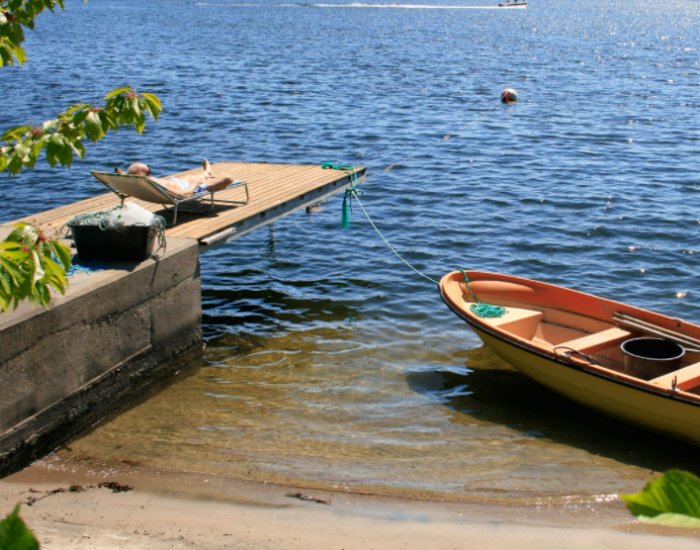
I had in mind something similar to the image below that I found on the web. I'm wondering a bit about the limits for such a construction. It feels like a simple case from the formula collections I haven't looked at in about 30 years. So I need some help from someone more experienced. I'm thinking of solidly building on my concrete mount on land and letting two generously sized galvanized steel beams extend out. Where is the reasonable limit for that idea? I would estimate the example in the picture to be 4 meters and not particularly thick beams.
It is not obvious how to calculate, but if you start from a common deflection criterion when four adults stand side by side at the far end, you need two HEA 280 beams that are fixed in the concrete. The fixing may require 2 m. 2 pieces of 6 m long HEA 280 beams cost nearly 25000 SEK, but it may be worth it.
It's not obvious how to calculate, but if you start from a common deflection criterion when four adults stand side by side at the far end, you need two HEA 280 beams that are encased in the concrete. The encasement might require about 2 m. Two 6 m long HEA 280 beams cost close to 25000 SEK, but maybe it's worth it.
As mentioned, I'm aiming for a pier 8 meters long from the current concrete docking point. I think it should be distributed in the most suitable way between an extended docking point and the beams. It might be possible to extend the docking point by two meters, i.e. about 14 tons of concrete. That leaves a 6 meter protrusion which, with two meter encasement, requires an 8 m beam.
An existing professionally built pier that couldn't withstand the ice cost 110,000 SEK ten years ago. It probably costs double that now to get a similar one that might not survive the winter either, plus there's the cost of getting rid of the old one. So the cost of the beams isn't a determining issue. I'm not looking to build anything myself. This is too big, difficult, heavy, and inaccessible for me. It requires a large work barge and other equipment to bring the concrete, steel, etc., by waterway.
What is it going to be used for? Mooring a boat? What type of boat? Why not lay out a buoy for the boat instead?
Sun deck, swimming pier, boat dock. 8 meters is what is required to reach sufficient depth for diving or coming in with a sailboat. The tip about a hanging dock fulfills everything except being a "patio". We have (had) buoys in combination with the dock. Right now, we don’t have our own boat, but it will come. Otherwise, we have guests who use it.
Talk about money down the drain! Have you seen the Norwegian versions of docks that can be filled up in wintertime? No foundation in the water is needed then.
The deflection of people swimming is a trivial problem compared to the weight during icing. I have seen docks covered with 1-1.5m of drift ice packed onto the dock by wind and waves; those forces together break most things.
I would have looked at a solution that can be taken in for the fall.
More like your post #4 but collapsible if needed. We had stone pier and wooden frame on ours for many years before ice and storm crushed it. Haven't built a new dock because it just leads to problems and expensive costs. We use a buoy and are otherwise considering a floating dock.
Click here to reply
Vi vill skicka notiser för ämnen du bevakar och händelser som berör dig.




Jonatan79 said: