13,000 views ·
33 replies
13k views
33 replies
Steel beam HEA / HEB / IPE under extension - dimensioning help

You could develop the concept by creating a spreadsheet where you only need to input beam type, span, and load, to see the deflection. The difference with, for instance, glulam is just that it's a different modulus of elasticity (which can also vary due to differences in loading and climate class). The formula you have used refers to a uniformly distributed load. For point loads, there are other formulas. You have examined aspects of the beams’ bending strength. It is still necessary to check the conditions at the supports, support pressure, and shear force.
Thank you! What would the deflection be for a HEA160 with a load of 4000kg (alternatively a load of 2000kg - which should be approximately half the deflection?) Could Balkylen provide the answer in a simple way? - I feel some uncertainty that I’m using the right formula in my spreadsheet and don't know how to check…. In "my program," there is also the pressure in kg/cm2 for the supports, and it is not anywhere near any limit. Concrete hollow blocks have a strength of 5MPa (51kg/cm2), Leca blocks have a strength of 3N/mm2 (30.6 kg/cm2) With an even load of 4000kg, the pressure on the wall is around 5-6kg/cm2 (depending on how large the support will be) The formula for a point load, I believe, is: P x L^3 / 48 x E x I
Hi.
I don't know if you've already found the answer you were looking for, but I would probably go for a HEA/HEB200 and wedge it at regular intervals to counteract the deflection. Or even better, if it's possible to dig out in the middle first and support the beam. Then you might be able to go down to a 120-140 beam as well. IPE beams are more stable at lower self-weight, but the construction height is somewhat higher. I had a HEB200 in the garage with c/c 3m between the attachment points. I calculated it would handle 3 tons.
I don't know if you've already found the answer you were looking for, but I would probably go for a HEA/HEB200 and wedge it at regular intervals to counteract the deflection. Or even better, if it's possible to dig out in the middle first and support the beam. Then you might be able to go down to a 120-140 beam as well. IPE beams are more stable at lower self-weight, but the construction height is somewhat higher. I had a HEB200 in the garage with c/c 3m between the attachment points. I calculated it would handle 3 tons.
That was substantial.V Vadvadetjagsa said:Hello.
Don't know if you already got the answers you were looking for, but I would probably go for an HEA/HEB200 and chock it down at regular intervals to counteract the deflection. Or even better, if possible, dig out the middle first and brace the beam. Then you might be able to go down to a 120-140 beam as well. IPE beams are more stable at a lower self-weight, but the construction height is slightly higher. I had an HEB200 in the garage c/c 3m between attachment points. I calculated it would handle 3 tons.
According to a quick estimate, that beam would have a deflection of 0.9mm at 3 tons (+ self-weight approx. 200kg)
Since most values are "assumed" in my case, one has to try to estimate (and maybe that's the hardest) - I almost understand why no engineer wants to take on this type of problem...
I have assumed the following values (as mentioned by, among others, @justusandersson as a guideline)
Live load 8m x 4m = 32m2 * 200kg/m2 = 6400kg
Dead load 32m2 * 50kg/m2 = 1600kg
total 8000kg (with a good margin)
Assume that half the weight is on this beam = 4000kg
I choose an HEA160
Using the formula .: u = (5 * Q * L³) / (384 E * I) the deflection (at maximum load) would be approx. 9.8mm
(which, however, is about 3mm more than L/600) But I have not taken account of the existing sill (which is to remain)
HEA160 would weigh approx. 100kg - which is fully manageable.
(but I may have calculated something wrong and would wish someone checked my calculations)
It might be that some form of support is placed to counteract the deflection - but I haven't calculated this yet. (it almost becomes a form of point load) Unless I find something "broader" to lay between, e.g., 5mm in the middle and a bit narrower on the edges. - considering oak shims, but we'll see...
In "professional constructions," the beam is probably pre-bent from the start - upper and lower side... but that's another question...
The main thing is that I keep the extension above ground - otherwise, it will be quite high ceilings

A Albireo said:It was quite generous. According to a quick estimate, that beam would bend by 0.9mm at 3 tons (+ own weight about 200kg)
Since most values are "assumed" in my case, one has to try to estimate (and that might be the hardest part) - I almost understand why no engineer wants to take on this type of problem...
Assumed the following values (as among others @justusandersson indicated as a guideline) Useful load 8m x 4m = 32m2 * 200kg/m2 = 6400kg Self-weight 32m2 * 50kg/m2 = 1600kg total 8000kg (with a good margin) Assume that half the weight ends up on this beam = 4000kg I choose a HEA160 Using the formula .: u = (5 * Q * L³) / (384 E * I) the deflection (at max load) would be about 9.8mm (which is however about 3mm more than L/600) But then I have not taken into account the existing sill (which is to remain). HEA160 would weigh approx. 100kg - which is fully manageable. (but I may have calculated something wrong and would wish someone to check my calculations)
There may be some kind of support placed to counteract the deflection - but I haven't calculated that - yet. (it almost becomes a point load) If I don't find something "wider" to place, for example 5mm in the middle and slightly narrower at the edges. - thinking of oak spacers but we'll see... In "professional constructions" the beam is probably pre-bent from the beginning - top and bottom... but that's another issue... The main thing is to keep the extension above ground - otherwise it will be quite high ceiling
Yes, it's hard to calculate something like this exactly, so a little over-dimensioning probably doesn’t hurt. You will have supports for the beam on each side, so the question is whether the beam bends a little which could lead to settlements in the walls, I assume. But if you drive a couple of wedges with a meter or so apart and try to distribute the load as well as possible, it significantly reduces that risk. Just be careful not to wedge up the building so it settles the other way. It doesn’t seem to weigh that much.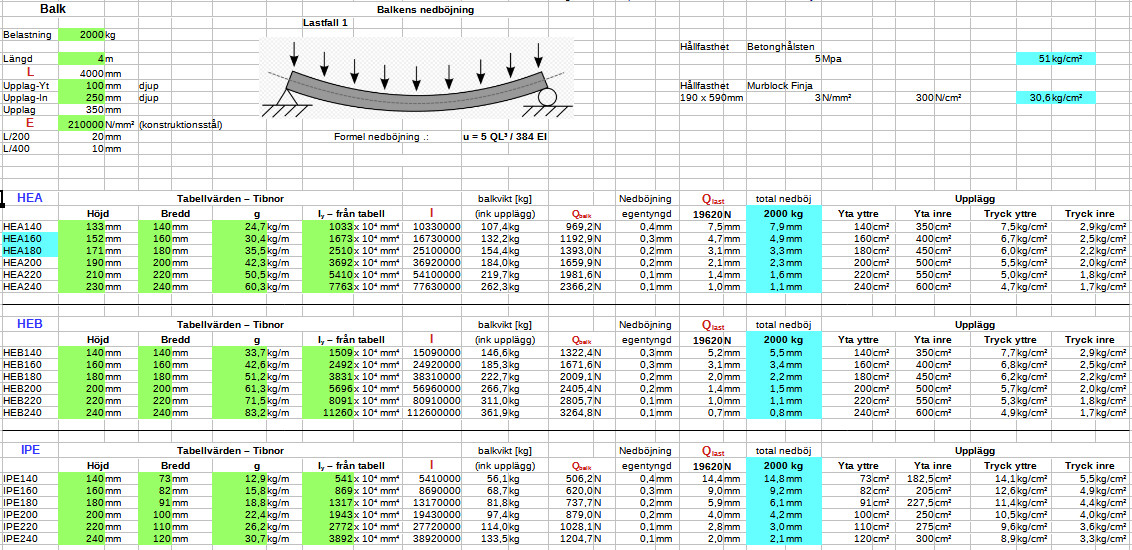
Hello, I hope you can help me calculate this HEB200 beam that I plan to use for support when removing a wall.
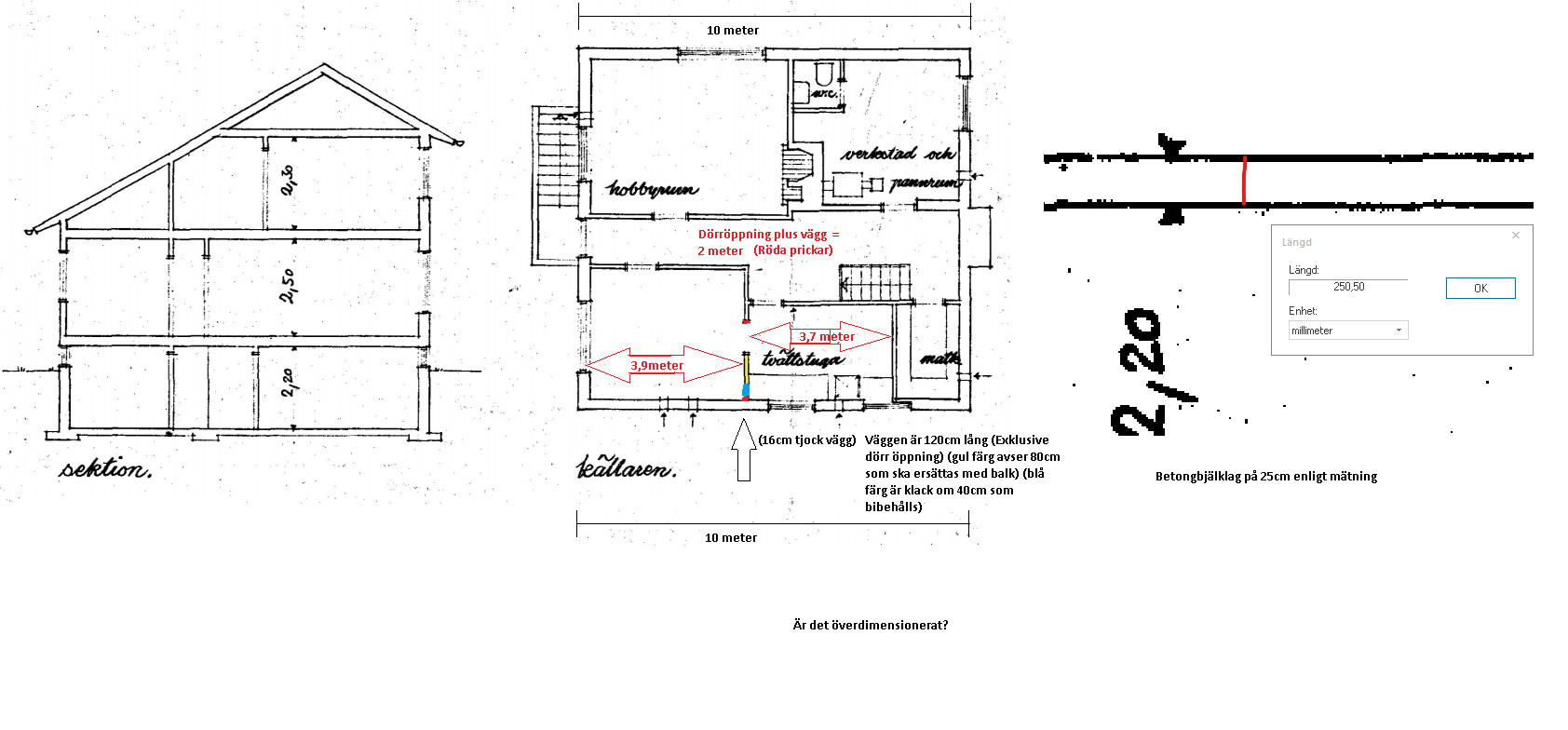
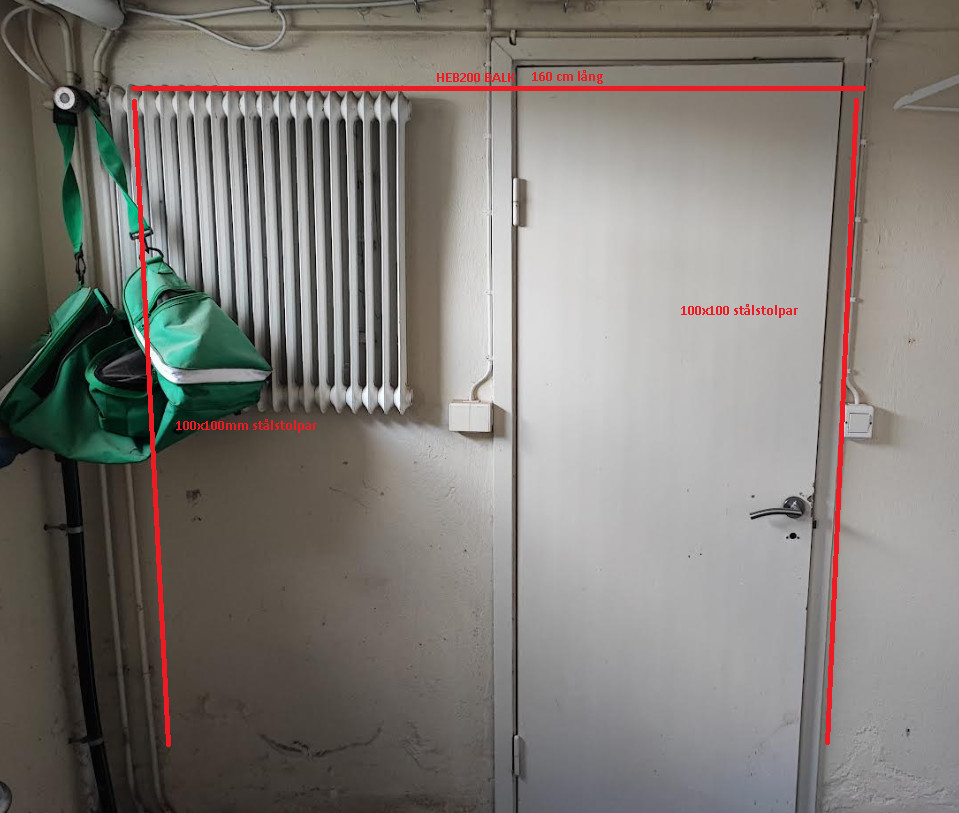
The wall is 200cm including the door opening. I plan to leave a ledge of 40 cm and replace the remaining part with a beam of 160cm, resting on steel posts 100x100 mm.
Is it too weak a construction?
What calculations regarding loads does the building department require for this construction?
If someone can do the calculations, I would be very grateful.
It is a poured concrete slab, so the wall should most certainly be load-bearing (says the inspector), even though it is only 120cm (excluding the door opening).
Grateful for a response.
The wall is 200cm including the door opening. I plan to leave a ledge of 40 cm and replace the remaining part with a beam of 160cm, resting on steel posts 100x100 mm.
Is it too weak a construction?
What calculations regarding loads does the building department require for this construction?
If someone can do the calculations, I would be very grateful.
It is a poured concrete slab, so the wall should most certainly be load-bearing (says the inspector), even though it is only 120cm (excluding the door opening).
Grateful for a response.
It feels a bit difficult to answer your question with the information you have provided.
1) If the inspector says it's a load-bearing wall, we should probably trust that. I don’t understand where the wall is placed in the drawing. (Is it between the two big red arrows?) Even concrete is "self-supporting" if made in the "right way" (right quality/reinforced etc. - but it's harder to assess).
2) An important component in a calculation is - what weight does the wall support? (how thick is the concrete slab? Is it just the concrete that burdens the wall? (or is there a wall above supporting the floor to the second floor/the roof, etc.?))
3) What I find difficult to decipher is the length of the beam. Is the total length of the beam 2000mm? One support is 400mm. The other support is 100mm? That is, the distance between the supports is 2000mm - 400mm - 100mm = 1500mm. The door today is 900mm? Can it be correct that the opening would be 1500 - 900 = 600mm wider than today?
4) HEB200 is a strong beam - spontaneously no problems. But another calculation that must be made - what load can the steel supports of 100x100 withstand? That is, what weight should the beam support? (Is it 2000kg or 5000kg or ...)
1) If the inspector says it's a load-bearing wall, we should probably trust that. I don’t understand where the wall is placed in the drawing. (Is it between the two big red arrows?) Even concrete is "self-supporting" if made in the "right way" (right quality/reinforced etc. - but it's harder to assess).
2) An important component in a calculation is - what weight does the wall support? (how thick is the concrete slab? Is it just the concrete that burdens the wall? (or is there a wall above supporting the floor to the second floor/the roof, etc.?))
3) What I find difficult to decipher is the length of the beam. Is the total length of the beam 2000mm? One support is 400mm. The other support is 100mm? That is, the distance between the supports is 2000mm - 400mm - 100mm = 1500mm. The door today is 900mm? Can it be correct that the opening would be 1500 - 900 = 600mm wider than today?
4) HEB200 is a strong beam - spontaneously no problems. But another calculation that must be made - what load can the steel supports of 100x100 withstand? That is, what weight should the beam support? (Is it 2000kg or 5000kg or ...)
On the floor plan, I have written down measurements with color instructions. The wall is 1.2 meters plus the door opening of 80cm. 2 meters in total. But the beam should only be 160cm. That is, the door opening plus 80cm of "yellow" wall. In total, an HEB200 beam of 160cm should replace the existing door opening plus 80cm of wall.
Excuse me - but I don't quite understand.
On the floor plan, the standing beams - (whatever kind of beams they are) seem to be marked with red dots.
You mention that the blue load-bearing wall should be retained. But I don't understand why one of the standing beams is placed outside the blue wall. (the blue wall loses its load-bearing function.)
The strength of the "iron pillars" must also be calculated. (they may be weaker than HEA180)
If I understood correctly, the door is 800mm, and you want to make an opening twice as wide. (=1600mm)
What material is the blue wall made of? (it's quite thick)
Is it wood/masonry or... - Why aren't the existing walls sufficient to support the beam?
Which wall on the sectional drawing is relevant? (Does this wall (yellow/blue) only support the arch, etc., or is there also a load-bearing wall above?)
In the floor plan, the room doesn't seem that wide.
Is a beam even necessary? (since the arch is still 250mm thick) When was the arch made?
There should be someone who can answer what standards existed when the arch was made.
(Concrete quality, etc.)
Perhaps it would be best to start a new thread?
On the floor plan, the standing beams - (whatever kind of beams they are) seem to be marked with red dots.
You mention that the blue load-bearing wall should be retained. But I don't understand why one of the standing beams is placed outside the blue wall. (the blue wall loses its load-bearing function.)
The strength of the "iron pillars" must also be calculated. (they may be weaker than HEA180)
If I understood correctly, the door is 800mm, and you want to make an opening twice as wide. (=1600mm)
What material is the blue wall made of? (it's quite thick)
Is it wood/masonry or... - Why aren't the existing walls sufficient to support the beam?
Which wall on the sectional drawing is relevant? (Does this wall (yellow/blue) only support the arch, etc., or is there also a load-bearing wall above?)
In the floor plan, the room doesn't seem that wide.
Is a beam even necessary? (since the arch is still 250mm thick) When was the arch made?
There should be someone who can answer what standards existed when the arch was made.
(Concrete quality, etc.)
Perhaps it would be best to start a new thread?
Yellow wall plus doorway is 160cm. That's the part where the beam will be mounted. The blue is the ledge that is retained. The wall is masoned, which is why I set up posts. Red dots might be unnecessary information, but I thought it might be useful in the calculation.
The arch is not 250mm, 250mm is the thickness of the floor slab.
The sectional drawing shows the masonry walls that run along the corridor on the floor plan. I am quite doubtful if the wall is even load-bearing since the concrete floor slab itself also supports, but if the inspector says so, as he lives in a similar house, then it must be so.
The arch is not 250mm, 250mm is the thickness of the floor slab.
The sectional drawing shows the masonry walls that run along the corridor on the floor plan. I am quite doubtful if the wall is even load-bearing since the concrete floor slab itself also supports, but if the inspector says so, as he lives in a similar house, then it must be so.
Last edited:
What is it built with? Often you can have a wall as a supporting bearing, meaning no post is needed. An HEB200 seems very oversized with this short span. I myself have the entire carport roof resting on two steel beams where one goes directly into the garage's masonry wall with one end while the other stands on a VKR column. And in my case, it is an isolecasten that the beam rests on.
HelloR roli said:
It's a house from '58, so it's solid concrete walls. The outer walls are blåsbetong (easy to drill into), but the inner walls in the basement are hard as stone (difficult to drill into). The beam could probably rest on the ledge (blue) that is left, but at the other end, a beam is needed as I don't want to make modifications to the wall to the right of the door.