
5,013 views ·
13 replies
5k views
13 replies
Is this the correct fastening for a post?
As a happy hobby builder, I'm trying to learn more about construction techniques. I thought I was starting to get a little sense of what's right and wrong. But then I saw this mounting of a post on a municipal building.
Is this really the right way? Won't the post absorb water at the bottom and rot?
Is this really the right way? Won't the post absorb water at the bottom and rot?
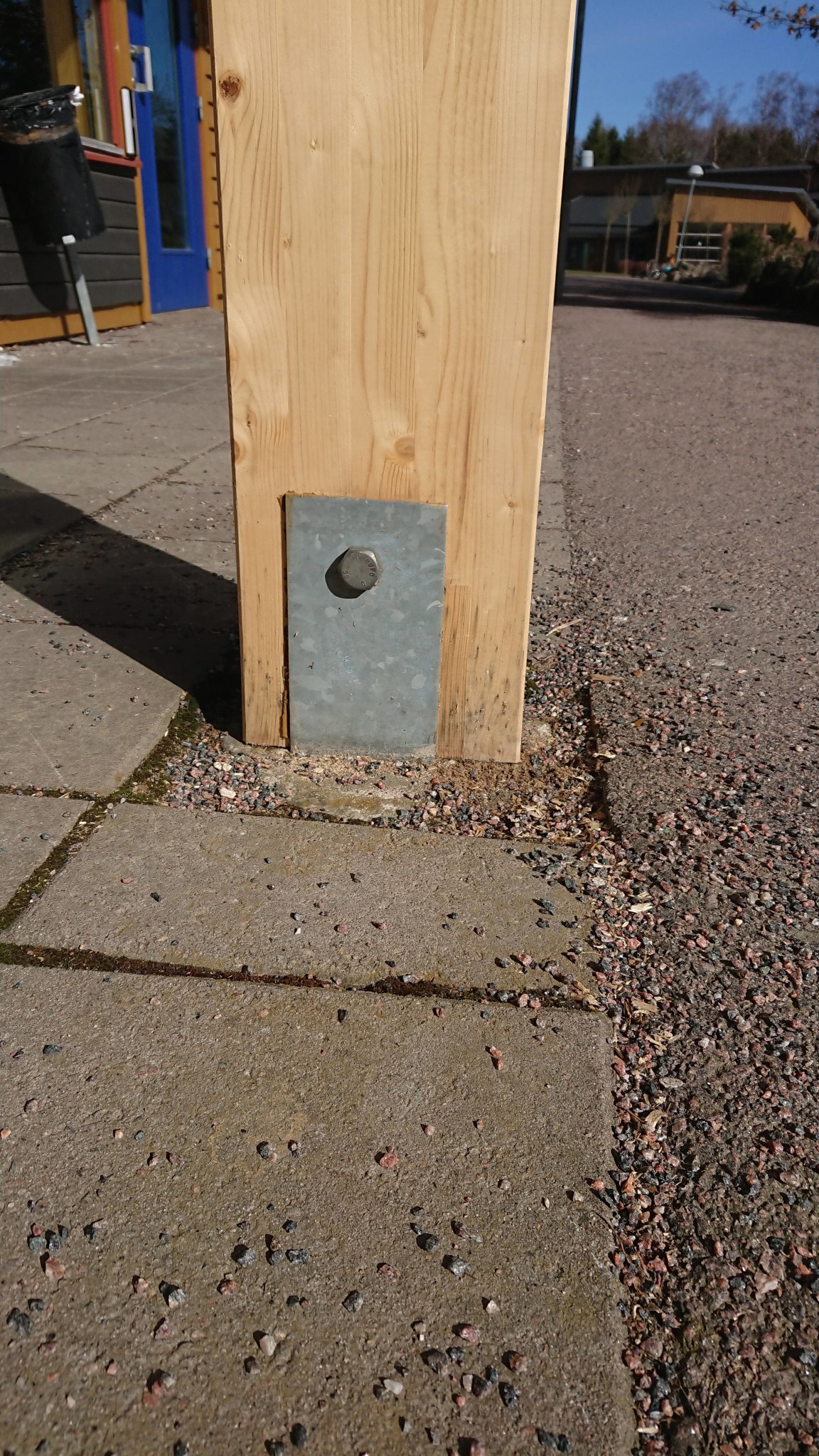


They probably thought the post would stand more firmly if it is on the ground/concrete base. If you lift it a couple of cm, it rotates around the fastening bolt and becomes unstable. But why is there only one bolt? There should be at least two to provide stability, right?
The screw hole might be underground now. There are usually two.KnockOnWood said:
I would like to see that the plinth sticks up a bit from the ground to protect it against moisture, but it is incorrect to say that bearing is not allowed on wooden posts. If you have slightly larger loads in the post, there is no chance to accommodate that load only through the screws without bearing. However, the end grain must be protected against moisture in some way.
On the one hand, as previously mentioned, you should raise the plinth's upper edge from ground level.
On the other hand, protection can be achieved by, for example:
https://www.traguiden.se/konstrukti...ra/projektering/anslutningsdetaljer/pelarfot/
Otherwise, the three parts of the glulam manual can be found for free on the internet. There you can find quite a few "approved" details.
It is not automatically wrong to only have a screw attachment since it probably involves a hinged connection and does not need to take up moment.
On the one hand, as previously mentioned, you should raise the plinth's upper edge from ground level.
On the other hand, protection can be achieved by, for example:
- Attaching an end plate of steel (painted / stainless / galvanized).
- Attaching an oil-hardened wood fiber board at the end.
https://www.traguiden.se/konstrukti...ra/projektering/anslutningsdetaljer/pelarfot/
Otherwise, the three parts of the glulam manual can be found for free on the internet. There you can find quite a few "approved" details.
It is not automatically wrong to only have a screw attachment since it probably involves a hinged connection and does not need to take up moment.
They were quite sturdy (broad) flat bars. It could be that the flat bar on the other side has a hole that is positioned higher/lower (it can be difficult to drill a continuous bolt). If the holes are offset from each other, you automatically get a small lever that can handle a (small) moment.
But I would also like to have something under the wooden pillar that doesn't absorb moisture. Preferably an air gap. The flat bars themselves are likely strong enough to press down X number of tons into the plinth without the wooden end resting against the plinth.
But as someone else wrote, it was probably a cheap price in the bid
But I would also like to have something under the wooden pillar that doesn't absorb moisture. Preferably an air gap. The flat bars themselves are likely strong enough to press down X number of tons into the plinth without the wooden end resting against the plinth.
But as someone else wrote, it was probably a cheap price in the bid
It is often not the foundation that is the load limitation, but the transfer between wood and screw that cannot handle X number of tons....T tobbbias said:
That is completely true! Well pointed out.R roli said:
As additional info, you might think of it like this:
A French wood screw M10 has an area of about 58 mm² and a yield strength of 400 MPa for galvanized ones. For pure shearing, the square root of 3 (approximately =1.73) is added as a factor against the yield strength. This means it can handle about 58*400/1.73 = 1.3 tons. Then there are 2 of them, so about 2.5 tons.
Usually, there is also some kind of clamping force between metal and wood that creates a contact surface with friction that can absorb some force as well. So I guess about 3 tons in total maybe.
If you instead look in the glulam handbook Part 3 page 58, you get the more reasonable value for an M10 screw joint with double shear approximately 12.1kN = 1.21 tons parallel to the fibers.
If I remember correctly, these are characteristic values that should be multiplied by the current climate class and material coefficient, which can even halve the strength (0.65/1.3=0.5) and then we end up at 605kg.
If I remember correctly, these are characteristic values that should be multiplied by the current climate class and material coefficient, which can even halve the strength (0.65/1.3=0.5) and then we end up at 605kg.
Click here to reply