
10,099 views ·
18 replies
10k views
18 replies
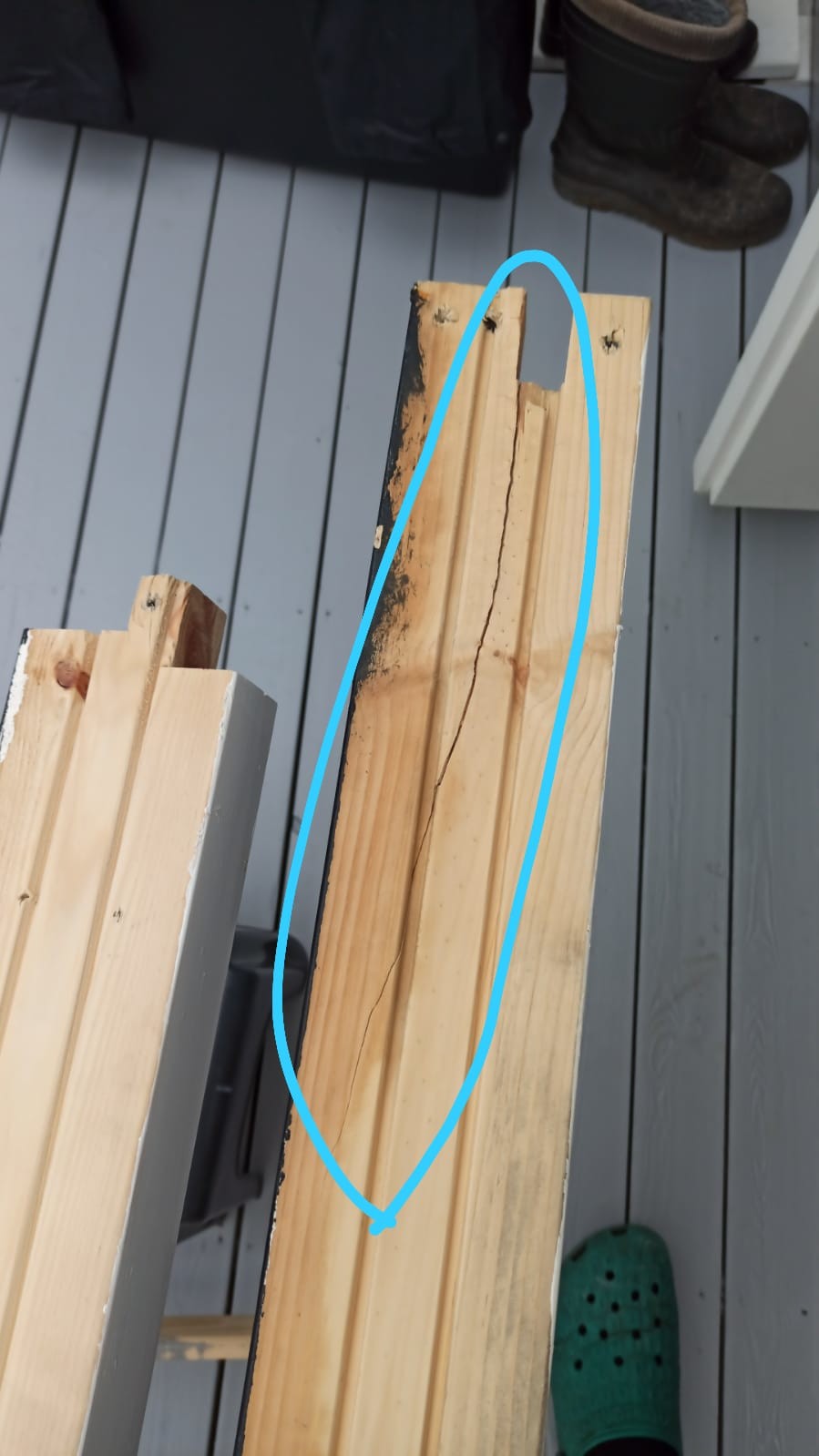
Best way to repair crack in this wooden stud
Hello,
I have a small query... A couple of days ago, my wife and I bought a used sectional door. Today, after we washed all the parts for repainting, we found a long crack in one of the beams. These are grooved, so I think it might not be easy to just go out and buy a new one.
Thus, my question is: What is the best way to save this beam? At home, I have wood filler, wood glue, and long wood screws. Besides these three methods, is there anything else you would recommend?
Thank you very much in advance!
Best regards, Patrick
I have a small query... A couple of days ago, my wife and I bought a used sectional door. Today, after we washed all the parts for repainting, we found a long crack in one of the beams. These are grooved, so I think it might not be easy to just go out and buy a new one.
Thus, my question is: What is the best way to save this beam? At home, I have wood filler, wood glue, and long wood screws. Besides these three methods, is there anything else you would recommend?
Thank you very much in advance!
Best regards, Patrick


Member
· Västernorrland
· 12 076 posts
I had widened it as much as I dared and pressed in good wood glue and then clamps.
Cutting in from the side might not be a good idea. You will never be able to glue end grain with any strength retained and will end up with a weak point. Better in that case to split the wood completely and glue the entire piece. Or do as @Stefan1972 wrote and widen it, press wood glue in as well as possible, and clamp it.A ArneTW said:
Yes, exactly as mentioned above. Either break off the cracked piece and then glue it back or try to widen the crack as much as you dare (which might then become option one) and try to get glue into as much of the crack as possible and put it under pressure. After gluing, secure with a screw from the thin part into the thicker part.
It's the beam that should be above the door. Definitely a good idea that I will keep in mind when the work is to be done!M marka said:
I consider screwing it to be completely unnecessary and perhaps even detrimental in terms of strength. When you glue a crack in the wood, the joint will be at least as strong as the wood was originally (stronger really because, after all, the wood has cracked).R roli said:Yes, just as above. Either break off the cracked piece and then glue it back, or try to widen the crack as much as you dare (could then become option one) and try to get glue into as much of the crack as possible and clamp it. After gluing, secure with a screw from the thin part into the thicker part.
Screws can be useful in situations where you cannot clamp the pieces together in another way. When building speaker cabinets, it is common to screw while the glue dries and then remove the screws so they don't move and ruin the surface finish after filling the holes.
Thanks, so clamps are recommended as Stefan1972 also pointed out?R RoAd said:I consider screwing it to be completely unnecessary and possibly even worse in terms of strength. If you glue in a crack in the wood, the joint will become at least as strong as the wood was originally (stronger actually because the wood has, after all, cracked).
Screws can be useful in situations where you can't clamp the pieces in another way. When building speaker cabinets, it's common to screw while the glue dries and then remove the screw so they don't move and ruin the surface finish after filling the holes.
Yes, you need to get everything under proper pressure for it to turn out well. It is recommended to use a couple of battens (or similar) on the sides to spread the pressure from the clamps over a larger area, especially where the cracked piece is thin.P ph659266 said:
Guess you mean pre-drill. I still claim that screwing is unnecessary, and if you even have to pre-drill, it will weaken the rule. I believe it will hold anyway, but I wouldn't do it. The glue is strong enough.J Johan456 said:


Possible pre-drilling and screwing do not weaken...R RoAd said:
The glue is certainly strong enough, but screw-gluing is actually always stronger as you simply get the advantages of both without any new disadvantages, provided it's done correctly.