Hello,
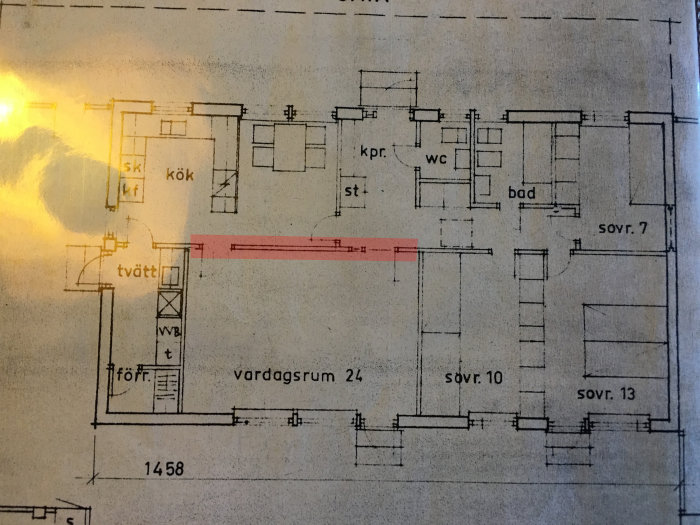
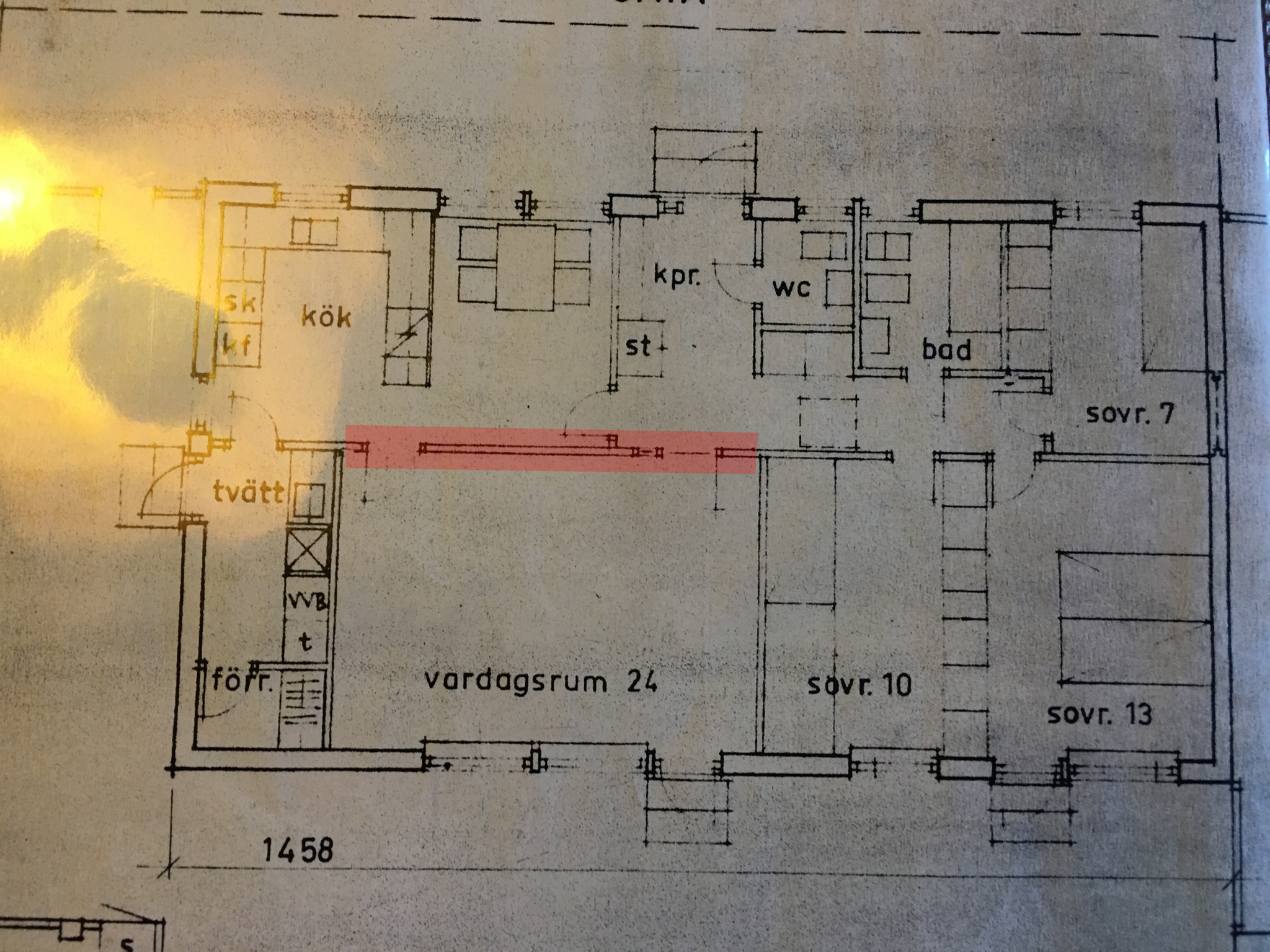
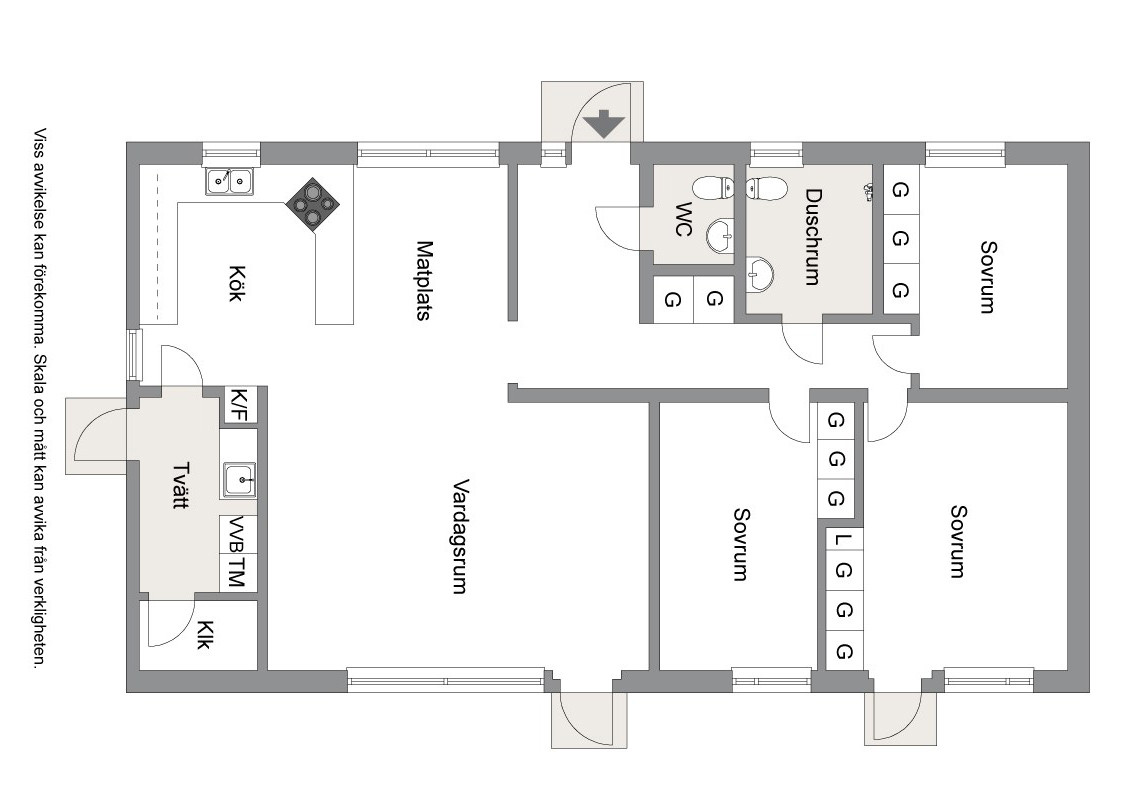
I have a single-story house of 105 sqm and I want to tear down the wall between the living room and the kitchen. The wall is about 6 meters long and I'm wondering if there is any way to determine whether the wall is load-bearing or not? See attached floor plan.
Information about the house.
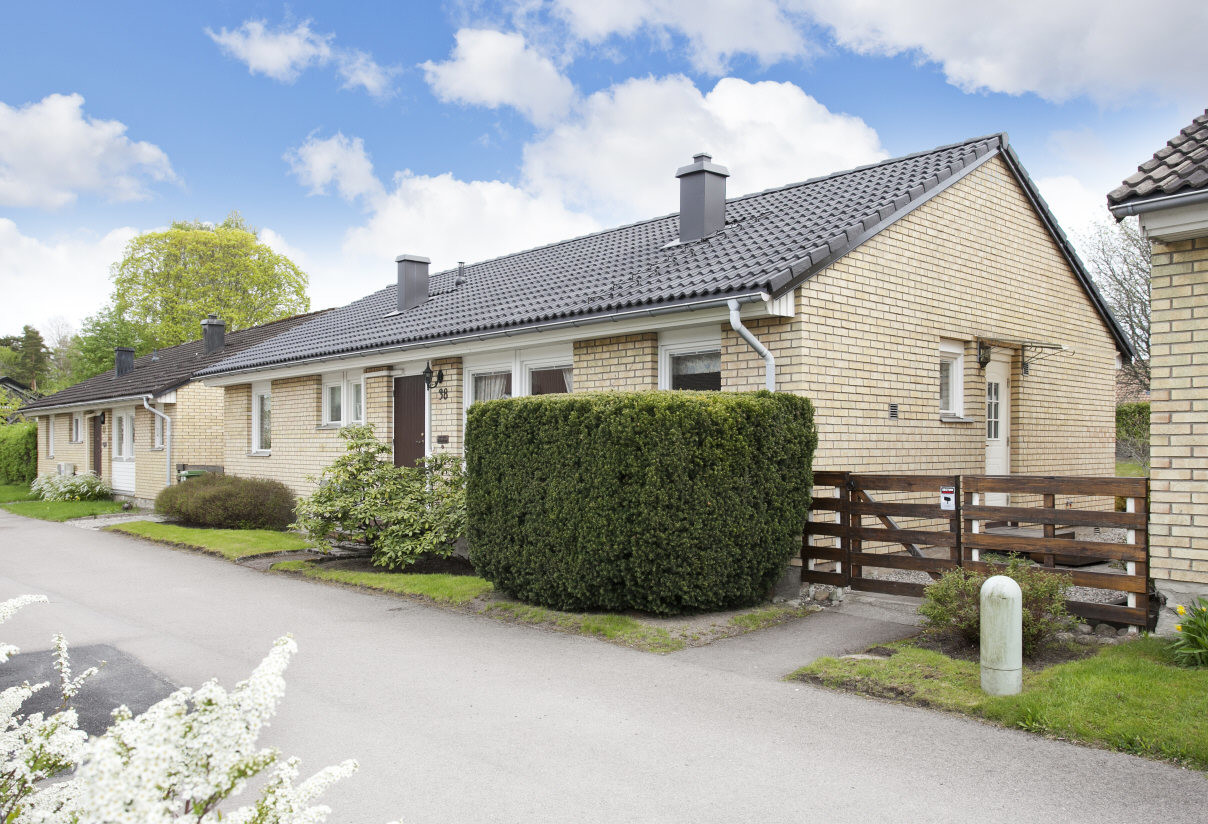
Year of construction: 1971
Foundation: Crawl space
Frame: Wood
Facade: Brick
It is the classic position for the "hjärteväggen" which in its upward extension supports the roof ridge. Strange though that it is not located in the middle of the house. Take a picture of the roof trusses so that one can see their construction.
If the scale is still accurate (length/width ratio), the house's width is about 8 m. This is a large span, so I believe the wall is load-bearing. 4-5 m feels more reasonable as a span.
Looks to be a load-bearing heart wall...
...but a floor plan doesn't tell the whole truth.
Thanks
Thomas_Blekinge said:
This is the classic position for the heart wall which in its upward extension supports the roof ridge. However, it's strange that it's not in the middle of the house. Take a picture of the roof trusses so that one can see their construction.
Thanks . I don't have access to the house yet, but I'll send a picture of the roof trusses as soon as I get the house.
harry73 said:
If the scale is still correct (length/width ratio), the width of the house is about 8 m. This is a large span, so I think the wall is load-bearing. 4-5 m feels more reasonable as a span.
The scale is correct and the width of the house is about 8m
It is the classic position for the hjärteväggen which in its extension upwards supports the roof ridge. Strange though that it is not located in the middle of the house. Take a picture of the roof trusses so that we can see their construction.
The hjärteväggen absolutely does not need to be in the middle of the house. It has been a long time since such symmetry was the norm. The main thing is that it divides the span into two sufficiently short parts.
You can certainly remove the wall even though it is load-bearing as long as you relieve it with a glulam beam. Since it is a single-storey house, you might avoid reinforcing above the rafters, so you won't need a beam on the inside.
If the house has only one floor, the roof trusses are often free-spanning, and in that case, rest only on the exterior walls.
If it is such a construction, then you can safely remove every interior wall …
If the house had had an upper floor, the wall would have been almost 100% certainly a load-bearing heart wall.
But as it is now, it only depends on the roof truss construction if any wall is load-bearing at all. It's relatively easy to make roof trusses that are self-supporting at that span. However, if the designer/house manufacturer doesn’t have to do it, they can save a bit on price/material by allowing walls to be load-bearing.
Okay . As soon as you can, crawl up into the attic and see if there are truss rafters. There probably are, with a roof pitch of 27 degrees. With a distance of 8 meters between the walls, it doesn't matter if it's a single V or double W (google a bit... it becomes too complicated to explain the difference, but it becomes crystal clear once you've seen a picture).
If there are truss rafters, then it's almost certain that the wall is not load-bearing. To be absolutely sure, you should dig away some insulation and check how the splice on the tie beam looks. If there is a more than a meter-long nail plate on each side of the splice with an unlikely number of anchor nails from each side in every piece of timber, then it's good. To be on the safe side, count the nails and publish here. Other joints are also important, as well as the quality of the timber.
Kind regards, Findus
Last edited:
Vi vill skicka notiser för ämnen du bevakar och händelser som berör dig.