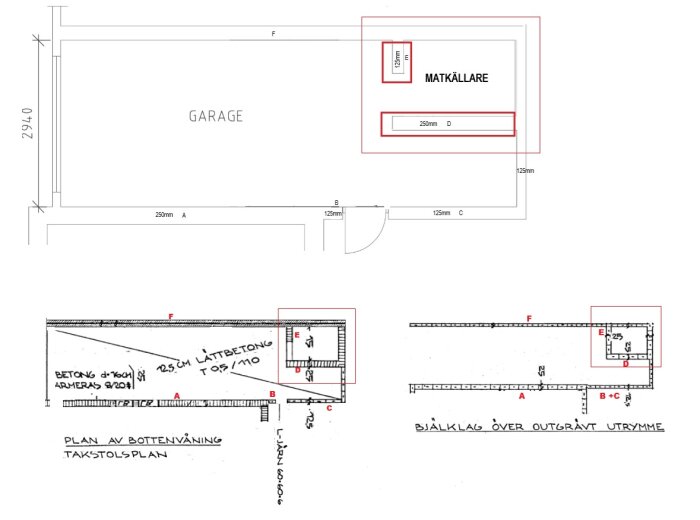
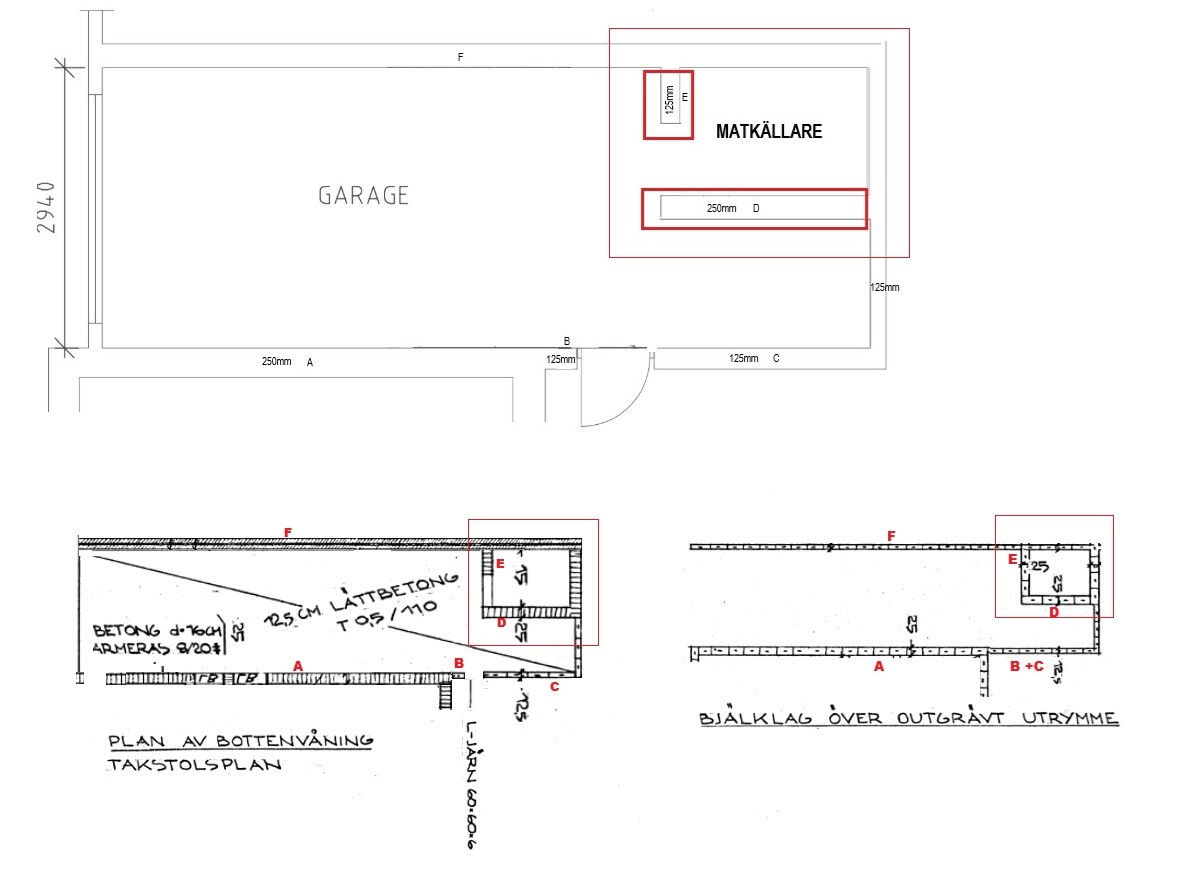
Considering renovating the garage. The garage currently has a room that is an old pantry (1.5x1.5m) and I would like to remove it to make the garage larger.
Is wall D (and E) load-bearing or significant? Or are they only erected as partition walls for the pantry?
Wall A: 250mm aerated concrete
Wall B: 125mm aerated concrete
Wall C: 125mm aerated concrete Wall D: 250mm aerated concrete (this wall is to be demolished) Wall E: 125mm aerated concrete (this wall is to be demolished)
Wall F: 12cm solid brick + 3cm mineral wool + 12 cm solid brick. (adjacent to the neighbor's garage as the garages are connected).
The roof is 125mm aerated concrete, large slabs that extend across the garage as segments. That is, from wall F to ABC. The aerated concrete roof also extends across wall D without a seam.
What makes me uncertain is that they have constructed a double-thick wall (D) in the middle as a separator for the old pantry.
I have added old construction drawings and clipped out only the relevant section. I have created the top image for clarity.
The house is from 1964, if that has any significance.
Why would the wall only be load-bearing there when it's the same span over the entire garage? It could be that something is coming down from above. Do you have a sectional drawing?
As mentioned, you write "The roof is 125mm aerated concrete, large slabs that span across the garage as segments. That is, from wall F to ABC. The aerated concrete roof also spans across wall D without a seam as well." That is, the slabs seem to go from wall F to A and also across wall D without being seamed on top.
Why would the wall only be load-bearing there when it's the same span across the entire garage? It could be that something comes down from above. Do you have a sectional drawing?
Unfortunately, no drawings other than what I shared in the image! What made me uncertain was that wall C is half the thickness of wall A. So I was worried that the root cellar's wall meant that wall C wouldn't have as much load on it!
Don't you think it has to do with insulation?
The old drawing does say that E should also be 250mm
Very possible it has to do with insulation! It is indeed a cold garage, but of course, the pantry should maintain lower temperatures. You are absolutely right about E. It's me who wrote it wrong in my image. It is, of course, also 250mm.
As mentioned, you write "The roof is 125mm lightweight concrete, large slabs that span across the garage as segments. That is, from wall F to ABC. The lightweight concrete roof also spans across wall D without seams as well.". That is, the slabs seem to go from wall F to A and also over wall D without being seamed on top.
Correct! But the load in 90% of the garage is between the brick wall (F) and a twice as thick lightweight concrete wall (A). So since wall C is only made of half (125mm) maybe a thicker wall was made for the food cellar to distribute the load.
I can add that I also sent the drawings to a construction engineering firm that couldn't determine from the pictures I sent (the same ones) if it was load-bearing or not, and they want to make an on-site visit to give their opinion. It might have been just a way to make money, but they themselves said that it was in their interest not to come out if they could easily see from the drawings that it wasn't load-bearing.
Spontaneously, I personally think it should be obvious to say that it is NOT load-bearing. But I am an amateur and base it on what seems logical. Just like you said - a pantry with insulated walls, therefore thicker. Also, the fact that the ceiling is not jointed but the panels run across from wall to wall in 90% of the garage.
It feels a bit disappointing to bring in an engineer for 2000:- for an on-site visit that concludes the same. But sometimes you have to bite the bullet and do it the right way to sleep well at night.
Click here to reply
Vi vill skicka notiser för ämnen du bevakar och händelser som berör dig.