Want to tear down a chimney that is not used for anything and is just in the way in our rather small kitchen that we want to renovate and change the layout of.
How can you tell if the chimney is load-bearing? I understand that you can bring in a professional, but what can I look for myself if I run up to the attic? Is it common for the chimney to support the floor structure and the roof? House from the 1940s.
Are you sure it's not being used? You have no ventilation via the chimney then?
I would say it's impossible to answer. In my house from about the same time, it looks like nothing load-bearing is attached to the chimney. They've built around it with the framework and left a gap without insulation, probably to avoid contact with the hot stone. I discovered this during extensive renovation work where the frame and chimney were exposed when replacing the subfloor and ceiling and such. It's probably hard to tell if there are any attachments without starting to tear things down. As for the roof, it's unlikely that it supports anything. The chimney usually lies between two rafters, go up to the attic and check.
Thank you for the answer! You're right that it doesn't support the roof. So the question is about the floor joists. Hmm, can it be difficult to see then? Do you mean that you have to start tearing up the floor or chimney to see? Then my idea that I could determine this myself falls apart... A company I emailed with promptly said that it must be offset, without even having been here to look... Elsewhere I've read that the chimney is not designed to support the house, only its own load...
Yes. It could probably be both. It's likely only supporting itself, but that's a guess, and none of us or the construction company has X-ray vision. You never know how they built and thought in the 40s... You can always start dismantling it from the top as you have to do anyway. Then you'll see how it looks when you reach the attic floor.
Still - no ventilation pipes in the chimney?
I'd say it costs more than it's worth to get that extra square meter in the kitchen. At the same time, only you know what it's worth, and I never say that anything is impossible.
But if the beams go into the chimney, I would see it, right? It's an unheated attic without a floor. There is only insulation. If I don't see anything connecting to the chimney, then it shouldn't be load-bearing.
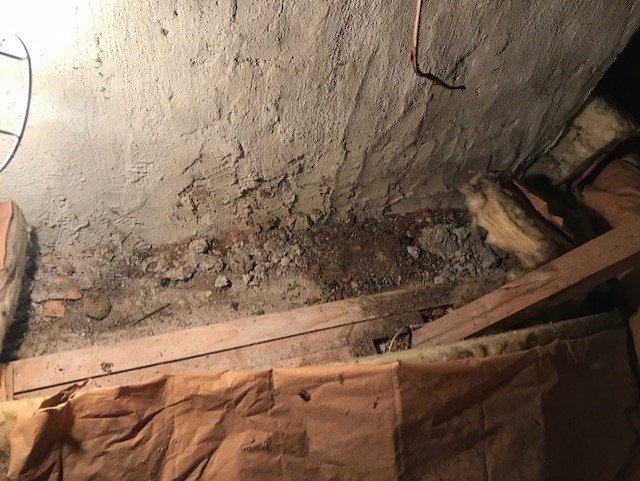
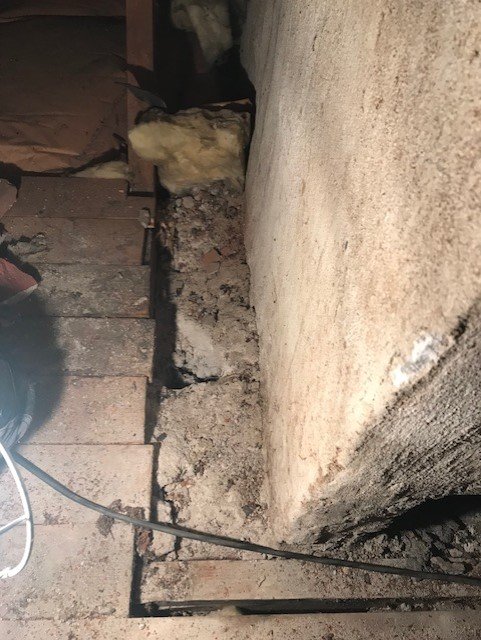
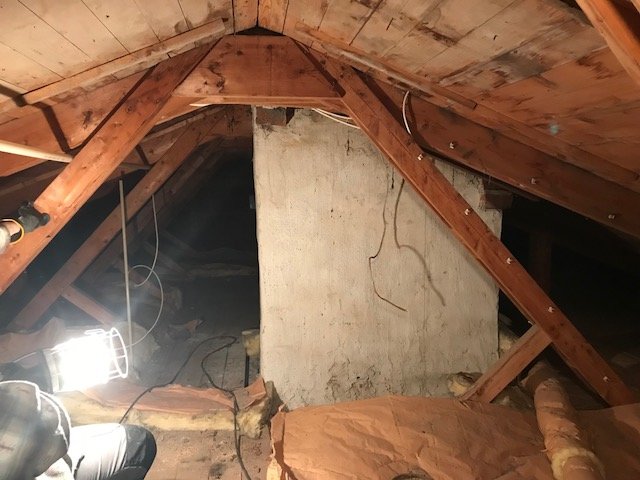
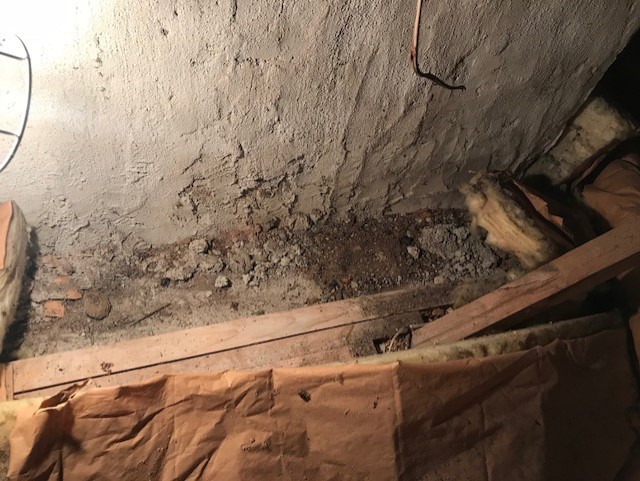
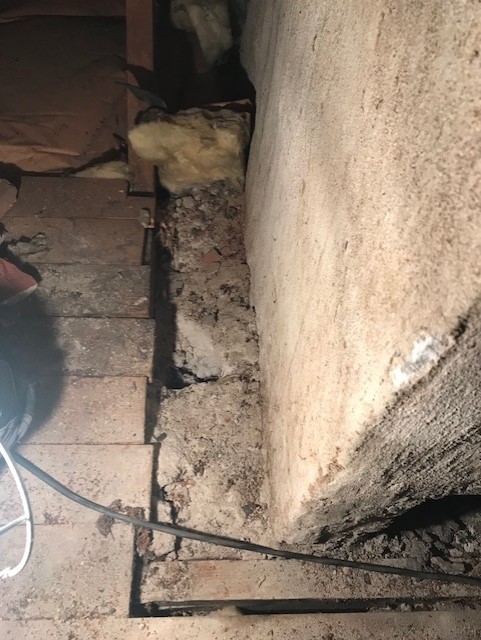
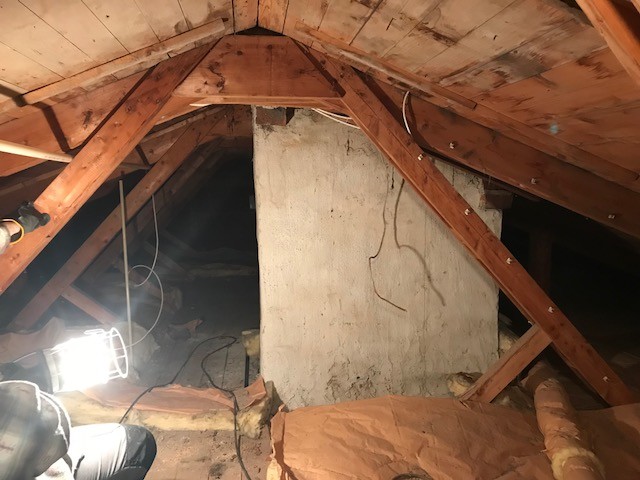
Was up in the attic and checked. Please see pictures, hope they can reveal something
There is actually a ledge around the chimney - but I don't see any beams resting there.
There is a framework attached to the chimney from the side, but it's unclear to me what significance it has for the rest of the joist.
The chimney is located between 2 roof trusses so it doesn't obstruct or split any truss. The trusses are of a truss model and seem to be free-bearing according to my amateur assessment, about an 8-meter span with a bottom chord and struts.
That's how it looks for me too. Honestly, I think it can be done very well both execution-wise and in terms of structural integrity to take down a 5-meter chimney. But... You do have an alternative solution ready for the ventilation, right? That piece is more beneficial for the natural draft than one might think (even though it’s no longer kept warm). It's meant to work that way in those buildings, and you can run into some issues if you mess around with it too much.
Thank you for the response!
Good input regarding the ventilation.
How does passive ventilation work in a cold chimney?
What should I replace with?
Would it be enough to save one channel from the chimney that still goes inside the wall, but remove all of the chimney that is out in the room?
Thanks for the answer!
Good input regarding the ventilation.
How does natural draft work in a cold chimney?
What should I replace it with?
Would it be enough to save one channel from the chimney that is still inside the wall, but remove everything from the chimney that is out in the room?
Draft is created by the height difference between the chimney top and the floors beneath it.
Honestly, I would be cautious about tearing down the chimney for several reasons. One is definitely that the house is built to work with the chimney, both for heating and ventilation. It can cost quite a bit to fix equivalent ventilation in another way. Another reason is that you don't know what heating options will come in the future. Removing the possibility for some form of, e.g., fireplace that requires a chimney seems limiting to me. It costs quite a bit to install a chimney again, even if it ends up being a metal chimney.
I would also think one, two, and three times about whether it really must be demolished, because the day it's gone and the years go by, other thoughts usually come to mind about most things, and all of a sudden you would have wanted one... then you regret it terribly. In my house, there were two chimneys, and one was demolished for no real reason, and yes, in the 50s-60s, a lot of unnecessary things were done, if you could say so. A fine chimney wall should be taken care of. If it were hopelessly lost and would require a total renovation, then okay, but consider this carefully. You can place the fridge and freezer in other places that might ultimately work better.
Yes, it feels like quite a big intervention to remove it. The problem is that the kitchen is small, so the chimney really limits how we can use the kitchen.
What does it roughly cost to install mechanical ventilation?
Small is indeed a matter of definition...........in my house from 1900, the kitchen is very small. It was just a production kitchen, so to speak, and the master folks ate in other rooms. Today we are 8 people eating in the kitchen, and yes, it's cramped. Only fridge and freezer box in the basement. That works too. However, it does not live up to modern ideals with open floor plans and huge spaces.
Vi vill skicka notiser för ämnen du bevakar och händelser som berör dig.