Thought I would update this thread for people in the future. I don't know if everyone who has posted will be notified or if it's only when you reply/quote a user, but those who are not interested can turn off notifications for this thread. Apologies for all the posts, but I have a legitimate question, so there will be one more post.
I know that an air gap is necessary for good ventilation so that moisture doesn't get trapped when I then insulate.
This wall is a "clean" outer wall with panels mounted directly on the studs. I will remove the panels and install a nail batten.
The gym and sauna will remain cold 90% of the time.
In these cases, no plastic is used in front of the insulation since temperature fluctuations lead to condensation, plastic traps moisture = mold/rot, etc. I will use wind paper anyway.
Do I understand this correctly?
Now to the question I originally intended to ask!
Is an air gap also required when I build an interior wall in the barn that is not exposed to rain and so on?
Take the following wall as an example:
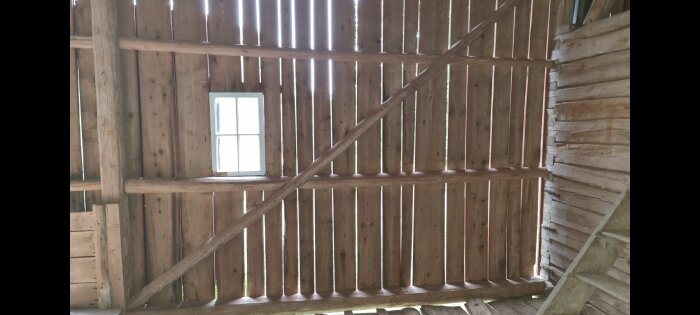
This wall should be insulated. There is coarse paneling mounted directly on the studs. Should I also set a stud as an air gap here when I attach the material I plan to use as cladding? I've read that it's the air that insulates and various other things.
Don't be afraid to write a few lines. Take care of yourselves guys!
You don't need to put any plastic on the ground. I assume that the floor is not (or will not be) directly against the ground, there will be air circulating underneath and keeping the floor dry. It's some type of pillar foundation with stone pillars, I would guess.
Insulating spaces that are mostly going to be cold is not an easy thing. Surely, there's someone here who has good tips!
You don't need to put any plastic on the ground. I assume the floor isn't (or won't be) directly against the ground, there will be air circulation underneath to keep the floor dry. It's some type of pillar foundation with stone pillars, I would guess.
Insulating spaces that are mostly going to remain unheated isn't an easy task. There's probably someone here with good tips!
It's timber resting on stones.
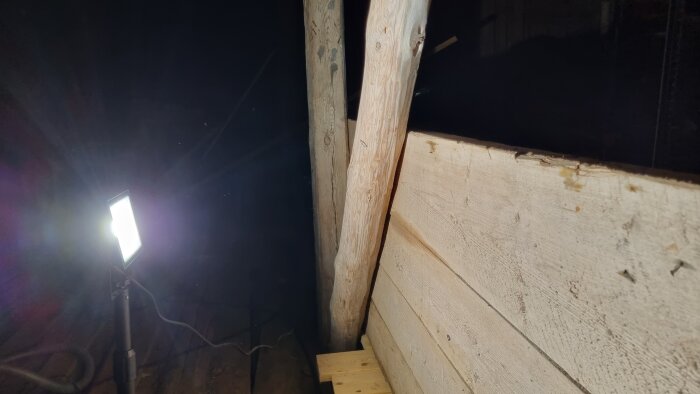
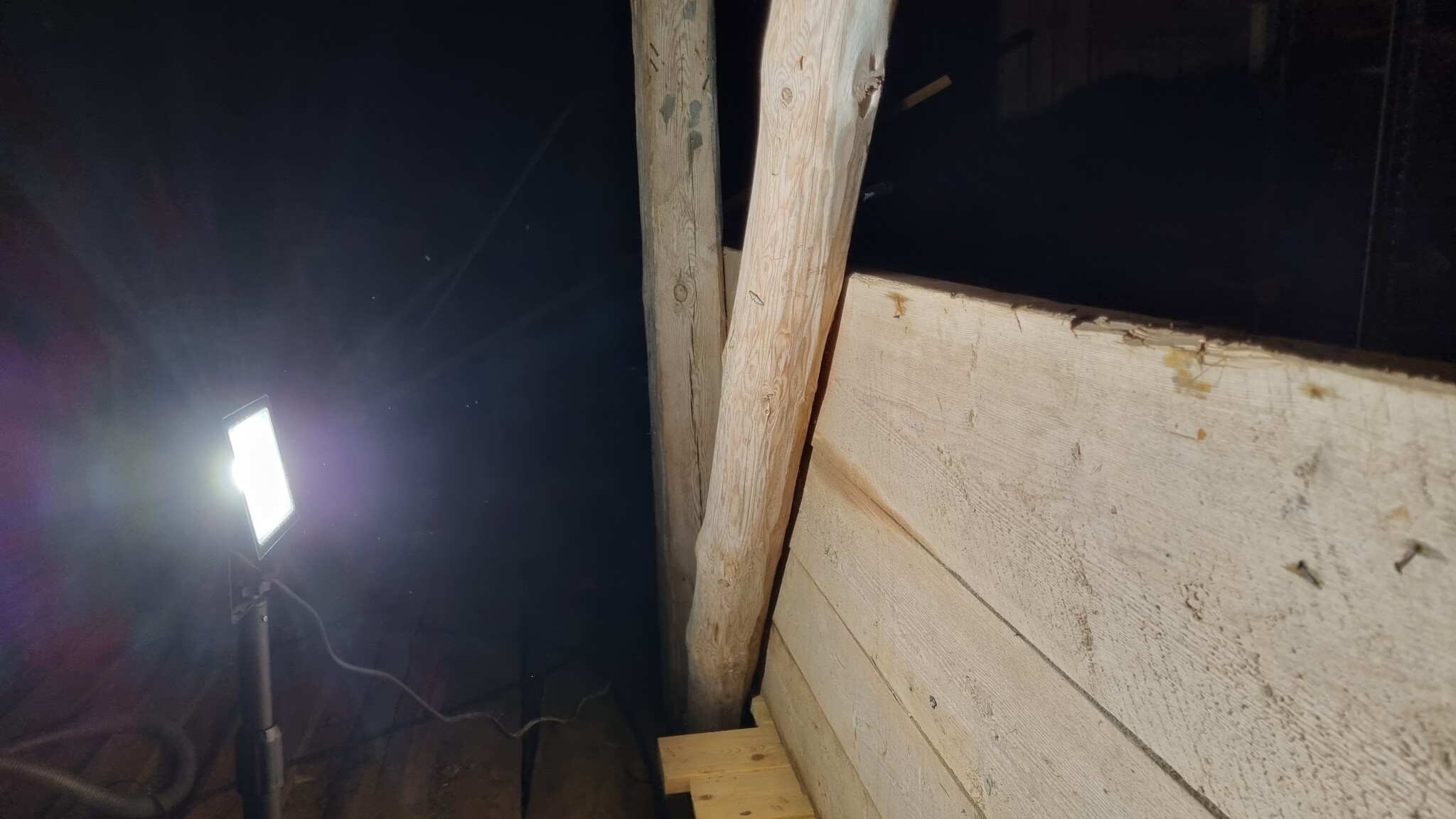
3 load-bearing beams, and then timber has been placed on top of these. It's 140cc so I'll need a beam in between so it doesn't feel shaky. Which solution do you think is best to secure these beams?
I'm leaning towards using joist hangers and reinforcing them in various ways. There shouldn't be more than 300-400kg in the gym.
That's correct. I understand that cold spaces are more difficult. But for the facade wall, I will remove the boards and create an air gap and wind barrier (that breathes).
I'll probably make an air gap on all the walls. But I have a question for you:
What should I cover the interior walls with, meaning on the outside? First, I thought about OSB boards, class 3 does withstand moisture. However, I haven't found out if OSB boards breathe. It's glue, etc. It feels doubtful. Now I'm thinking about tongue and groove boards. It's light but somewhat more expensive, but I'm not penny-wise and pound-foolish.
Do you have any other suggestions, or does tongue and groove sound like a good idea?
Regards
Velinga2002
Joist hangers will be good for securing the joists.
For the interior walls, I vote for rough boards first and plywood second. OSB doesn't look nice as wall cladding and is also difficult to keep clean from dust and stuff.
I know that an air gap is necessary for good ventilation and to prevent moisture from getting trapped when I later insulate.
[image]
This wall is a "pure" exterior wall with panels mounted directly on the studs. I will knock off the panels and install battens.
The gym and sauna will be cold 90% of the time.
In these cases, no plastic is used in front of the insulation as temperature fluctuations lead to condensation, plastic traps moisture = mold/rot, etc. I will use wind barrier anyway.
Do I understand this correctly?
Now to the question I was originally going to ask!
Is an air gap also required when I build an interior wall in the barn that is not exposed to rain, etc.?
Take the following wall as an example:
[image]
This wall will be insulated. Rough paneling is mounted directly on the studs. Should I also add a stud as an air gap when I install the material I plan to use as a covering? I've read that it is the air that insulates and various other things.
Don't be afraid to write a few lines. Take care of yourselves, folks!
When you have such large spaces, I don't quite understand the point of removing the old facade to install battens and insulation. Old houses tend to be anything but straight and level and rarely have cc measurements that fit today's insulation, so I would consider putting a wind barrier, asfaboard, 'Örnpapp', masonite, or similar inside the exterior wall and then framing up an insulated wall inside.
For the interior walls, I vote for tongue and groove in the first place and plywood second. OSB doesn't look great as a wall covering and is also difficult to keep clean from dust and stuff.
Then it's joist hangers! Thank you for your patience. I really appreciate all the help I get. I'm young and have quite a bit of responsibility. I have no one else to ask except the members on byggahus.
I'll go with plywood. I want a spartan look. I'm going to lay soft "gym floor" on top of the plywood (floor). I wasn't clear about what I meant by "interior wall." One of the walls is clad (the one facing outwards), one will be a log wall. But the other two I will have to build to make it like a room in the barn.
Inside, I'll use plywood as you said, and behind that will be the insulation. But behind the insulation, that is, what covers the outside of the wall. This picture shows what I mean:
There they seem to have used OSB as cladding? Maybe it's in a country with a dry and warm climate or where the entire space is heated. The appearance looks okay with OSB as in the picture. But my question is whether OSB boards "breathe" like tongue and groove, for example. The aesthetics are less important. What do you think? What materials are suitable for this?
Then it's joist hangers! Thank you for your patience. I really appreciate all the help I get, I truly mean it. I am young and have quite a lot of responsibility. I have no one else to ask except the members on byggahus.
I'll go with plywood. I want a Spartan look. I'll lay soft "gym floor" on top of the plywood (the floor).
I wasn't clear about what I meant with "interior wall".
One of the walls is façade-clad (the one facing outwards) and one will be a timber wall. But the other two I'll have to build so it becomes like a room in the barn.
Inside I'll go with plywood as you suggested and behind that is the insulation. But behind the insulation, meaning what covers the outside of the wall.
This picture shows what I mean:
[image]
There they have probably used OSB as cladding?
Then maybe it is in a country with a dry and warm climate or with the entire place heated.
The appearance looks okay with OSB as in the picture. But my question is whether OSB boards "breathe" like, for example, raw paneling. The aesthetics are less important.
What do you think? What materials are suitable for this?
I think that plywood or OSB will work well enough, although I would personally choose regular rough-sawn boards for a 'rough' surface like the one you describe.
OSB with a nail gun is at least very quick if that's significant...
I think that plywood or OSB will work well enough, even though I personally chose regular rough-sawn boards for a 'rough' surface like the one you describe. OSB with a nail gun is at least very quick if that's of importance.
Didn't get any notification that you replied! Then I'll go with OSB (class 3) as the exterior cladding. Inside, I'll either use plywood or OSB, we'll see. I have another question I would appreciate an answer to. The two walls that I'm building inside the barn. Do I need a 20mm air gap on these? I've read a lot of threads but everything is relative. These walls will be in a cold barn, so it's not like insulating a room in a place where they have 10-12c minimum year-round, but for me, it will be the same temperature outside as in the barn. The only thing I'm thinking about is whether OSB boards "breathe" since they have glue in them. I'm not very good at this. I'm mainly thinking about avoiding moisture damage. I definitely won't be having a vapor barrier. Here's a picture after the second oiling Have a nice Midsummer!
Why insulate at all if it will be unheated? Build a new interior frame and use wind barrier paper on the inside against the "gym" and then horizontal rough boards to make it tight, which you also oil nicely, so it looks nice inside the new room. The "outside" inside the barn doesn't really matter how it looks, does it?
Why insulate at all if it's going to be unheated anyway? Frame up a new inner structure and wind barrier on the inside against the "gym," and then lay horizontal rough boards there to make it tight, oil it nicely and it will look good inside the new room. The "outside" inside the barn doesn't really matter how it looks, right?
I plan to heat it as needed. I just built a gym and a small workshop on the barn's other side, so there won't be any insulation here except for the sauna, where it will be at least 70mm Isover. I ripped up the floor because it was so lousy and uneven. It will be a small lounge where you can sit and drink, etc. My friends usually want to take the "party" out to the barn anyway. Haha
I think plywood or OSB will work well enough, although I myself would choose regular rough-sawn planks for a 'rough' surface like the one you describe.
OSB with a nail gun is at least very quick if that matters...
I put up battens with screws. After one packet I noticed it was expensive, hahaha. I'm going to buy a nail gun because I have a compressor in the barn. It will be a bit cheaper.
I put up battens with screws. After one package, I noticed it was expensive, hahaha. Going to buy a nail gun because I have a compressor in the shed. It'll be a bit cheaper.
Hammer nails by hand or borrow a nail gun instead, buying fasteners or tools without thinking tends to become unnecessarily expensive.
Click here to reply
Vi vill skicka notiser för ämnen du bevakar och händelser som berör dig.