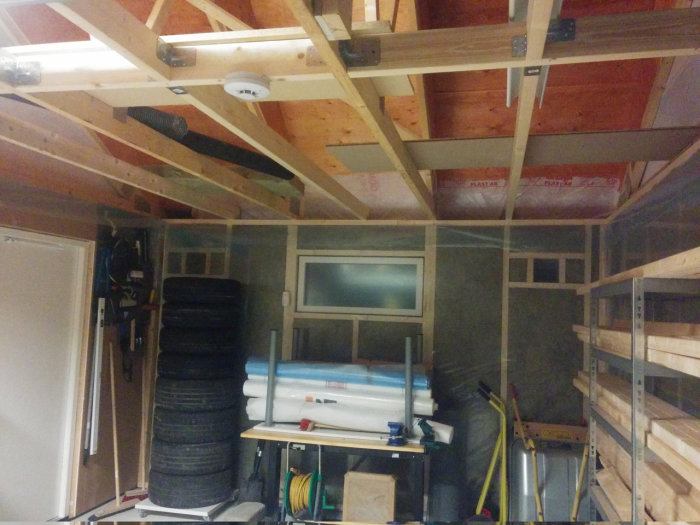
I am going to install chipboard panels on the ceiling of a garage that is 4m wide and about 7m long. This is being done partly for insulation and partly to create extra storage space. Currently, there are 120x45mm joists running along the garage with about 60cc spacing.
My idea is to reinforce the construction with 3 underlying IPE beams about 1.75m apart from each other, which will rest on 90x90 glued laminated timber beams attached to the sides (that is, 4 meters between support points, the same width as the garage, of course).
Anyway, now to the actual question. I looked at different IPE beams here http://www.montano.se/category.html/ipe-balk and they are of course available in different sizes. My gut feeling tells me that I can manage with the smallest ones (IPE 80) but I would like to hear what those of you with experience have to say about it. The pressure from above won't be very large, but I assume that one should calculate with 1-1.5 tons just to be safe. The goal is to be able to walk up there and store things without worrying.
The rafters in the ceiling, as I understand it, don't seem to have any ability at all to support anything more than the roof itself, or?
Then 3 IPE 80s for the entire floor structure don't seem very reliable...
Do you mean the existing 120x45mm rafters? I installed 3 of the 5 myself afterwards; initially, there were only 2 with 120cc spacing, and they are essentially the lower part of the truss itself. These IPE beams are not meant to support the roof itself, as the roof is already there. Instead, they are meant to support the new "upper level" with the pressure that arises from the weight of the floor particle boards and any potential load (after all, it's supposed to be a storage space).
Ok,
If we consider 100kg/m2 for load and self-weight (residences are calculated with 200kg + self-weight) and we allow 1cm deflection on the beams (the standard is length/400), we get the following scenario:
Each beam is loaded with 1/5 of the total load (three beams and two walls bear).
The total load will be: 2800kg (4x7x100) which becomes 560kg per support.
The formula for a simply supported beam with evenly distributed load shows that you need a beam with a moment of inertia I = 218cm4
Therefore, choose an IPE 120 which has I = 318cm4
(IPE 80 only has 80cm4 moment of inertia and thus the floor would only handle a load of 37kg/m2 without deflecting more than the standard)
Ok,
If we calculate with 100kg/m2 for load and self-weight (residential buildings are calculated with 200kg + self-weight) and that we accept 1cm deflection on the beams (the standard is length /400), we get the following scenario:
Each beam is loaded with 1/5 of the total load (three beams and two walls support).
The total load becomes: 2800kg (4x7x100) which then results in 560kg per support.
The formula for a simply supported beam with evenly distributed load gives that you need a beam with a moment of inertia I = 218cm4
Therefore, choose an IPE 120 which has I = 318cm4
(IPE 80 has only 80cm4 in moment of inertia, and the floor would only support a load of 37kg/m2 without bending more than the standard)
Exactly the type of answer I was looking for Thank you so much for the calculation and the help with this!
Here you go.
If you can live with slightly more than 1cm deflection, you can also use IPE100 and still sleep well; in that type of space, it is not something that bothers you. The strength of an IPE100 is easily sufficient, but as mentioned, it comes at the expense of deflection that exceeds the norm by a bit.
You're welcome. If you can live with more than 1cm of deflection, you can also use IPE100 and still sleep well; in that type of space, it's not something that bothers you. The strength of an IPE100 is more than enough, but as mentioned, it comes at the expense of deflection that is slightly more than the norm allows.
I understand, you still want it to be solid and durable; that's why I asked the question in the first place. That it bends a little more than the norm may not matter as much since I'll rarely be up there. I don't think the floor will feel "wobbly" even with IPE100, right?
Regarding the sides, I assume that standing 90x90 glulam beams on which the IPE beam rests are sufficient. What are your thoughts on that part?
Hardly shaky, but a slight "vibrating" sensation can occur if you stand and stomp on a long steel beam; personally, I would choose the type of beam that I could most easily obtain.
90x90 glulam to support about 300kg sounds very secure as long as it's a normal ceiling height. If there are many meters in ceiling height, the posts should be anchored to the wall to prevent buckling.
Hardly shaky, but a bit of a "vibrating" feeling can occur if you stand and stomp on a long steel beam, personally, I would go for the type of beam that I could easily obtain.
90x90 glulam to support around 300kg sounds very secure as long as the ceiling height is normal. If it's a lot of meters in ceiling height, the posts should be anchored to the wall to prevent buckling.
Ok, that sounds good! The ceiling height is "normal," i.e., 2400mm. Just one last thought...
Could one use two screwed together 120x45 regular studs (making it 120x90) as support instead of 90x90 glulam? I ask because the walls already consist of 120mm studs, and if possible, one could use an existing 120mm wall stud plus screw another one to the side and then place the IPE beam on it (you would have to cut the existing 120mm beam at the top to fit the IPE beam).
Again, my gut feeling says this should work too, but I was wrong last time with the IPE80 What do you think?
It is quite a small load we are talking about for the pillars. I believe that a 95x45 screwed into the wall can handle the load without any problem. So two 120x45 are both suspenders and a belt.
Ok, that's good. Once again, you want it to be durable and properly dimensioned, but at the same time, you shouldn't overdo it too much either. "Standard" 120x45 wood studs are much cheaper than laminated timber, so I'll go with that instead.
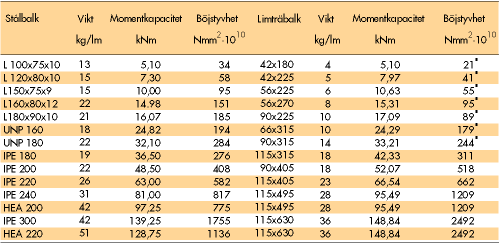
I have to raise the question again a little... I have an acquaintance who claims that glulam can match the strength of an IPE beam, and I became a little curious to hear what size of glulam beam is needed to match IPE120 and IPE100 respectively.
This could also be an option IF the claim is correct.
Of course, glulam can be an option, but I lack the knowledge to calculate/size glulam beams; the only thing I can say for sure is that it will be larger than the corresponding IPE.
I believe there are calculation tools online at, for example, moelven, but I have no experience with it as I am a mechanical engineer and prefer to use steel in my constructions

 Thank you so much for the calculation and the help with this!