
41,323 views ·
60 replies
41k views
60 replies
Insulation that mice cannot penetrate?
Thank you for your response. These are the kinds of things I need to hear.T tompaah7503 said:You must understand one thing, and that is that there is no insulation that helps if you don't simultaneously add heat in some way. If your pipes are positioned in such a way that they don't get heat from anywhere, for example, heat leakage from your heated house, they will eventually freeze if the water is still, even if they are insulated. Insulation delays the cold, but it doesn't create heat.
 Okay, I need to add heat in some way. How do I do this? I was thinking about the heating cable that was suggested earlier. Isn't there a risk that mice will totally feast on such a cable, so I'll have to buy a new one in the future?
You only see small pieces of your installation and no entirety. But at least in the pictures you've posted, I would have tried not to have insulation above the pipes, but only sealed downward. In that way, the pipes will be heated by waste heat from the house if they are exposed upward. Downward, it's even more important that you seal properly and also against drafts if there's any draft. You can use the existing insulation and redistribute it a bit.
All water froze? How do you know that? It only takes a small ice blockage at a single spot on the incoming water line and you won’t be able to run water anywhere, hot or cold.Husköpare 8 said:
All water froze. It was only the cold water in the kitchen that worked when I brought in the plumber. The pipes are copper pipes I assume? I have uploaded two pictures so you can see what it looks like, in both the kitchen and the room where the toilet is.
Someone here mentioned that when insulating against the foundation, one should not use mineral wool/stone wool?
It's a wooden house from the '30s. Norrland.
Since you could run cold water in the kitchen, the incoming water hasn’t frozen but rather later in the chain. What we know now is that the hot water has frozen somewhere, probably shortly after the water heater since the hot water didn't work anywhere (theoretically it could have frozen at several places after branching, but that's not knowable right now). Additionally, the cold water to the toilet has frozen. You need to find out where it is freezing and fix it there, or alternatively, address the pipes along their entire length. It's about insulating against the cold; the best is if the pipes run as close to the warm side as possible with as much insulation against the cold side as possible. On the warm side, you shouldn't insulate the pipes, as it could actually make things worse than they are now.
The problem is that if I am to seal downwards, under the pipes, it becomes difficult... The pipes are directly on the cold ground, so it's hard to reach to seal against the foundation. What do you do in this case? No wonder the pipes froze, when they are lying directly on the ground. And since I keep the kitchen cabinet closed, it gets cold under the sink. So I have to keep the kitchen cabinet open all the time, so the house heat comes in under the sink. That way I can get heat into the kitchen cabinet, but it's not so nice to have the cabinet open when having guests over, for exampleT tompaah7503 said:You can only see small parts of your installation and no overall view. But at least in the pictures you've posted, I would try not to have insulation above the pipes, but only sealed downwards.
That way, the pipes will be heated by waste heat from the house if they are exposed upwards. Downwards, it's even more important to seal properly and also against drafts, if there are any. You can use the existing insulation and redistribute it a little.
So I don't need to replace the insulation? Someone said here before that the type of insulation I have shouldn't be used directly against the foundation because it absorbs moisture?
The plumber said the water froze just after the water heater in a T-pipe that lies against the foundation. So you could absolutely be right about that. There were apparently two ice plugs: one at the T-pipe and the other in the kitchen cabinet in the pipe against the ground.V vectrex said:All the water froze? How do you know that? It only takes a small ice plug in one spot on the incoming water to prevent you from running water anywhere, either hot or cold.
Since you could run cold water in the kitchen, the incoming water hasn't frozen; it's later in the system. What we know now is the hot water has frozen somewhere, probably right after the water heater since the hot water didn't work anywhere (theoretically, it could, of course, have frozen in several places after branching off, but we can't know that right now). Additionally, the cold water to the toilet has frozen. You need to find out where it freezes and fix it there, or alternatively, address the pipes along their entire length. It's about insulating against the cold; the best is if the pipes run as close to the warm side as possible, with as much insulation against the cold side as possible, and you shouldn't insulate the pipes on the warm side, as it could potentially make things worse than they are now.
As I wrote to "tompaah7503," how do I get insulation under the pipes when they lie directly against the ground?
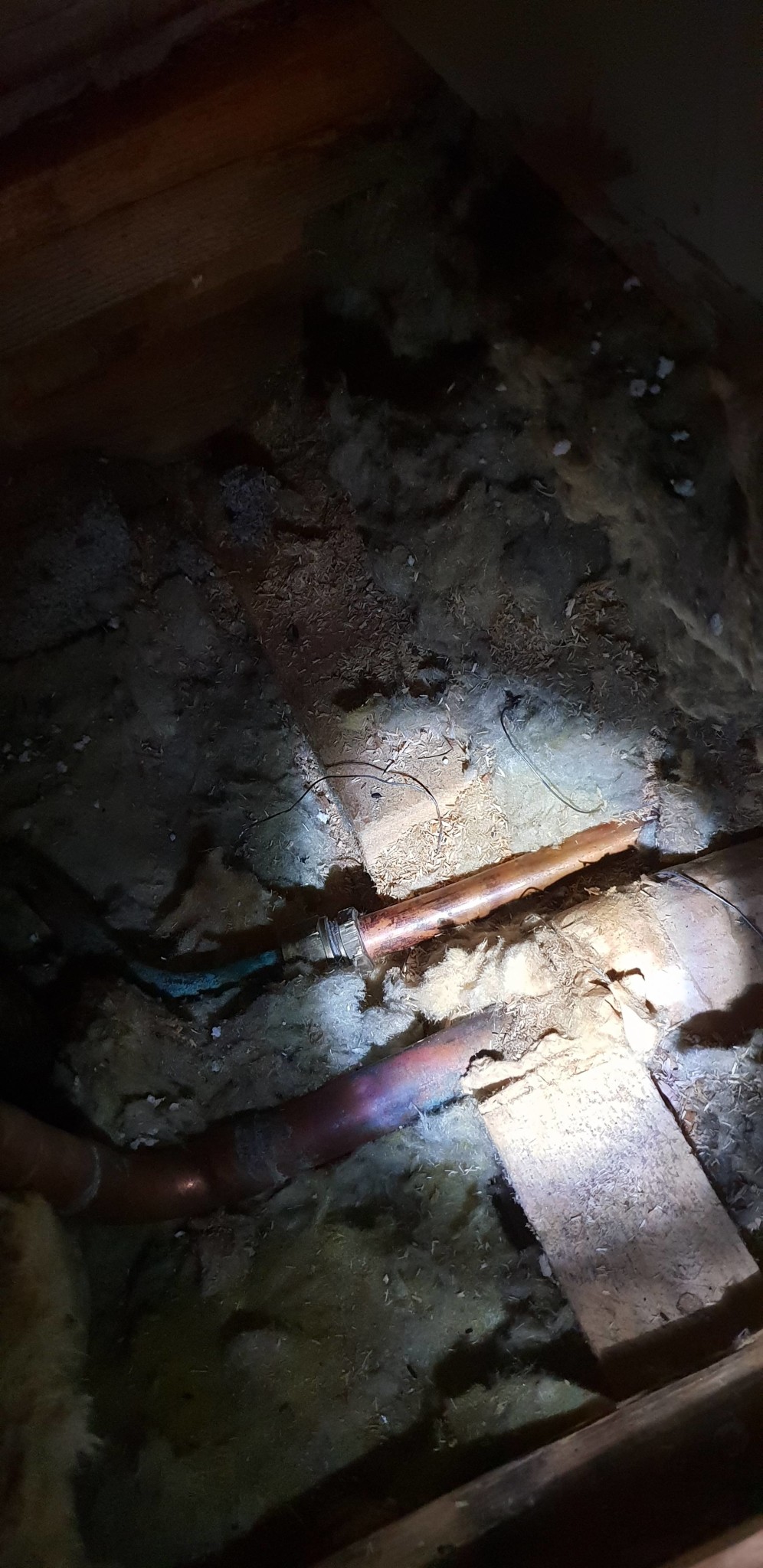
It looks like a wooden beam that's been cut into to make room for the pipes. I lifted the insulation a bit and found that it's a long deep hole going straight down. But it looks like wood all the way down. I'll have to remove all the wool and see how far down the hole goes. I'll send a picture with an angle so you can see that it looks like a wooden beam all the way down.major_tom said:

I will have to dig into this once I've bought a pair of proper gloves. Right now, I have no desire to delve further into this. The cabinet will remain open for now, and I'll tackle it later. I'm a bit playfully shy, so I haven't dared to dig into this before.
But now I'm really curious about how deep I can get under the insulation, and what kind of ground is there. To be continued...
But now I'm really curious about how deep I can get under the insulation, and what kind of ground is there. To be continued...

I now realize that I'm not used to expressing myself in construction contexts, as I'm such a beginner at this haha. I apologize if I'm unclear.useless said:
I thought the pipes were against the ground all the way, since the pipes are against the wooden beam in one place. But then when "major_tom" asked what is under the pipes, it gave me a reason to remove the wool in another place to take a look. That's when I noticed that there is a deep hole right down.
At this point, I decided that I need to dig into this another time, as digging into this without proper construction attire doesn't seem like a good idea.
Hope I was clearer now

Isn't it a subfloor?
If the house has a crawl space, it usually means that there is a subfloor with air (=crawl space/crawl height) below it, before reaching the ground. I can't imagine they've laid insulation and wooden joists directly on the ground.
Assuming it's a normal subfloor with a crawl space underneath, it's possible to insulate under the subfloor where the pipes run to protect them from the cold below. As previously mentioned, no insulation should be placed on top.
A fundamental problem is that small rodents get into the subfloor and have pulverized the insulation under the pipes, allowing the cold to penetrate and creating wind tunnels for the polar chill to pass through the insulation.
Considering there are small rodents in the subfloor, and that the trash cabinet doesn't have a sealed floor, don't you have problems with these little critters inside? You will if the doors to the trash cabinet are left open.
Time to start looking for a hatch into the crawl space.
Good hunting.
If the house has a crawl space, it usually means that there is a subfloor with air (=crawl space/crawl height) below it, before reaching the ground. I can't imagine they've laid insulation and wooden joists directly on the ground.
Assuming it's a normal subfloor with a crawl space underneath, it's possible to insulate under the subfloor where the pipes run to protect them from the cold below. As previously mentioned, no insulation should be placed on top.
A fundamental problem is that small rodents get into the subfloor and have pulverized the insulation under the pipes, allowing the cold to penetrate and creating wind tunnels for the polar chill to pass through the insulation.
Considering there are small rodents in the subfloor, and that the trash cabinet doesn't have a sealed floor, don't you have problems with these little critters inside? You will if the doors to the trash cabinet are left open.
Time to start looking for a hatch into the crawl space.
Good hunting.