
8,316 views ·
7 replies
8k views
7 replies
Insulating HEB beam against condensation and how it should be mounted?.
I intend to demolish a load-bearing wall and instead install an HEB beam of 180mm. The span will be 4800mm. A structural engineer has looked at it and the beam should be sufficient. However, I forgot to ask the engineer what I should place the beam on. I would prefer to avoid using more beams since they are expensive and heavy. Perhaps the beam can be mounted on standing studs? The beam itself weighs 380kg. Four trusses will rest on it, the roof angle is 27 degrees, and the snow zone is 2.5.
So the first question is, can it be supported with wooden studs and how thick should they be?
I understand that the beam must be insulated against condensation (fire protection is not needed in a house). I thought I'd make it easy for myself and buy ventilation insulation socks to cover the beam, would that work?
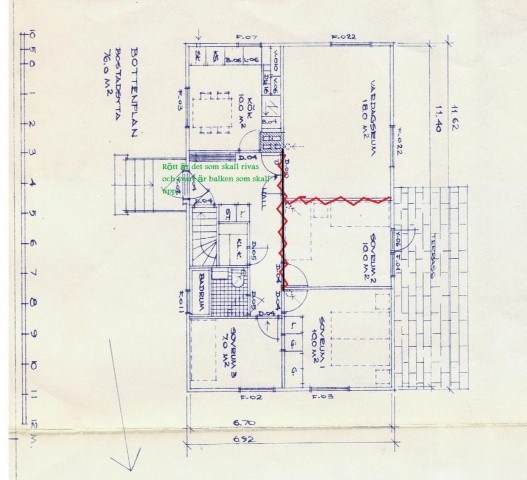
The red on the drawing is what will be demolished and the black line is the beam to be installed.
Ps. The drawing includes a chimney breast. This is no longer present and therefore cannot serve as equivalent support.
Grateful for answers from someone knowledgeable in this area.
So the first question is, can it be supported with wooden studs and how thick should they be?
I understand that the beam must be insulated against condensation (fire protection is not needed in a house). I thought I'd make it easy for myself and buy ventilation insulation socks to cover the beam, would that work?
The red on the drawing is what will be demolished and the black line is the beam to be installed.
Ps. The drawing includes a chimney breast. This is no longer present and therefore cannot serve as equivalent support.
Grateful for answers from someone knowledgeable in this area.

Last edited:
Hello! If the designer has sized the beam and made the necessary calculations, he/she should be able to determine the dimensions of the columns in no time. The loads are already calculated. So my tip is to check with K.
Also, I don't understand at all why the beam should be insulated against condensation. It's located in a warm space overall, isn't it?
Then I can't help but have another thought, and I don't mean to be snarky, but: it looks like there are truss roof beams on your house, these are normally free-spanning between the exterior walls—is the wall really load-bearing?
Also, I don't understand at all why the beam should be insulated against condensation. It's located in a warm space overall, isn't it?
Then I can't help but have another thought, and I don't mean to be snarky, but: it looks like there are truss roof beams on your house, these are normally free-spanning between the exterior walls—is the wall really load-bearing?

I also think it sounds excessive to insulate, have never experienced it being a problem.
Experience suggests that 6´´6 (150x150) would be a suitable dimension but I am not a constructor.
Experience suggests that 6´´6 (150x150) would be a suitable dimension but I am not a constructor.
Then I'll need to lay low with the insulation for a while. The focus now shifts to the questions:
1) Are the trusses self-supporting? Only responses from someone who truly knows.
If they are, then the second question is irrelevant; if not, answers and suggestions are welcome.
2) Should the beam act as a support or instead a hanging support? In other words, should I mount it in the attic and let the trusses hang from it, or should I bring it into the house?
IF I should have it in the attic, should I choose glulam instead of steel, advantages/disadvantages?
:x
1) Are the trusses self-supporting? Only responses from someone who truly knows.
If they are, then the second question is irrelevant; if not, answers and suggestions are welcome.
2) Should the beam act as a support or instead a hanging support? In other words, should I mount it in the attic and let the trusses hang from it, or should I bring it into the house?
IF I should have it in the attic, should I choose glulam instead of steel, advantages/disadvantages?
:x
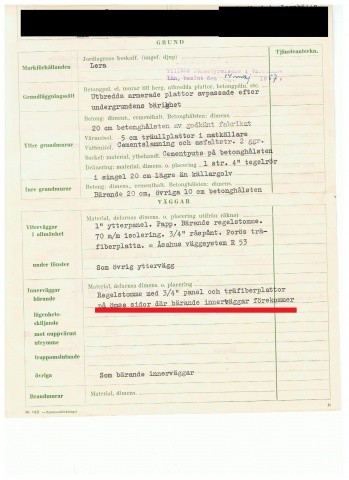


"Free-standing truss construction" so if it's built according to plan it should be fine, but it feels strange that the designer suggested this then, maybe he knows something we don't, has he inspected and seen something in the attic? or is this on the ground floor/basement?
EDIT: I see it seems to be the entrance level, it feels like you should have a talk with the designer, if it's unclear whether it should be in the attic or in the living spaces, it feels like many other things could be unclear...
/U
EDIT: I see it seems to be the entrance level, it feels like you should have a talk with the designer, if it's unclear whether it should be in the attic or in the living spaces, it feels like many other things could be unclear...
/U
The constructor has just taken a quick glance, quickly calculated and suggested the thickness of the beam. He hasn't calculated or delved into it more than that. Considering paying someone to do it so I can blame someone when it goes wrong.
I also see that it says self-supporting but then it also mentions load-bearing interior walls, which puzzles me and makes me uncertain. As you say, it's the entrance level and the attic is cold attic. Whether the beam should be inside or outside is just a matter of taste.
Might have to bring a constructor here equivalent....
I also see that it says self-supporting but then it also mentions load-bearing interior walls, which puzzles me and makes me uncertain. As you say, it's the entrance level and the attic is cold attic. Whether the beam should be inside or outside is just a matter of taste.
Might have to bring a constructor here equivalent....
Last edited:

Do the trusses look like in the drawing in reality? If so, they are self-supporting, and you don't need a beam. However, if the current wall is located right under a joint in the truss, you might want to consider it again. A 7m span with a W-truss should never be a problem with that roof angle. I believe you should interpret the text in the building description as being general for several different house types from the manufacturer, but that there are no vertically load-bearing interior walls in your case.
Ask your "engineer" if the bottom chord of your truss can really transfer the snow load to the current wall when it isn't located under a joint...
/Engineer
Ask your "engineer" if the bottom chord of your truss can really transfer the snow load to the current wall when it isn't located under a joint...
/Engineer
Thank you for all the answers. I went the extra mile and ordered a 6-meter glulam beam 90X450. It should handle the snow load, so now I'm really safe. Maybe I’m throwing away 3000kr, but I can't risk it.
Criticize me if you want, but I hope to be satisfied with my coward solution.
Ps. I will make a hanging construction for security and to have a nicer ceiling.
See this image.
Criticize me if you want, but I hope to be satisfied with my coward solution.
Ps. I will make a hanging construction for security and to have a nicer ceiling.
See this image.

Last edited:
Click here to reply