I am about to start a Attefall house that will function as a storage/guest room.
I have some thoughts on how to insulate the roof. On the outside, I will have concrete tiles, battens and counter battens, roofing felt, and sheathing.
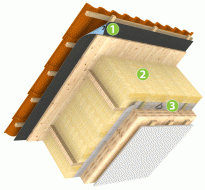
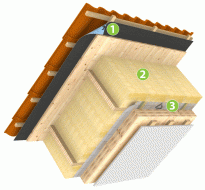
On the inside, there will be 220mm studs, with 220mm insulation, plastic, battens, and gypsum board. Roughly according to the image below:
But then I've read in other threads that you should have an air gap. Where do you have the air gap?
I've watched quite a few videos now. The most common method seems to be framing with 45x45 and then placing some type of board on it, followed by insulation. Or insulation directly on 45x45. Which is preferable?
Then I saw something else that was new to me. That you lay half the depth of the insulation first. Then place plastic and then the rest of the insulation. Why is that? I thought the plastic was on the inside of all the insulation
The plastic is placed that way to create an installation zone for electricity, etc. This way, there is no need to perforate the plastic around outlets, etc. Perforated plastic can cause warm indoor air to escape into the wall and meet cooler air, causing the air to release its moisture. When building with plastic, it is important to ensure it is completely sealed everywhere. The installation zone is usually made 45 mm.
The simplest way is to use 28x45 or 34x45 nails/screws fastened to the sides of the rafters against the boards, then take a masonite and nail/screw it to the battens you just fastened to the rafters. Start installing the masonite from the ridge and then downwards with a few cm overlap if one masonite is not enough from ridge to eave. This way, any moisture won't be able to flow down into the seam of the masonite. Then you need to have ventilation at the eave so that air can enter the air space.
The simplest way is to take 28x45 or 34x45 nails/screws fastened to the sides of the rafters against the sheathing, then take a masonite and nail/screw it to the battens you just nailed to the rafters. Start mounting the masonite from the ridge downwards with a few cm overlap if one masonite doesn't suffice from ridge to eaves. This way, any potential moisture won't run down into the joint of the masonite. Then, you must have ventilation at the eaves so that air can enter the air gap.
Is ventilation at the eaves sufficient? I will have a mono-pitched roof.
Okay, I didn't realize it was a sloped roof. But you should also have the ventilation open at the "ridge" to allow air circulation. I noticed I might have been a bit unclear earlier when I read through my post. I mean that you should lay the battens so the air gap is 28 or 34mm. 45 seems a bit like overkill and you lose a bit more insulation value, so 28-34mm is sufficient.
If you extend the battens and masonite all the way out to the air gap for the panel, you finish there. Then, when you install the paneling, leave a gap of about 28mm up towards the roof boards so you get air circulation for both the panel and the roof in one go.
Yes, exactly that's what I meant just don't forget to put insect mesh in the air gap if you haven't done that already. If you're going to have underspiking, then it's just a matter of attaching it to the underside of the rafters.
Yes, exactly that's what I meant just don't forget to install insect netting in the air gap if you haven't already done so. If you're going to have undersarking, you can just run it along the underside of the rafters.
Great!
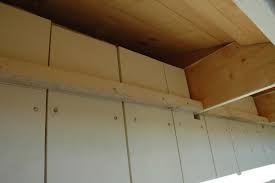
Just two questions then. I was thinking of attaching boards to the underside of the rafters. Does that ruin the air gap?
Then I was planning to have vertical paneling, which means the nailing battens run horizontally along the wall. Does that ruin the air gap of the wall?
Okay, that's called under-spiking, and it doesn't destroy the ventilation. Instead, you nail/screw the boards to the underside of the rafters with a gap of about 10mm between them. Then you can just staple the insect net to the underside of the rafters before you nail the under-spiking in place. If you want vertical paneling, you must first attach "ströläkt" (a type of batten) like 22x45 vertically on the studs in the wall, then you nail the spikläkt through the ströläkt and into the stud. This gives you a 22mm air gap behind the paneling, and you also have to staple the insect net there too. Or, you don't have to, but if you want to avoid wasps and other unpleasant creatures from building nests in the air gap, then you must. If you use a metal insect net, mice won't get in either.
Click here to reply
Vi vill skicka notiser för ämnen du bevakar och händelser som berör dig.