
I need advice pretty quickly.
I'm building my first house - actually an extension of 50m2 with a concrete foundation slab. I'm reading EVERYTHING I can get my hands on and bouncing ideas with my designer. But some things seem to be unclear to everyone?
I'm building with 35 cm Lecablock below ground and Weber 35 cm Iso-Leca above ground.
To achieve the best insulation value, Weber recommends sealing between the polyurethane surfaces, between the horizontal surfaces in the blocks and the mortar joints. But there's no glass wool seal that fits??! The space is 10mm high and 150mm wide, glass wool seal is 22mm high and 50mm wide!!?
Ideally, it would be 12-15mm high and 130-140mm wide? but I can't have the masons cutting the seal, can I?
I've come up with an alternative, why not use foam sealant? It's the same material as the insulation in the Weber blocks. The only thing to be cautious about is using too much? When the foam sealant hardens and the mortar shrinks, it could "press" too much?
Also, a rigid joint is used in the vertical joint, which could allow both moisture and heat to leak? Is it a good idea to "glue" the vertical joint with a very thin line of foam sealant? It should also improve the mechanical stability.
Weber has no sensible answers other than to use a strip of glass wool at 22x50mm and it should be "okay".... Doesn't seem optimal to me at all...
What if I use foam sealant AND glue the vertical joints? Then I would have a 150mm thick moisture barrier in the middle of the wall, is that good or bad? No moisture can get in, but none can get out either?
I'm going to have an exhaust air heat pump, so the ventilation will be good enough that it might not matter?
Masonry begins on Monday, November 5th, so quick tips are gratefully received.
I'm building my first house - actually an extension of 50m2 with a concrete foundation slab. I'm reading EVERYTHING I can get my hands on and bouncing ideas with my designer. But some things seem to be unclear to everyone?
I'm building with 35 cm Lecablock below ground and Weber 35 cm Iso-Leca above ground.
To achieve the best insulation value, Weber recommends sealing between the polyurethane surfaces, between the horizontal surfaces in the blocks and the mortar joints. But there's no glass wool seal that fits??! The space is 10mm high and 150mm wide, glass wool seal is 22mm high and 50mm wide!!?
Ideally, it would be 12-15mm high and 130-140mm wide? but I can't have the masons cutting the seal, can I?
I've come up with an alternative, why not use foam sealant? It's the same material as the insulation in the Weber blocks. The only thing to be cautious about is using too much? When the foam sealant hardens and the mortar shrinks, it could "press" too much?
Also, a rigid joint is used in the vertical joint, which could allow both moisture and heat to leak? Is it a good idea to "glue" the vertical joint with a very thin line of foam sealant? It should also improve the mechanical stability.
Weber has no sensible answers other than to use a strip of glass wool at 22x50mm and it should be "okay".... Doesn't seem optimal to me at all...
What if I use foam sealant AND glue the vertical joints? Then I would have a 150mm thick moisture barrier in the middle of the wall, is that good or bad? No moisture can get in, but none can get out either?
I'm going to have an exhaust air heat pump, so the ventilation will be good enough that it might not matter?
Masonry begins on Monday, November 5th, so quick tips are gratefully received.
I tested both methods and concluded that heated professional winter-SPUF was the best.
It’s not much more expensive than the scrap SPUF from Byggmax. Byggmax-SPUF provides barely half as much foam for 30:-/bottle, compared to the professional SPUF bottle for 80:-. Additionally, Byggmax-SPUF isn’t specified for use below +5C, while professional winter-SPUF is okay down to -10C!
Another plus is that professional winter-SPUF becomes more elastic than the harder Byggmax-PUF. Thus, the risk of SPUF in the bed joint pressing on the PUF part in ISO-Leca when the mortar shrinks as it cures is reduced.
A bucket of warm water where the SPUF gun stood between uses resulted in a loose and very well-expanding PUF, despite freezing weather.
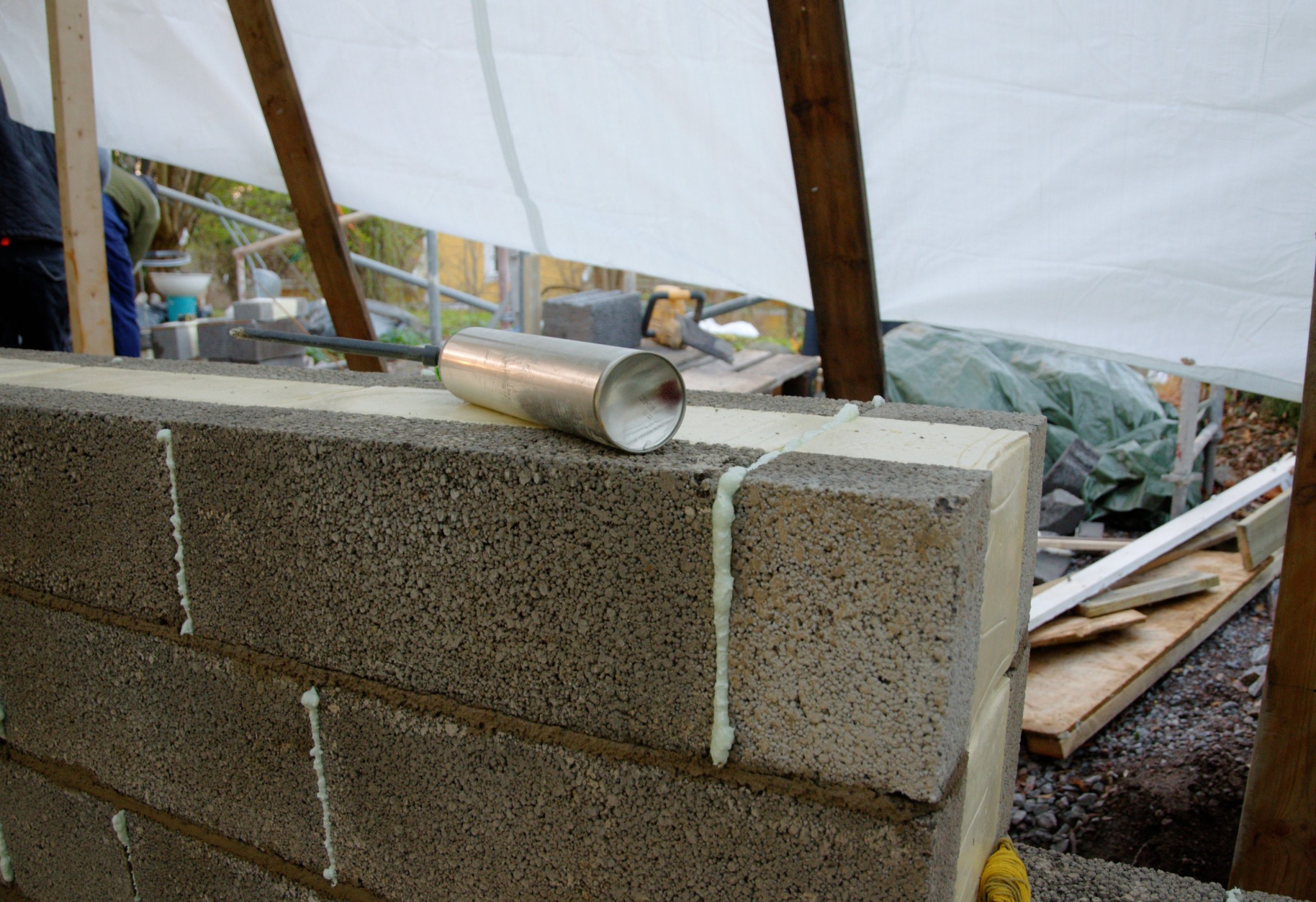
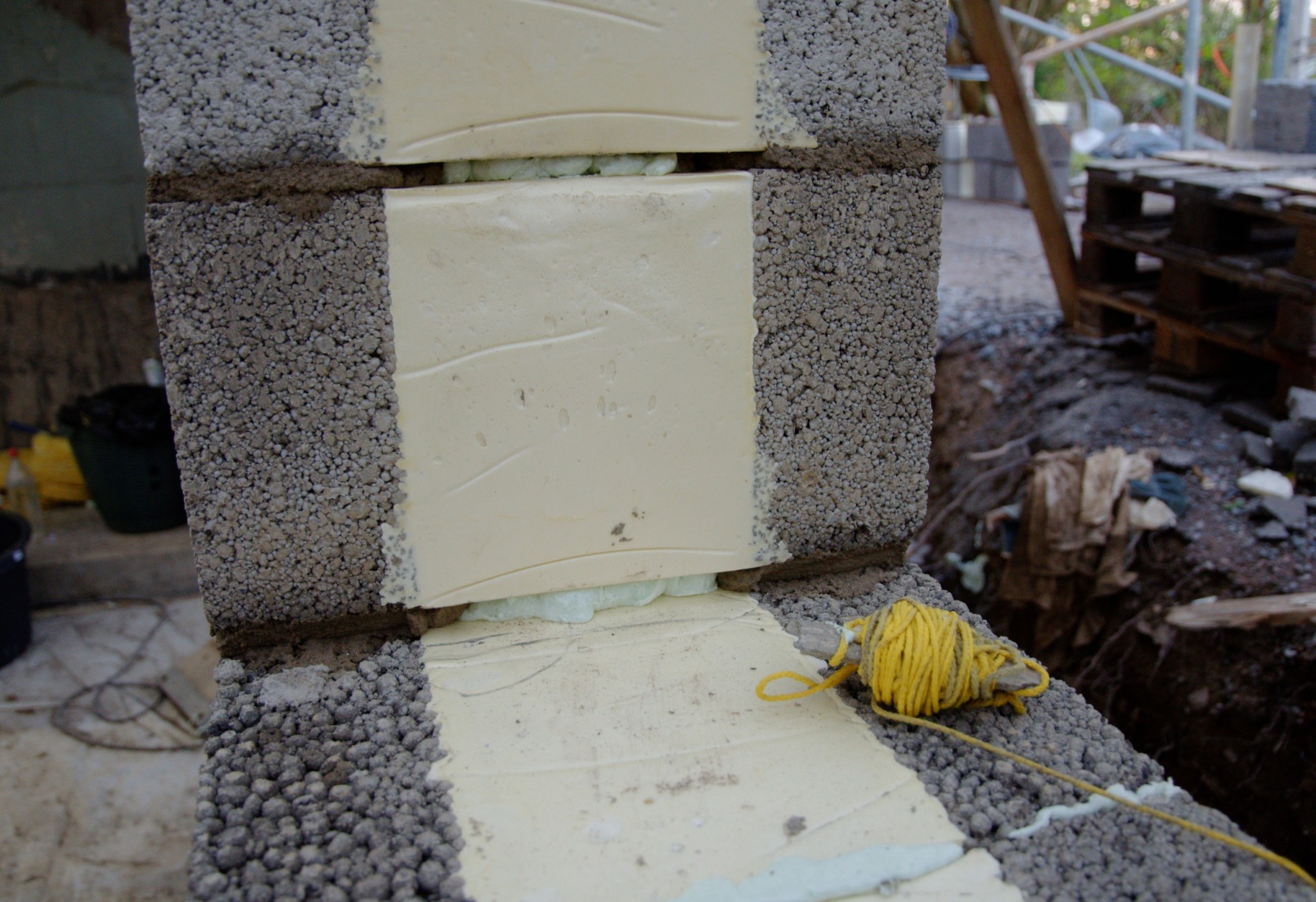
I placed three beads in the bed joint on the 15 cm wide PUF surface on the Weber ISO-Leca block (35x19x50cm) and a galvanized steel reinforcement in the bed joint with B-mortar in the Leca surface on the outside of the block and an untreated steel reinforcement on the inside surface with B-mortar (steel reinforcement in every 3rd layer).
I enhanced the mortar with 100 grams of sodium nitrate per 25 kg sack of B-mortar, which protected the mortar against frost down to about -5C and showed no visible lime crawling (whitening) on the surface.
Then I didn’t use mortar-free head joint masonry as Weber recommends for their ISO-Leca, but instead placed 2 beads of SPUF in the inner Leca (10cm), 2 in the ISO surface (15cm), and 2 in the outer Leca (10cm) in the vertical surface between blocks (head joint).
PUF, as I understand, is diffusion-tight, so I get an integrated moisture barrier in the wall, which I would NOT have gotten with an empty head joint and fiberglass backing in the bed joint. http://www.buildingscience.com/docu...need-for-vapor-retarders-in-above-grade-walls
Weber’s measures claim that the U-value decreases from 0.22 without backing in the bed joint to 0.15 WITH fiberglass backing for the 35 cm wide block. I wonder how much better it will be with SPUF in both the bed joint AND the head joint?
I will return with pictures.
Additionally, I get better stability in the wall when the head joint is "glued" with SPUF than with an empty head joint.
It’s not much more expensive than the scrap SPUF from Byggmax. Byggmax-SPUF provides barely half as much foam for 30:-/bottle, compared to the professional SPUF bottle for 80:-. Additionally, Byggmax-SPUF isn’t specified for use below +5C, while professional winter-SPUF is okay down to -10C!
Another plus is that professional winter-SPUF becomes more elastic than the harder Byggmax-PUF. Thus, the risk of SPUF in the bed joint pressing on the PUF part in ISO-Leca when the mortar shrinks as it cures is reduced.
A bucket of warm water where the SPUF gun stood between uses resulted in a loose and very well-expanding PUF, despite freezing weather.
I placed three beads in the bed joint on the 15 cm wide PUF surface on the Weber ISO-Leca block (35x19x50cm) and a galvanized steel reinforcement in the bed joint with B-mortar in the Leca surface on the outside of the block and an untreated steel reinforcement on the inside surface with B-mortar (steel reinforcement in every 3rd layer).
I enhanced the mortar with 100 grams of sodium nitrate per 25 kg sack of B-mortar, which protected the mortar against frost down to about -5C and showed no visible lime crawling (whitening) on the surface.
Then I didn’t use mortar-free head joint masonry as Weber recommends for their ISO-Leca, but instead placed 2 beads of SPUF in the inner Leca (10cm), 2 in the ISO surface (15cm), and 2 in the outer Leca (10cm) in the vertical surface between blocks (head joint).
PUF, as I understand, is diffusion-tight, so I get an integrated moisture barrier in the wall, which I would NOT have gotten with an empty head joint and fiberglass backing in the bed joint. http://www.buildingscience.com/docu...need-for-vapor-retarders-in-above-grade-walls
Weber’s measures claim that the U-value decreases from 0.22 without backing in the bed joint to 0.15 WITH fiberglass backing for the 35 cm wide block. I wonder how much better it will be with SPUF in both the bed joint AND the head joint?
I will return with pictures.
Additionally, I get better stability in the wall when the head joint is "glued" with SPUF than with an empty head joint.
Last edited:
Click here to reply